

Baby Massage for Relaxation: Nurturing Your Connection and Calm
The constant rocking. The weary sighs. The feeling of being 'touched out' yet somehow deeply disconnected from the tiny human in your arms. It's a heavy paradox, isn't it? You're never physically alone, yet the loss of your own identity in the postnatal blur can feel incredibly isolating. If you've been searching for a way to quiet the fussiness and the internal noise, baby massage for relaxation offers a path back to your own centre. It isn't just a physical ritual for your little one; it's a mutual recalibration of two nervous systems, allowing both of you to breathe a little deeper. 🌿
You likely already feel that touch is the most natural language you share, even if the exhaustion makes it hard to listen. We're going to discover how this gentle art can soothe your infant's nervous system whilst helping you reclaim your own sense of peace and maternal confidence. By moving from a place of 'doing' to a place of 'being', you'll find that a calmer baby and a more confident parenting style are well within your reach. We'll explore the science of connection and the simple, rhythmic techniques that turn a fretful afternoon into a moment of genuine, shared calm.
Table of Contents
What is Baby Massage for Relaxation and Why Does it Matter?
Imagine a language that doesn't require a single word. At its heart, baby massage for relaxation is exactly that: a rhythmic, intentional dialogue of touch designed to communicate safety and deep, unwavering love. It's more than just a physical technique. It is a moment of stillness in a world that often feels like it's spinning too fast. For a new mother, this practice becomes a grounding tool, a way to anchor yourself when postnatal anxiety starts to rise. It's a gentle reminder that you are exactly what your baby needs. 🌿
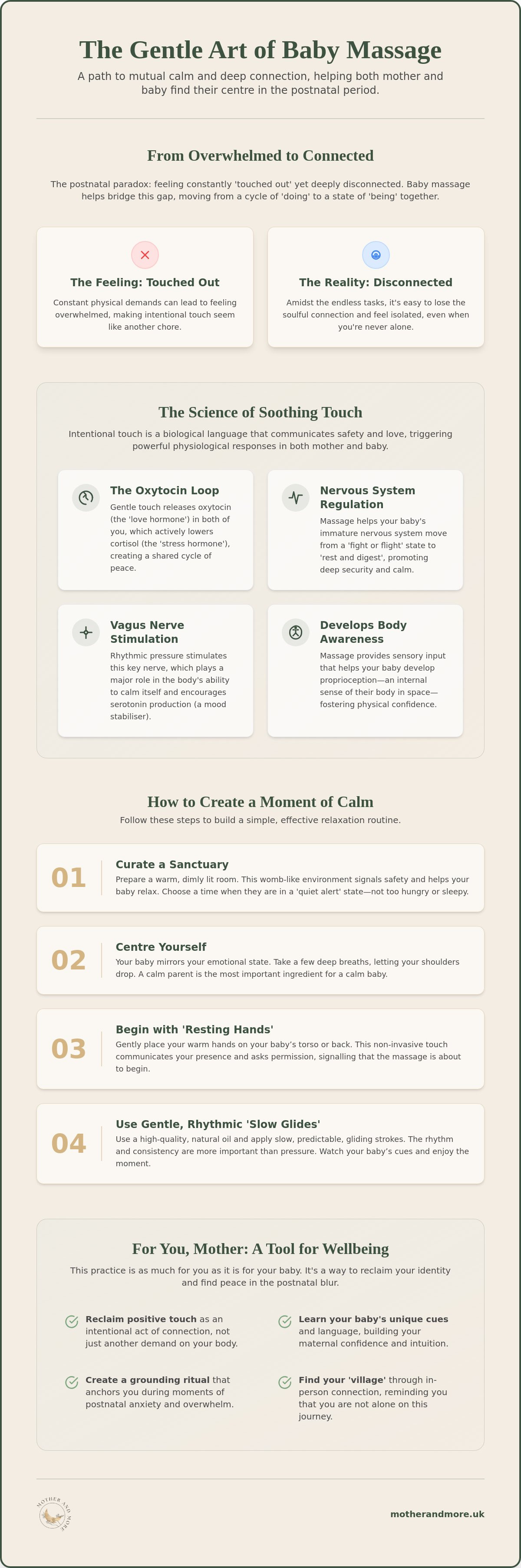
When your skin meets theirs, something magical happens. A rush of oxytocin, often called the 'love hormone', floods both of your systems. This chemical surge actively lowers cortisol levels, the hormone responsible for stress. It's a beautiful, self-sustaining cycle. As your baby relaxes, you relax; as you find your peace, they feel it too. This shift triggers the 'relaxation response', moving your little one's nervous system from a state of 'fight or flight' into 'rest and digest'. It's the biological foundation of calm.
The Science of Soothing Touch
This isn't just about feeling good. It's biology. Gentle, rhythmic pressure stimulates the Vagus nerve, a key player in the body's ability to calm itself down. This stimulation also encourages the production of serotonin, the body's natural mood stabiliser. Infant massage provides the necessary sensory input to help your baby understand where their body ends and the world begins. Proprioception is the internal sense that tells us where our limbs are in space, providing a vital foundation for a baby's sense of physical security and confidence.
Relaxation as a Foundation for Bonding
In the early weeks, it's easy to fall into the trap of 'doing' for your baby. Feeding, changing, winding; it can feel like a never-ending checklist. Using baby massage for relaxation invites you to move into a state of 'being' with them instead. It's an opportunity to learn their unique 'cues', the subtle shifts in their gaze or the way they curl their toes, which form their earliest language. You start to anticipate their needs with a quiet confidence that only comes from this deep, focused attention.
If you're feeling 'touched out', the idea of more physical contact might feel overwhelming. However, massage helps you reclaim touch as a positive, intentional act of connection rather than a demand on your body. It transforms a functional relationship into a soulful one, building a foundation of trust that will last a lifetime. It's about finding that genuine moment of peace in the day where everything else just fades away.
Understanding the Nervous System: How Touch Calms the 'Fight or Flight' Response
Your baby's nervous system is like a delicate instrument that hasn't been tuned yet. In these early months, it's immature and prone to quick overwhelm. Because infants lack the internal tools to self-soothe, they rely entirely on you for 'external regulation'. Baby massage for relaxation acts as a vital bridge, helping them navigate away from the jagged edges of a 'fight or flight' response toward a state of deep security. It's a way of telling their body that the world is a safe, predictable place. 🕊️
This approach is quite different from therapeutic massage, which often targets specific physical ailments like colic or constipation. Whilst those have their place, relaxation massage is purely about emotional safety. Research from the American Academy of Pediatrics notes that deep-touch pressure has a profound calming effect on the nervous system. By using slow, intentional strokes, you're helping your baby's body prioritise 'rest and digest' functions over stress. When they feel this level of peace, their entire physiology begins to settle.
Co-Regulation: The Heart of Maternal Wellbeing
Your baby is a biological mirror. Through 'mirror neurons', they are hardwired to pick up on your emotional state and even your heart rate. This is why your own wellbeing is so central to the process. If you're feeling frantic, they'll likely mirror that tension. Try using gentle breathwork during your massage sessions. Focus on long, slow exhales to settle your own heart rate whilst you work. If the postnatal blur has left you feeling disconnected from yourself, exploring life coaching for mums uk can be a beautiful way to manage that underlying stress and reclaim your maternal confidence.
Identifying the 'Quiet Alert' State
Success with baby massage for relaxation is all about timing. You want to find the 'quiet alert' state. This is the sweet spot where your baby is neither too hungry nor too tired. Look for these signs of readiness:
Bright, clear eyes focused on your face.
Relaxed limbs that aren't stiff or jerky.
A calm, interested facial expression.
If your baby starts to disengage by looking away, fussing, or arching their back, it's their way of saying they've had enough. Respecting these boundaries is a powerful part of the bonding process. It shows them that their voice is heard and their needs are respected. If you'd like to learn more about reading these subtle cues, joining one of our Baby Massage Courses can provide the hands-on guidance you need to feel truly certain in your technique.
Creating a Shared Sanctuary: The Practicalities of Mindful Touch
To truly embrace baby massage for relaxation, you need to create a dedicated 'Centre'. This isn't just a physical corner of the nursery; it's a mental sanctuary that you and your baby co-create. Think of it as a quiet pause in the day where the outside world, with its notifications and to-do lists, simply ceases to exist. By designating a specific space, you signal to your baby’s nervous system that it's time to transition from the bustle of play into a state of deep, restorative rest. 🕯️
The environment plays a pivotal role. Babies are incredibly sensitive to their surroundings, and a 'womb-like' atmosphere is the ultimate trigger for their relaxation response. Aim for a room temperature around 24 to 26 degrees Celsius to ensure they stay warm whilst undressed. Dim the lights or use soft, warm lamps to mimic the low-light environment they knew before birth. This sensory consistency offers immense physical and emotional benefits, helping to lower heart rates and prepare the body for sleep. It moves the practice away from being just another task to 'check off' and transforms it into a soulful, intentional ritual.
The Ritual of Preparation
Preparation is the bridge between the chaos of the day and the calm of the massage. Start by organising your space so that everything you need is within arm's reach. Warm towels, a fresh nappy, and your chosen medium should be ready before you begin. Choosing the right oil is essential for protecting delicate skin; you can find detailed advice in our guide on the best oils for baby massage uk. 🌿
Before the first stroke, always practice the 'Permission' ritual. Rub a little oil between your hands near your baby's face, letting them hear the sound and smell the scent. Ask them, "Is it okay if I give you a massage today?" Even before they can speak, they'll show you their answer through their body language. This simple act respects their autonomy from day one and builds a foundation of consent and trust. Over time, that specific scent will become a powerful signal that tells both of your bodies it's time to let go of tension.
Technique vs. Intuition
It's easy to worry about getting the strokes 'right', but your presence matters far more than your precision. Your baby doesn't need a perfect therapist; they need a present mother. Whilst specific baby massage techniques are wonderful for targeting issues like wind, relaxation massage relies on slow, firm, and predictable pressure. Avoid light, 'strokiness' or ticklish movements, which can actually be quite stimulating or irritating to a baby's sensitive skin. Instead, think of your hands as a warm, heavy blanket. This firm pressure provides the proprioceptive input they need to feel grounded and secure in their own bodies.
A Step-by-Step Relaxation Routine for You and Your Baby
Every session of baby massage for relaxation should begin in stillness. Before you move, simply place your warm, dry hands gently on your baby's chest or tummy. This is 'Resting Hands'. It's a silent signal that says, "I am here, I am present, and you are safe." By holding this position for a few deep breaths, you allow your baby to adjust to your touch and your energy. It's the foundation of everything that follows. 🌿
Once you both feel settled, you can transition into the 'Slow Glide'. These are long, continuous strokes that move down the limbs, designed to encourage lymphatic drainage and signal the nervous system to downregulate. Unlike the more vigorous movements used for play, these strokes should be steady and rhythmic. Think of the pace of a slow, calming song. This rhythm helps your baby find their own internal tempo of peace.
Lower Body: Grounding the Energy
Starting with the legs and feet helps your baby feel 'grounded' in their body. Use firm, encircling hands to glide from the hip down to the ankle. When you reach the feet, spend a moment on the soles. The centre of the foot, just below the ball, is a powerful reflexology point for relaxation. Gentle thumb circles here can work wonders for a fretful infant. If your little one seems particularly fussy or tense during the leg work, they may be experiencing digestive discomfort; our guide on baby massage for colic and wind offers specific techniques to help ease those physical blocks whilst maintaining a sense of calm.
Upper Body: Opening the Heart
Moving to the chest, use the 'Open Book' stroke. Place both hands in the centre of your baby's chest and stroke outwards towards the shoulders, as if you're smoothing the pages of a favourite book. This encourages lung expansion and deep, relaxed breathing. From here, move to the arms with a gentle 'milking' motion, releasing any tension they might be holding in their tiny hands. Finally, use your fingertips to very lightly smooth their brow, moving from the centre of the forehead out to the temples. This simple facial stroke is often the final key that helps a baby drift into a restorative sleep. ✨
If your baby is older and enjoys tummy time, the 'Back Soothe' is a beautiful way to conclude. Long, sweeping strokes from the neck down to the bottom provide a deep sense of security. To seal in this feeling of safety, finish with the 'Cuddle Wrap'. Pick your baby up and hold them close in a soft towel, allowing the warmth and your heartbeat to provide the ultimate reassurance. If you're ready to deepen this practice and find your own rhythm, our Baby Massage Courses provide a supportive space to master these routines with expert guidance.
Finding Your Village: Why In-Person Classes in East London Enhance the Experience
There is a limit to what a screen can offer during the raw, tender days of early motherhood. Whilst digital guides are convenient, they cannot offer a reassuring nod when your baby starts to cry mid-stroke or hold a space for your own weary heart. Transitioning your practice of baby massage for relaxation from the living room to a dedicated class environment changes the energy of the ritual. It moves from being another task on your solitary to-do list to a shared sanctuary where you are truly seen. 🌿
Stepping out of the home routine is often the first step in reclaiming your identity. In our sanctuary-like settings, the outside world fades. You're no longer just 'the person who changes nappies'; you're a woman connecting with her child amongst others who understand exactly how heavy that postnatal blur can feel. A facilitator does more than teach strokes. They guide you toward 'Attunement', the core theme of Infant Mental Health Awareness Week 2026. This focus on noticing and responding to your baby's emotional state is vital, especially as referrals to children's mental health services in England rose by 10% in 2024-25. Starting this journey of connection early builds a foundation of resilience for you both.
More Than Just a Class
Our baby massage classes east london are designed to be a soft landing for new parents. It's a space where you can hear your own thoughts and share your experiences without judgement. Seeing other babies' behaviours—the wriggling, the sleeping, and yes, the crying—helps to normalise your own journey. You quickly realise that you aren't doing anything 'wrong'. These sessions are the birthplace of local support networks that often last far beyond the initial five-week course, providing a village that sustains you through the years to come.
Taking the Next Step in Your Journey
As your baby grows and their needs shift, the way you connect will evolve too. Many families find that transitioning to baby yoga east london is a natural next step, blending that familiar rhythmic touch with more active movement. At Mother And More, we're deeply invested in the 'More'—supporting not just your baby's development, but your own life, career, and confidence. Whether through group coaching or one-to-one support, we walk alongside you as you navigate this transformation. ✨
The gentle art of baby massage for relaxation is just the beginning. It's a tool that empowers you to soothe your infant's nervous system whilst finding your own sense of peace. Trust your intuition and remember that in the quiet, rhythmic movements of your hands, you're building a world of security. You are exactly the mother your baby needs, and you don't have to walk this path alone.
Your Path to a Calmer Connection
You've discovered that the journey of baby massage for relaxation is about so much more than just physical strokes. It's a profound shift from the functional checklist of motherhood into a space of deep, rhythmic presence. By understanding how your own calm regulates your baby's developing nervous system, you've taken the first step toward reclaiming your confidence and peace. Whether you are creating a sanctuary at home or finding your village in a local class, these moments of intentional touch build a foundation of trust that will sustain you both through the years ahead.
Mother And More was founded by Rebecca Beazley, an accredited life coach and baby expert who has supported over 2,000 local families. We believe in the power of small, nurturing group sizes in the heart of East London that allow you to be heard and truly supported. If you're ready to move away from the postnatal blur and into a place of genuine connection, we'd love to welcome you into our community. ✨
Book your place in our next Baby Massage course in East London. You are doing a wonderful job, and you are exactly the mother your baby needs.
Frequently Asked Questions
When is the best time of day for a relaxation massage?
The best time for a relaxation massage is typically when your baby is in a 'quiet alert' state, usually after a bath or as part of a winding-down routine before bed. It's best to wait at least 45 minutes after a feed to ensure they are comfortable and their digestion isn't interrupted. Many mothers find that a mid-morning session, once the initial rush of the day has settled, provides a beautiful moment of connection. ✨
Can I massage my baby if they are crying or fussy?
It is generally best to wait until your baby is calm and receptive before starting. If they are crying or particularly fussy, their nervous system is already overstimulated, and adding more sensory input might increase their distress. Instead, use 'Resting Hands' or a gentle cuddle to offer comfort. Once they feel settled and secure, you can slowly reintroduce the rhythmic touch of baby massage for relaxation to help them maintain that peace.
How long should a relaxation massage session last?
A session can last anywhere from five to twenty minutes, depending entirely on your baby's age and their current mood. For newborns, a few minutes of gentle touch is often enough to provide a sense of security without causing overwhelm. As they grow and become more accustomed to the ritual, you can extend the time. Always let your baby’s cues guide you; if they show signs of disengagement, it’s perfectly okay to finish early.
Is baby massage safe for newborns under six weeks?
Yes, baby massage is safe for newborns, but it should be incredibly gentle and focused on still touch or very slow glides. In the first few weeks, your baby is still adjusting to the world outside the womb, so 'Resting Hands' is often the most effective technique. Avoid using any oils on their delicate skin for the first month, as their skin barrier is still developing and remains highly absorbent and sensitive. 🕊️
What if my baby won't lie still for a massage?
If your baby is wriggly or won't lie still, don't feel you have to force the traditional routine. You can try massaging them whilst they are sitting up, or even whilst they are being held in your arms. The goal is connection, not a perfect sequence of strokes. If they are consistently moving away, it might simply mean they are in an 'active' state and would prefer play over a relaxation ritual at that specific moment.
Do I need to use a specific oil for relaxation massage?
Choosing the right medium is important for protecting your baby's skin barrier. It's recommended to use scent-free, plant-based, cold-pressed oils such as high-linoleic sunflower oil, grapeseed oil, or fractionated coconut oil. Avoid olive oil or nut-based oils if there is a family history of allergies. A patch test is always a wise first step. Using a consistent, safe oil can become a sensory signal that tells your baby it's time to relax. 🌿
Can dads or partners do baby massage for relaxation too?
Absolutely, baby massage for relaxation is a wonderful way for dads and partners to build their own unique bond with the baby. It provides a dedicated time for focused, skin-to-skin connection, which is especially valuable if they aren't the primary caregiver during the day. This shared ritual helps partners feel more confident in reading the baby's cues and provides a practical way for them to support the infant's emotional and physical wellbeing.
How often should I practice massage with my baby?
You can practice massage as often as it feels right for both of you. Many families find that a daily ritual, perhaps as part of the evening wind-down, offers the most benefit for establishing a consistent sleep pattern. However, even doing it two or three times a week can significantly support your connection. The most important thing is that it remains an intentional, joyful pause in your day rather than a chore. ✨


Comments