

Finding Purpose After Becoming a Mother: A Gentle Guide to Rediscovering Yourself
What if the quiet ache of feeling lost isn't a personal failure, but the natural threshold of becoming someone new? Amid the relentless rhythm of feeds, laundry piles, and broken sleep, it is easy to feel entirely invisible beneath the weight of daily caregiving routines. You might find yourself quietly grieving your pre-baby autonomy, longing for your former career, or wondering where you went. Finding purpose after becoming a mother is rarely about snapping back to who you were before; it is about giving yourself gentle permission to evolve.
The truth is that matrescence reorganises your emotional world from the ground up, yet society often expects you to carry on without missing a beat. When you do try to carve out space for your own creative or professional spark, persistent mum guilt quickly tells you that your needs should come last. In this guide, you will discover how to quiet that guilt, validate this profound transition, and uncover the values that matter to you now. We will explore practical, restorative steps to help you feel grounded, confident, and genuinely fulfilled, both within motherhood and far beyond it.
Table of Contents
Understanding Matrescence: Why Becoming a Mother Reshapes Your Sense of Purpose
When your baby arrives, an unspoken expectation often settles over your shoulders. Society whispers that you should instantly feel complete, blissfully absorbed in domestic rhythms. Yet many women feel strangely untethered. You might look into the bathroom mirror and wonder where the old you disappeared to. This disorientation isn't a mindset flaw, nor is it a productivity failure. It is the beginning of a profound developmental metamorphosis.
The Science and Psychology of Matrescence
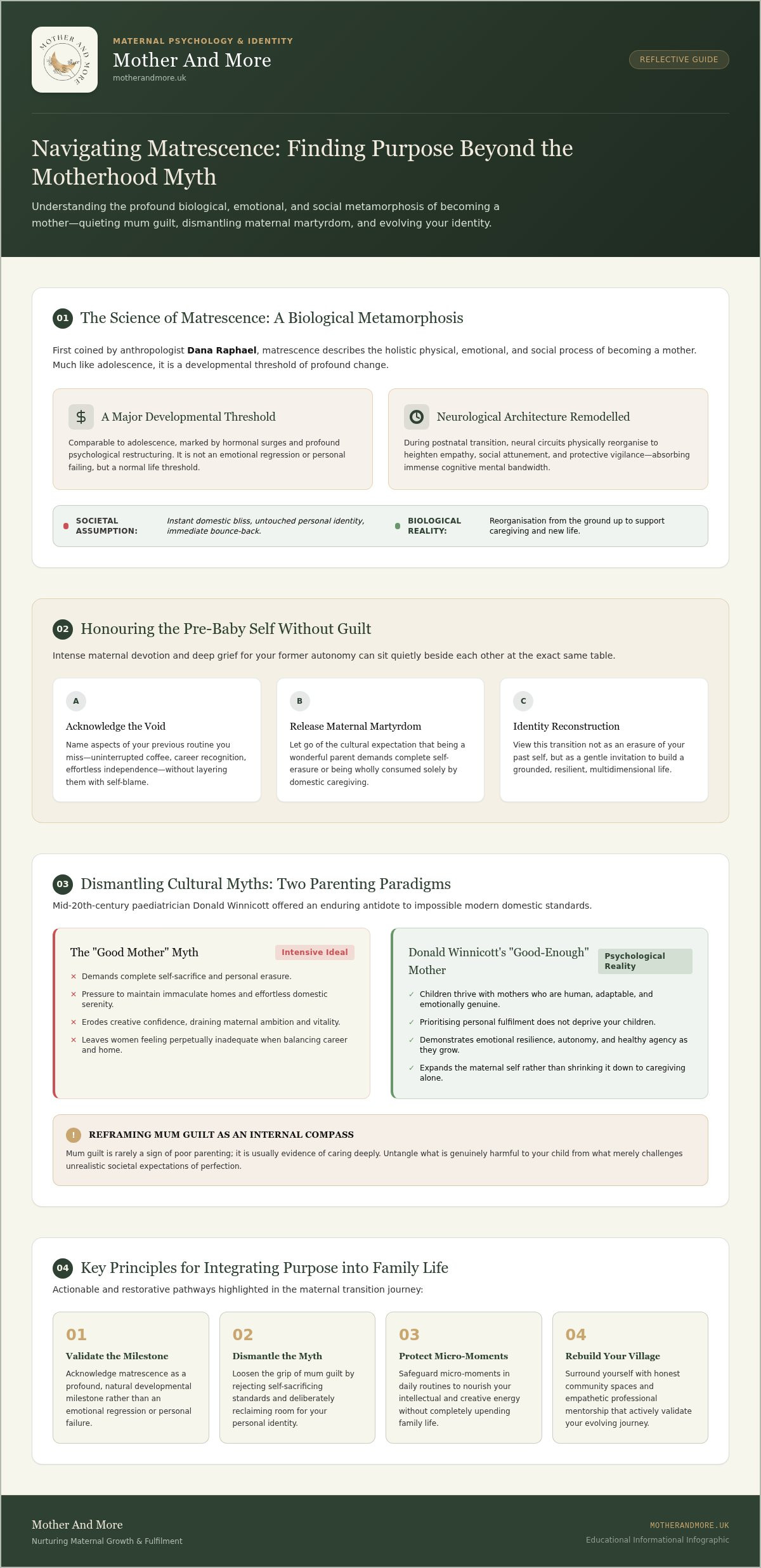
First coined by anthropologist Dana Raphael, matrescence describes the holistic physical, emotional, and social process of becoming a mother. Much like adolescence, it is a monumental life threshold marked by hormonal surges and psychological restructuring. Your brain is literally remodelling itself. During the postnatal transition, neural circuits reorganise to heighten empathy, social attunement, and protective vigilance.
This biological rewiring demands immense mental bandwidth. When your cognitive capacity is consumed by keeping an infant safe and soothed, your previous drivers naturally fade into the background. Understanding these neurological shifts changes how we view the journey of finding purpose after becoming a mother. You haven't lost your drive; your internal architecture is simply making space for an entirely new chapter.
Grieving Your Pre-Baby Self Without Guilt
True renewal begins by honouring what was left behind. It is entirely healthy to miss the effortless autonomy of your past, the uninterrupted morning coffees, or the recognition of your pre-baby career. Mourning these pieces of your life doesn't mean you love your baby any less. Intense maternal devotion and deep grief for your previous independence can sit quietly beside each other at the exact same table.
Acknowledge the void: Name the aspects of your old routine you miss without layering them with self-blame.
Release maternal martyrdom: Let go of the cultural myth that you must feel wholly consumed by caregiving to be a wonderful parent.
Embrace identity reconstruction: View this transition not as an erasure of self, but as an invitation to build a more grounded, multidimensional life.
Finding purpose after becoming a mother starts the moment you stop fighting to resurrect who you were before, choosing instead to nurture the resilient woman you are becoming.
Dismantling the "Good Mother" Myth and Untangling Mum Guilt
From the moment you step onto maternity leave, subtle cultural pressures begin to mount. Across the UK, modern mothers often find themselves caught between two exhausting ideals: excelling in their pre-baby careers whilst simultaneously embodying the pristine, endlessly patient homemaker. This pervasive "Good Mother" myth insists that maternal devotion requires complete self-erasure. Yet sacrificing your own aspirations doesn't make you a better parent; it simply drains the feminine ambition and vitality that makes you whole.
Deconstructing Unrealistic Cultural Expectations
Immaculate living rooms, wholesome homemade purees, and effortless domestic serenity dominate our feeds. These intensive mothering ideologies quietly erode creative confidence, leaving women feeling perpetually inadequate. Mid-20th-century paediatrician Donald Winnicott offered a far healthier antidote with his concept of the "good-enough" mother. Winnicott recognised that children do not need flawless caregivers. Instead, they thrive when mothers are human, adaptable, and emotionally genuine, offering them a grounded model of real life.
When you prioritise personal fulfilment, you aren't depriving your children. Research shows that maternal growth offers a powerful opportunity to expand the self, demonstrating emotional resilience and agency to your little ones as they grow.
Re-framing Mum Guilt as an Internal Compass
Mum guilt is rarely a sign of bad parenting; it is usually a sign of caring deeply. However, we often confuse healthy social empathy with irrational cultural guilt. Finding purpose after becoming a mother requires untangling what is genuinely harmful to your child from what merely challenges an unfair standard of perfection. When that familiar, tightening sting of guilt arises, pause and ask yourself:
Is this guilt rooted in genuine harm? Am I compromising my child's safety and emotional security, or am I simply violating an unrealistic standard?
Whose voice is speaking? Is this internal whisper my own authentic value, or is it an outdated societal expectation?
What does this longing reveal? What neglected passion, boundary, or personal desire is knocking at the door?
By viewing guilt as a curious prompt rather than a moral verdict, you transform it into a compass pointing toward your unmet needs. If you find yourself stuck in cycles of second-guessing, working alongside an accredited guide in reclaiming your identity and confidence can offer the structured, compassionate space you need to step forward without apology.
How to Rediscover Your Core Values: A 4-Step Reflective Framework
When you are operating on fragmented sleep and relentless feeding schedules, the idea of uncovering your life purpose can feel utterly exhausting. You do not need a grand, five-year career blueprint or an intense overhaul. What you need is a tender, low-energy method to listen to yourself again. Unpicking the 'good mother' myth allows you to separate what society expects of you from what your spirit genuinely craves today.
Step 1 & 2: Taking Inventory and Spotting Energy Leaks
Before discovering where you want to go, take stock of where your vitality currently flows. Many mothers unknowingly carry obsolete goals from their twenties or pre-baby careers that simply do not resonate with their present lives. Carrying outdated dreams creates invisible friction.
Begin with two gentle reflections:
The micro-energy audit: Over two days, notice which daily interactions leave you feeling nourished and which leave you entirely depleted. Pay attention to the subtle sensations in your chest and shoulders.
Releasing outdated milestones: Write down three expectations you set before having children that no longer feel meaningful. Consciously cross them out to free mental space.
Protecting essential boundaries: Identify one non-negotiable pause each day, even just five quiet minutes with a warm herbal tea, where nobody asks anything of you.
Step 3 & 4: Clarifying Values and Micro-Experimentation
Values are not rigid destinations; they are guiding principles that bring warmth and direction to ordinary days. Finding purpose after becoming a mother becomes practical and sustainable when you anchor it to real-life choices rather than external achievements.
To put this into gentle practice:
Select your guiding triad: Choose just three anchor words for this season of life, such as creativity, calm, or intellectual curiosity. Let these three words serve as your litmus test for saying yes or no to external demands.
Commit to micro-experiments: Dedicate ten minutes once a week to an activity completely unrelated to motherhood. Read two pages of a compelling non-fiction book, sketch an apple on the counter, or listen to a thought-provoking podcast whilst strolling.
Finding purpose after becoming a mother thrives on playful curiosity rather than relentless productivity. Treat each small choice as a soft experiment in discovering what brings you alive right now.
Practical Ways to Integrate Purpose and Meaning into Daily Family Life
Purpose does not require an empty diary or hours of uninterrupted silence. In truth, finding purpose after becoming a mother often flourishes in the quiet margins of ordinary family life. Rather than waiting for a distant future when your children are older, you can weave intentional moments of meaning directly into your present routine. It begins by creating protective boundaries around your energy and honouring your need for personal expression.
Carving Out Non-Negotiable Micro-Pockets of Time
Reclaiming your sense of self rarely happens in grand half-day stretches. Instead, it lives in deliberate fifteen-minute windows. Perhaps it is journaling at the kitchen table before the house wakes, or listening to a creative lecture whilst your baby naps in the sling. Small pockets add up to substantial internal shifts.
Protecting these moments requires sustainable teamwork at home. Honest conversations about invisible domestic labour are essential to free up your mental bandwidth:
Establish shared responsibilities: Agree on distinct, predictable intervals where your partner takes full charge of feeds, bedtime, or bathtime.
Equip your partner: Involve both parents deeply in early parenting techniques through supportive workshops for new dads, building confidence that allows you to step away without worry.
Release perfectionism: Allow the dishes to linger in the sink if washing them robs you of your only twenty minutes of quiet reflection that day.
Mindful Connection: Merging Presence with Self-Discovery
Infant activities do not have to feel mentally draining. You can turn routine baby interactions into grounding practices that restore your own central nervous system. When you sit on the mat together, notice the sensation of your feet against the floor and the steady cadence of your breath. Grounding yourself in the sensory realm pulls your mind away from anxious rumination.
Joining thoughtfully structured mother and baby wellness classes creates a calming environment where bonding with your baby and tending to your own spirit happen side by side. Engaging in soothing touch, gentle movement, and shared community reminds you that your baby's development and your personal enrichment can flourish together.
If you are longing to bring calm, rhythm, and clarity back into your daily routine, explore how to book an introductory coaching session with Mother And More to begin cultivating an intentional life you love.
Rebuilding Your Village: Why Community and Professional Mentorship Matter
Centuries ago, maternal transitions occurred within an expansive web of intergenerational care. Today, new mothers frequently navigate early parenthood behind closed front doors, separated from extended kin and expected to manage independently. In the UK, high childcare costs and return-to-office demands often deepen this sense of solitude. Navigating this cultural pressure alone can leave you feeling unseen. Rebuilding a village is not a luxury; it is vital for your emotional health.
The Power of Empathetic Peer Connection
Motherhood is rarely meant to be carried in isolation. When you sit in a circle of fellow parents where vulnerability is welcomed, the instinct to compare dissolves. Hearing another mother voice the identical doubts, fatigue, and identity questions you harbour in secret is extraordinarily liberating.
Nurturing genuine connections offers tangible emotional relief:
Normalises complex emotions: Transparent conversations remind you that feeling conflicted about domestic routines is entirely natural.
Bridges play and companionship: Gathering for shared sensory floor time allows your infant to explore safely while you enjoy meaningful adult dialogue.
Cultivates collective wisdom: Sharing practical problem-solving helps you see that no single person holds all the answers.
How Mother And More Supports Your Unfolding Journey
While compassionate peer friendships provide everyday camaraderie, intentional professional mentorship gives you the dedicated space to navigate major life choices. Rebecca Beazley, an accredited life coach and former social worker, founded Mother And More in London to serve as a supportive sanctuary. Having supported over 2,000 local families and hundreds of UK mothers through matrescence, Rebecca pairs deep emotional intelligence with structured developmental frameworks.
Through bespoke one-to-one coaching and collaborative group coaching, our programmes help you untangle who you are beyond caregiving. We explore career transitions, creative projects, and the shifting dynamics of your home life, helping you build unshakeable confidence in your choices. If you are seeking practical guidance in finding purpose after becoming a mother, exploring our accredited life coaching programmes for mums will help you align your personal goals with your growing family, with warmth and non-judgmental support at every step.
Embracing the Woman You Are Becoming
Motherhood changes you deeply, but it doesn't have to diminish who you are. Remember that finding purpose after becoming a mother isn't about rushing to retrieve a past identity; it's about giving yourself gentle permission to unfurl into the present. By untangling the unrealistic demands of maternal perfection, honouring the physical and emotional shifts of matrescence, and protecting quiet micro-moments for your values, you create space for a grounded, vibrant life.
You don't have to walk this unfolding path on your own. Founded by accredited life coach and former social worker Rebecca Beazley, Mother And More has supported over 2,000 local families and hundreds of UK mothers with a holistic approach combining emotional identity support with gentle infant wellness. When you feel ready to honour your aspirations alongside your family life, discover nurturing life coaching and mother-centred workshops at Mother And More. You deserve to flourish.
Frequently Asked Questions
Is it normal to feel like you have lost your identity after becoming a mother?
Yes, feeling untethered is completely normal and widely experienced. Matrescence completely reorganises your physical, emotional, and psychological landscape. Caring for an infant demands intense presence, which temporarily eclipses former routines, career roles, and personal hobbies. Feeling disconnected from your old life is not a sign of failure; it is the natural space where a richer, more resilient identity begins to take root.
How long does it typically take to find purpose after having a baby?
There is no rigid timetable, as self-discovery unfolds in gentle waves across early parenthood. Finding purpose after becoming a mother is an evolving process rather than an overnight milestone. The first year often centres on physical recovery and responsive infant care. As routines settle and mental bandwidth reopens, clarity emerges naturally, often gaining meaningful momentum between twelve months and three years postpartum.
What is the difference between postpartum depression and the identity transition of matrescence?
Matrescence is a healthy developmental threshold, whereas postpartum depression is a clinical condition requiring medical support. Matrescence involves questioning your values, processing new priorities, and grieving pre-baby freedom. Postpartum depression brings persistent feelings of hopelessness, severe apathy, deep exhaustion, or detachment from your baby. While accredited life coaching supports identity exploration, any concerns about clinical depression should always be shared with your GP or health visitor.
Can I find a new life purpose without sacrificing being an attentive mother?
Yes, pursuing your own passions directly enriches your parenting rather than taking away from it. Children do not benefit from maternal martyrdom; they thrive when guided by grounded, fulfilled mothers who model healthy self-worth. Genuine attentiveness is defined by the warmth and presence you bring to shared moments, not by the total surrender of your creative or intellectual life.
How do I manage guilt when spending time or resources on my personal growth?
Reframe personal growth as an essential restorative investment for your entire household. Mum guilt often arises from outdated societal myths telling you that maternal love demands complete self-denial. When guilt surfaces, gently check whether taking this time causes actual harm or simply challenges unrealistic expectations. Nurturing your own spirit builds patience and energy, allowing you to return to family life refreshed.
How can life coaching help me redefine my career or personal ambitions as a mother?
Maternal life coaching offers an empathetic, structured space to untangle what matters to you now. Working with an accredited coach allows you to clarify evolving priorities, dismantle imposter syndrome, and set healthy boundaries around work and family. At London's Mother And More, our coaching programmes support women in finding purpose after becoming a mother, translating personal aspirations into realistic, fulfilling steps without overwhelming your daily life.


Comments