

Soothing Baby Massage for Colic and Wind: A Gentle Guide for New Parents
It's 3 am, and the house is heavy with the sound of your baby’s distressed cries, their tiny legs pulled tight against a tummy that feels hard and uncomfortable. You've tried the rocking, the swaying, and the shushing, yet that feeling of helplessness remains as persistent as the exhaustion in your bones. Many parents find themselves in this exact moment, searching for a way to use baby massage for colic and wind to bring their little one some much-needed relief. We understand that watching your baby struggle with digestive pain is one of the most heart-wrenching parts of early parenthood, especially when you're longing for a natural, gentle way to bring them peace without relying on medicinal interventions.
You're not alone in this journey. This guide will show you how these intentional movements can become a transformative part of your daily rhythm, offering a soft way to ease discomfort whilst deepening your postnatal bond. We'll explore specific, soothing techniques designed to move trapped bubbles along and help your baby finally drift into a settled, restorative sleep. By the end of this article, you'll feel more confident in your ability to soothe your child, turning those chaotic moments into a quiet, healing connection. 🕊️
Table of Contents
Understanding Colic, Wind, and Your Baby’s Digestive Comfort
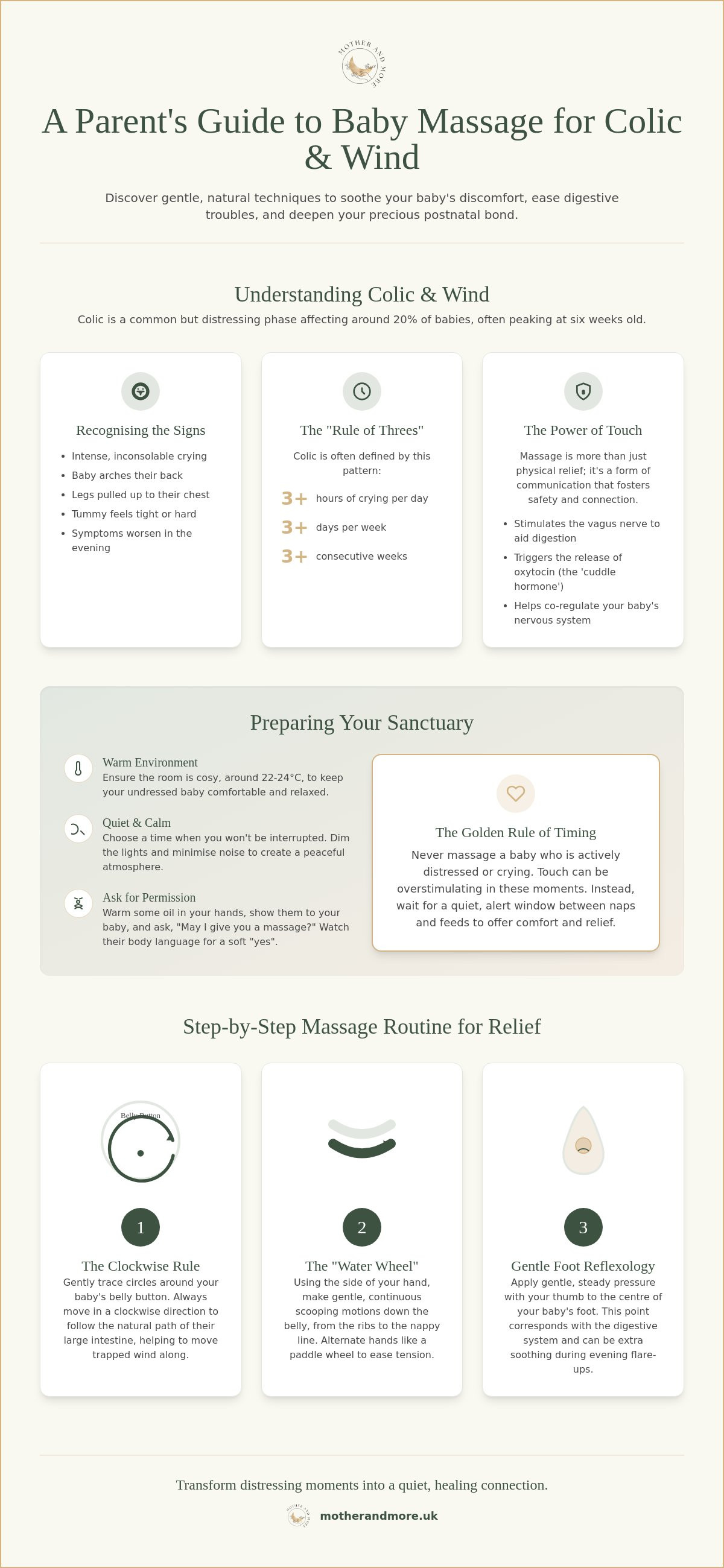
The first few months of parenthood are a season of profound transformation. You are learning a new language; the language of your baby's needs. Your little one is adjusting to a world of sensory input and a digestive system that is still finding its rhythm. When we talk about Baby colic or trapped wind, we aren't just discussing physical symptoms. We are acknowledging a period of intense emotion for both you and your infant. Research indicates that infantile colic affects roughly 20% of babies under 12 months, often peaking around six weeks of age. It is a heavy burden to carry. You might feel your confidence wavering as you try to soothe their inconsolable cries during the "Purple Crying" period. This is a normal, albeit exhausting, developmental phase that affects the entire family unit.
Beyond the physical relief, baby massage for colic and wind serves as a vital communication tool. When you touch your baby’s skin, you aren't just moving gas bubbles. You are stimulating the vagus nerve. This nerve acts as a bridge between the brain and the gut, encouraging peristalsis; the wave-like muscular contractions that move food and wind through the digestive tract. It is a gentle conversation of touch that says, "I am here, and you are safe." It transforms a moment of distress into a moment of deep, postnatal connection.
What is Colic? Recognising the Signs in Your Infant
Colic often presents as a specific, rhythmic distress that follows the "rule of three": crying for more than three hours a day, three days a week, for three weeks. You might notice your baby arching their back or scrunching their tiny legs up toward their chest in a defensive posture. Their tummy might feel tight to the touch or look slightly distended. It is different from general fussiness; this is a sharp, physical discomfort that can leave you feeling stripped of your parental identity. Recognising these behaviours is the first step toward reclaiming a sense of calm. It's okay to feel overwhelmed whilst you navigate these challenging evenings.
The Benefits of Abdominal Massage for Trapped Wind
Gentle abdominal strokes do more than just shift stubborn gas. They trigger the release of oxytocin; the "cuddle hormone" that lowers stress levels for both you and your child. By following the natural path of the large intestine, you help clear the way for comfort whilst encouraging the nervous system to shift into a state of "rest and digest." Regular baby massage for colic and wind sessions act as a preventative measure. They keep the digestive system moving smoothly before tension has the chance to build into a painful flare-up. It is a rhythmic, predictable ritual that builds trust and provides a sanctuary of relief amidst the chaos of the fourth trimester.
Creating a Nurturing Environment for Digestive Relief
Before you begin the physical strokes, you must first prepare the space. Think of it as creating a sanctuary. A soft, warm, and quiet corner where the outside world fades away. This is the foundation of baby massage for colic and wind. It's about more than just a technique; it's about the energy you bring to the interaction. When the environment is calm, your baby’s nervous system can shift out of a "fight or flight" response and into a state where healing and digestion can happen naturally.
Autonomy starts here. Even at just a few weeks old, your baby is a person with their own boundaries. Before your hands touch their skin, hold a little oil in your palms, show them your hands, and ask, "Can I give you a massage?". Watch their eyes. Look for a stillness or a soft "yes" in their body language. If they turn away or seem unsettled, respect that. We never massage a baby who is already mid-scream. It can be tempting to try and "fix" the crying with touch, but a distressed baby cannot process the sensory input. Wait for a quiet, alert moment instead.
Choosing the right medium for your touch is equally vital. You want something pure that respects the delicate nature of their skin barrier. We've put together a guide on the best oils for baby massage uk to help you make an informed, gentle choice for your little one's sensitive skin.
Setting the Scene for Relaxation
The room should feel like a warm embrace. Aim for a temperature between 22-24 degrees Celsius so your baby doesn't feel the chill when undressed. Soft lighting and rhythmic white noise can help you both enter a "flow" state. Your state of mind is the most important element of the sanctuary. If your shoulders are up at your ears, your baby will feel that tension. Take three deep breaths. Lower your heart rate. Your calm is their medicine. When you are grounded, your touch becomes more effective and your presence more soothing.
Safety First: When to Avoid Massage
Timing is everything. Always wait at least 45 minutes after a feed to ensure their tummy has had time to settle, which significantly reduces the risk of reflux. If the umbilical cord hasn't fully healed, avoid the abdominal area entirely. Whilst massage techniques for gas relief are incredibly effective, they must be used with awareness. Watch for disengagement cues like crying, arching away, or fussing. If your baby says "no", it's time to stop. For those wanting to deepen this practice, our Baby Massage Courses offer a supportive environment to learn these cues in real-time.
Step-by-Step Baby Massage Routine for Colic and Wind
Transitioning from preparing the environment to the physical practice is a moment of deep presence. When you begin, remember the golden rule of digestive support: always work in a clockwise direction. This follows the natural path of your baby’s large intestine, moving from the ascending colon on their right side, across the middle, and down the descending colon on their left. Massaging in the opposite direction can inadvertently push gas back the wrong way, causing more discomfort. Practising baby massage for colic and wind is a rhythmic conversation between your hands and your baby's body. It requires a soft touch and a steady, grounding pace.
The evidence supporting Massage for Infants with Colic suggests that these specific, intentional strokes can significantly reduce crying time by aiding the mechanical movement of gas. Integrating these baby massage techniques into your daily rhythm creates a predictable anchor for your little one. It turns a time of potential distress into a ritual of comfort. You aren't just treating a symptom; you're providing a sanctuary of relief through the power of your hands.
The Core Strokes for Wind Relief
Water Wheel: Place the flat of your hands horizontally across your baby’s tummy, just below the ribcage. Use one hand after the other to stroke downwards toward the hips, mirroring the motion of a paddle wheel. This helps move tension and gas bubbles down toward the pelvis.
Knees-to-Tummy: Gently hold your baby’s feet or ankles and press their knees softly toward their tummy. Hold for a count of five, then gently shake the legs out. This pulsing motion creates a physical release that often helps trapped gas escape.
Sun and Moon: The Sun and Moon stroke is a continuous, interlocking circular motion. Your left hand creates a full circle (the Sun) in a clockwise direction, whilst your right hand follows with a semi-circle (the Moon) on the top half of the tummy. This keeps the energy and the digestive movement flowing without breaks.
The "I Love You" Stroke Explained
The "I Love You" (ILY) stroke is often considered the gold standard for infant digestive health because it traces the exact shape of the large intestine. It's a beautiful way to conclude your baby massage for colic and wind routine. First, trace the letter "I" by stroking down the left side of your baby’s tummy (your right). Next, trace an upside-down "L" by moving your hand across the top of the tummy from their right to their left, then down that left side. Finally, create an upside-down "U" by starting at the bottom right, moving up, across the top, and down the left side. This specific sequence ensures that you are clearing the path for wind to move through the entire colon, providing a holistic sense of relief and calm.
Holistic Support: Beyond the Physical Strokes
True relief for a colicky baby is rarely found in a single technique. It is a holistic dance between physical touch and emotional resonance. Whilst the strokes we have discussed are powerful, they are most effective when supported by the invisible bond of co-regulation. Your baby’s nervous system is incredibly sensitive to your own. If your heart rate is steady and your breath is deep, you send a signal of safety to their tiny body. This energetic connection is just as vital as the physical baby massage for colic and wind routine itself. It tells their digestive system it is safe to relax and release tension.
Beyond the tummy, you can use other natural movements to support their comfort. Tummy time, for instance, acts as a passive form of baby massage for colic and wind by applying gentle, natural pressure to the abdominal wall. This helps strengthen their core muscles whilst encouraging gas to move through the intestines. You might also consider incorporating gentle baby yoga movements into your day. Soft, rhythmic stretches help release the physical tightness that often accompanies a long period of crying, allowing for a more settled state before bedtime.
Foot Reflexology for Digestion
When a full tummy massage isn't possible, foot reflexology is a wonderful alternative. The "solar plexus" point is located just below the ball of the foot, in the centre. Applying gentle pressure here calms the nervous system. You can also use soft thumb circles on the heel, which corresponds to the lower bowel. It is a discreet way to offer comfort whilst you are out and about.
Nurturing the Mother: Managing the Stress of a Crying Baby
The sound of your baby’s distress can feel like a physical blow. Taking a moment for a simple "box breath" can reset your nervous system in seconds. Remember that your identity is not defined by your baby’s crying. Our life coaching for mums uk helps you reclaim your confidence amongst the chaos. If you're looking for a supportive space to learn both the physical and emotional tools of parenthood, consider joining one of our Baby Yoga Classes to find your village.
Finding Your Village: The Benefits of Guided Baby Massage Classes
Whilst digital tutorials offer a starting point, they can't feel the tension in your baby’s tummy or notice the subtle shift in your posture. Learning baby massage for colic and wind in a guided, in-person environment provides a level of reassurance that a screen simply cannot replicate. A professional instructor acts as a compassionate mentor, gently correcting your rhythm and ensuring you apply the exact amount of pressure needed to be effective yet safe. This hands-on guidance transforms a technical skill into a confident extension of your parenting. It's about moving from "Am I doing this right?" to "I know exactly how to soothe my child."
There is a profound therapeutic value in the shared experience of the fourth trimester. Stepping out of your home and into a room filled with others who understand the weight of sleep deprivation and the sound of colicky cries is an act of self-care. It breaks the isolation that often accompanies early parenthood. In our baby massage classes East London, we create a sanctuary where you can exhale. You're not just learning a routine; you're finding a community that walks alongside you as you navigate these major life transitions.
The East London Community: Bonding Beyond the Mat
We pride ourselves on building a support network that extends far beyond the massage mat. Whether you are joining us from Hackney, Leyton, or Bow, you'll find a village of local families navigating the same shifts in identity. These connections often blossom into lasting friendships that support your mental health throughout motherhood. Your instructor isn't a distant authority figure but a trusted companion who understands the complexities of your new world. We hold space for the tears, the laughter, and the quiet moments of bonding that happen when you feel truly seen and supported.
Booking Your First Session
Choosing the right path for your family is a personal decision. You can choose between a comprehensive multi-week course that allows for deep learning or a focused one-off workshop for a gentle introduction. Choosing a professional course ensures that your practice of baby massage for colic and wind is grounded in safety and expertise. For your first session, simply bring a soft towel and your baby’s favourite blanket. We provide the rest, including a safe, warm environment to practice. We also believe that connection is a family affair. That’s why we offer dedicated workshops for new dads, encouraging partners to build their own unique bond through touch and shared wisdom.
Embracing a Calmer Future with Your Little One
You've discovered that relief for your baby is held within your own hands. By mastering the rhythmic strokes of baby massage for colic and wind, you're doing more than shifting physical discomfort; you're building a lifelong foundation of trust. From the intentional "clockwise rule" to the quiet power of co-regulation, these tools allow you to move through the fourth trimester with confidence whilst deepening your bond. You don't have to face the long, unsettled nights in isolation.
At Mother And More, we've supported over 2,000 local families through these early hurdles. Our small, nurturing groups in the heart of East London are led by accredited life coach and baby expert Rebecca Beazley. We provide a safe space to grow alongside your child and other local parents. Join our next Baby Massage Course in East London and find your village.
You're doing an incredible job, and we're here to walk beside you. 🌿
Frequently Asked Questions
Is baby massage safe for newborns with colic?
Yes, baby massage is safe for newborns, provided you use a feather-light touch and wait until their umbilical cord has fully healed. Whilst you can begin gentle strokes from birth, many parents find that waiting until their six-week check-up offers extra peace of mind. It's a beautiful way to introduce soothing touch early on, helping your little one feel secure as they adjust to the world outside the womb.
How often should I massage my baby for wind relief?
You should aim to perform a massage routine two to three times a day for the best results. Consistency is the secret to preventing wind from building up into a painful flare-up. By making it a regular part of your morning and evening rhythm, you help keep their digestive system moving smoothly. This proactive approach often reduces the intensity of evening crying sessions.
Can baby massage make colic worse if done incorrectly?
Massage won't make colic worse if you follow the "clockwise rule" and use a gentle, responsive pressure. Massaging in an anti-clockwise direction can inadvertently push gas back into the system, which might increase discomfort. This is why learning the correct baby massage for colic and wind techniques through professional guidance is so valuable for your confidence and your baby’s comfort.
What is the best time of day to perform a colic massage?
The best time is during your baby’s "quiet alert" state, often between morning feeds or after a nap. You want them to be calm and receptive, not hungry or over-tired. Many families find that a mid-morning session helps clear gas built up overnight, whilst a late afternoon massage can help prevent the "witching hour" distress that often peaks in the early evening.
What happens if my baby starts crying during the massage?
If your baby starts to cry, you should stop the massage immediately and offer them a comforting cuddle. Their cries are a way of saying "not right now," and it's vital to respect that boundary to maintain their trust. You can always try again later when they feel more settled. Massage should always be a positive, consensual experience for both you and your child.
Can I use regular olive oil for baby massage in the UK?
It is generally recommended to avoid regular olive oil, as its high oleic acid content can sometimes disrupt a newborn’s delicate skin barrier. Instead, opt for a cold-pressed, food-grade vegetable oil like sunflower or grapeseed oil. These are much gentler and allow your hands to glide easily without causing irritation. They provide a safe, natural way to nourish your baby's skin during your routine.
How long does it take for baby massage to help with wind?
You might notice your baby passing gas or having a bowel movement almost immediately after a session. However, the cumulative benefits of baby massage for colic and wind often take a few days of consistent practice to become fully apparent. As their digestive system settles into a predictable rhythm, you'll likely see a calmer baby with significantly fewer nighttime digestive flare-ups.
Does baby massage help with reflux as well as colic?
Yes, gentle massage can support babies with reflux by encouraging the nervous system to relax and aiding overall digestion. It's crucial to wait at least 45 to 60 minutes after a feed before starting, and you may need to keep your baby slightly upright. This helps ensure that the strokes don't accidentally trigger a reflux episode whilst still providing the benefits of soothing, rhythmic touch.


Comments