

Baby activities for 3 month old London: free and paid indoor ideas
A three-month-old doesn’t need a packed day out: some of London’s indoor attractions are free, including the Science Museum, and children aged 17 and under can enter the London Transport Museum free. For baby activities for a 3-month-old in London, gentle outings with colour, light and new sounds can be just as lovely as a planned class.
It’s understandable to want ideas that feel enjoyable without making the day complicated. At this age, a short visit, time for a feed or nap, and the freedom to change plans can make all the difference.
This guide brings together free and paid indoor attractions, plus baby fitness classes, yoga and massage ideas. You’ll find London locations and timings to help you plan, along with options for keeping an outing simple and flexible. Whether you’re hoping to share a new experience together or meet other parents, there are gentle ways to make a little room for connection in your week.
Table of Contents
1. Free and paid indoor attractions for babies
For baby activities for a three-month-old in London, start with places where you can pause, feed or leave early. The Science Museum in South Kensington has free admission, and its Pattern Pod features a goldfish pond projection that ripples when touched. It offers a gentle visual focus for your baby while you enjoy an indoor outing.
Children aged 17 and under can enter the London Transport Museum free. Its displays offer colour, shapes and changing scenes to look at together, while toddlers may enjoy the buses and trains more actively. The British Museum has more than 80,000 items on display, so choose a small area rather than trying to see everything. Tate Modern showcases modern and contemporary art from the 1900s to today, offering large-scale images and open spaces for a slower gallery visit.
For a paid indoor attraction, Sea Life London aquarium houses more than 500 species and contains more than 2 million litres of water. The shifting colours and movement can make a short visit engaging, even if your baby spends most of it close to you. London Zoo is primarily an outdoor outing, but its indoor animal spaces can be part of a broader visit; children under three can enter free. Plan around your baby’s routine, not the attraction’s full itinerary.
Classes offer another kind of indoor activity. For a three-month-old, look for sessions that welcome babies from that age, such as baby yoga, gentle movement, music or sensory play. A class can provide a predictable structure and time with other parents. Read the session details for the age range and booking requirements, as popular times may fill. Music sessions might include singing, simple rhythm instruments or listening together; sensory activities can use light, colour and texture.
Bring nappies, wipes, a change of clothes, feeding supplies and a familiar blanket. A lightweight pram or sling can make it easier to get between the entrance, changing area and activity.
At group activities, keep your baby close, follow the facilitator’s instructions and make time for feeds or rest. Choose a clean, uncluttered spot, and don’t pass your baby around unless you’re comfortable with it. At museums, galleries and classes, step away from busy areas if your baby seems overwhelmed.
Before setting out, note the nearest baby-changing facilities and a quiet place to pause. The Design Museum has a feeding room in its basement, while the Science Museum’s baby-changing area nearest the Pattern Pod has a toilet and changing table. Knowing these details can make an indoor visit easier to organise.
2. Fitness, baby yoga and baby massage
At three months, parent-and-baby fitness can be gentle and flexible. Some sessions combine adult movement with time for your baby to rest nearby, while others centre on shared stretches, songs or floor-based play. Look for a class description that welcomes young babies and explains how to adapt the movements. The aim is to connect and move at a comfortable pace, not keep up with a demanding workout.
Baby yoga offers a slower rhythm. A session may include songs, gentle movement with your baby and stretches you do beside them. The instructor guides the session while you pay attention to your baby’s cues and take a break whenever needed. Read about the class format and what to bring before booking. A regular class can also give you a familiar place to meet other parents.
Baby massage is another calm, hands-on activity. A course usually teaches techniques step by step, giving you time to practise with your baby and pause when they need a feed, cuddle or rest. Follow the instructor’s guidance and your baby’s responses; there’s no need to complete every movement. If you’d like a guided starting point, explore baby massage course details.
Music and sensory sessions can complement movement classes. Singing a nursery rhyme, listening to a gentle rhythm or sharing a short storytelling activity gives you something simple to enjoy together. Some groups use animal sounds or colourful objects as prompts. At this age, your baby can take part in your arms or on a mat, without needing to move around the room. Even a quiet class can feel like a small adventure.
To choose between fitness, yoga and massage, consider what would make the session manageable for you. Do you want to stretch, learn a soothing routine or spend time with other parents? Weigh up the venue, journey and session time alongside your baby’s usual rhythm. A nearby community space may suit better than travelling across London to combine a class with a theatre visit, gardens or Battersea Park. Those outings can be lovely, but tickets, crowds and transitions may make a class the simpler choice.
Keep the experience responsive. Bring feeding supplies, nappies and a change of clothes, and give yourself permission to arrive quietly or leave early. A class is shared time, not a performance. Whether you choose baby yoga, massage, music or parent fitness, look for a session that lets you stay present with your baby and enjoy the moment together.
3. London venues, times and locations
Choose the venue first, then pick a session time that fits your baby’s routine. Southbank Centre hosts Wordplay every two weeks, offering a named option for storytelling with your little one. Read the event details for the format and location before setting out. A regular event can give your week a gentle point of focus without needing a full day of attractions.
To find and book baby classes near you in London, search by borough or nearby station alongside terms such as baby yoga, music or sensory sessions. Use the venue’s events calendar or booking page to find the location, age guidance and available times. Compare the journey with your usual feeding and nap pattern before choosing.
For a central London outing, consider how you’ll travel from the station to the venue with a pram. At the Barbican, Farringdon is the recommended Tube option because it has lifts; Barbican station has many stairs. Choosing the easier route can make an indoor event more manageable, especially with a changing bag.
South Kensington has several attractions close together, including the Science Museum. Keep the plan simple: choose one activity, identify the entrance and note where you can pause indoors. A morning visit may suit your baby’s routine better than an afternoon outing, but your feeding and sleep rhythms are the best guide. Avoid adding a second venue just because it’s nearby.
For classes, search local libraries, community centres and family venues using your postcode. Read the session listing for the baby age range, whether adults join in and how booking works. A music class may involve songs and listening; a sensory session might focus on colour, lights or simple textures. These details can help you decide whether the activity suits both you and your baby.
Before booking, make a simple travel plan. Note the nearest station, a step-free route if available, the entrance and a place to feed or change your baby. If the session is near a school or busy shopping street, allow time for the journey and arrival rather than aiming to walk in at the last moment. A little breathing space can make the start feel calmer.
For a first visit, choose one location and one activity, such as Wordplay at Southbank Centre or a nearby class. Save the booking details on your phone and pack what you need before leaving home. London has plenty to explore, but one clear destination can be enough for a calm outing.
A listing gave the Magic Garden at Hampton Court Palace an 11 am opening through October 29, 2023; check current details before planning around a timed opening. Keeping one destination in view leaves room to adjust if travel or your baby’s routine changes.
4. What activities are suitable for a 3-month-old baby?
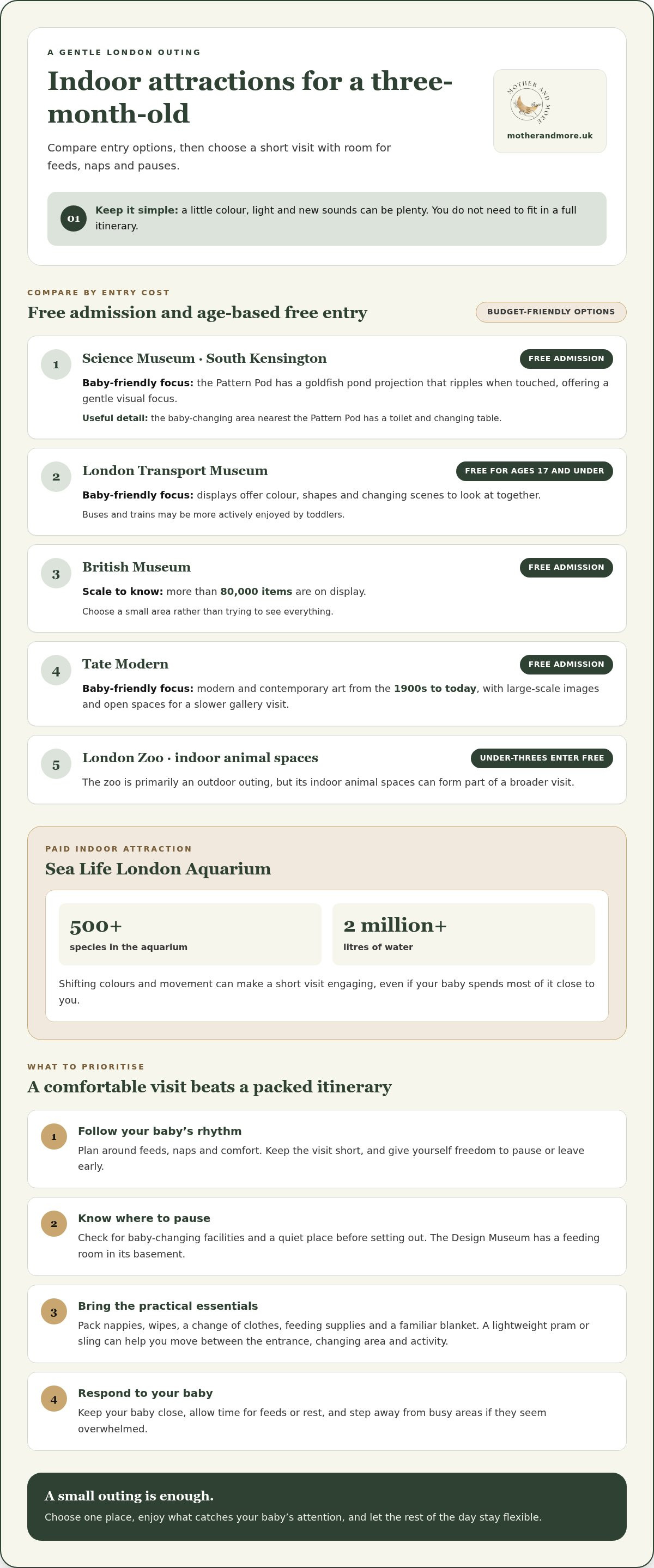
At three months, keep activities simple and centred on time together. Sit face to face and talk gently, then pause to let your baby look at you. A brightly coloured picture book gives you something to describe, while a soft song adds sound and rhythm. These small moments work at home, on a blanket or during a quiet break at a London museum.
For a visual activity, hold a colourful toy within your baby’s view and move it slowly from side to side. Give them time to watch, then change the object or stop if they lose interest. A mirror can also make a familiar play space more engaging. Keep each activity brief and follow your baby’s attention rather than trying to fill the whole morning.
Try a short tummy-time play session when your baby is awake and settled. Lie face to face, or place a favourite toy nearby as a point of focus. Talk, smile or sing while your baby explores the view. If the position doesn’t suit the moment, switch to a cuddle or another activity. You don’t need a class for every meaningful play session.
Gentle movement can be part of shared play, too. With your baby comfortably supported, sing a familiar nursery rhyme and add small, slow movements that follow the music. Baby yoga classes offer a guided setting for parent-and-baby movement, while massage classes introduce touch through a calm, step-by-step routine. Choose an activity that feels comfortable for both of you, and take pauses as needed.
Books, songs and household objects can create a sensory activity without elaborate equipment. Describe the colours in a picture book, listen to a soft musical toy together or let your baby look at a clean, textured cloth. Keep it simple: offer one object, describe it and notice whether your baby seems interested. A short moment of connection is a complete activity.
Outings can be simple, too. At the Science Museum, focus on one visual feature, such as the Pattern Pod’s rippling goldfish pond projection, rather than planning to see every gallery. A quiet corner in a library can become a shared reading spot. At home, alternate a song, a cuddle and a look at a book, then let your baby’s cues guide what comes next.
There’s no need to measure a good day by how many activities you complete. Choose one simple idea, such as a song or a book, and let your baby’s interest set the pace. If a planned activity doesn’t fit the moment, a cuddle and a quiet pause are also time spent together.
5. Where are free baby activities for 3-month-olds in London?
Several London attractions let a three-month-old visit without an admission charge. Children under four can enter Kew Gardens free, and children under four can also enter London Wetland Centre free. At Battersea Park Children’s Zoo, children under two enter free. Your baby falls within each age group, so these places can make a family outing easier to plan around your budget.
Kew Gardens gives you a spacious setting for a gentle visit. Choose a short route, pause when your baby needs feeding, and enjoy the changing colours and shapes around you. The gardens have over 50,000 plant species, so you can take in a small area rather than trying to explore everything. A pram-friendly plan can include time outdoors and a quiet break when your baby needs one.
London Wetland Centre offers a different atmosphere, with wetland habitats and wildlife to see together. A visit can be as simple as following one path and stopping to take in the surroundings. Your baby may enjoy looking around from a sling or pram while you take a slower walk. Check the route and current opening details before travelling, then choose a visit length that works for your family.
Battersea Park Children’s Zoo is another option for seeing animals together, with free entry for children under two. Make the visit manageable by focusing on a few areas instead of trying to see every animal. Battersea Park itself offers space for a walk before or after the zoo. Keep your baby’s feed and rest routine in mind when deciding how much to include.
Free entry doesn’t always mean the whole day is cost-free. Travel, food and any paid adult admission can still affect your plans, so decide what you’ll spend before leaving home. For a simpler outing, bring a feed, nappies and a change of clothes, then choose one main destination. A nearby park or quiet stop gives you flexibility if your baby needs a pause.
To choose between Kew, London Wetland Centre and Battersea Park Children’s Zoo, consider the journey, the setting you’d enjoy and how easy it is to take breaks. Save the venue details on your phone and plan a straightforward route from your nearest station or bus stop. A gentle visit can mean a walk, looking at plants or animals, and a cuddle when your baby wants closeness.
If you’d like to add a guided parent-and-baby activity to your routine, explore gentle activities for you and your baby.
Other London options can add variety to a gentle day out. At the Horniman Museum, the aquarium gives you a chance to watch jellyfish together, offering a simple focus for your baby while you take a relaxed look around.
The Royal Academy of Arts has a dedicated baby-changing room and extra-large toilet cubicles where visitors can take a buggy, which may help you plan practical pauses. Under-18s can visit the London Transport Museum for free, so it is another possible family stop.
Mother And More: Baby Massage Courses
Mother And More offers Baby Massage Courses for parents who’d like guided, gentle time with their baby. If you’re drawn to a calm activity at home or want to learn massage techniques in a supportive setting, a course can be a natural next step. Baby Yoga Classes offer another way to share movement and connection. You can choose the approach that feels most comfortable for you and your three-month-old, without needing to fill every day with outings or activities.
For more information about baby massage and yoga, visit motherandmore.uk.
Choose a gentle next step for you both
Planning baby activities for a three-month-old in London can be a chance to notice what feels good for you as well as your baby. Perhaps you’d like a familiar weekly rhythm, a quiet moment of connection, or simply more confidence in trying something new. Let that feeling guide your next step; there’s no need to turn every day into an outing.
If you’d value support beyond planning activities, Mother And More offers Baby Massage Courses and Baby Yoga Classes, alongside One to One Life Coaching for mothers. Choose the kind of support that fits what you need now, whether that means sharing time with your baby or making space for yourself.
Contact Mother And More to explore your next step. Take it gently, and trust that small moments together can be meaningful.
Frequently Asked Questions
What baby classes are available for 3-month-olds in London?
Baby massage, baby yoga, music and sensory sessions are all options to explore for a three-month-old. Mother And More offers Baby Massage Courses and Baby Yoga Classes for parents and infants. For a first class, choose a format that lets you stay close to your baby and pause for a feed or cuddle. Use the class’s age guidance to find a suitable session, then plan your journey around its start time.
Which London baby activities are indoors and suitable for rainy weather?
Indoor choices include the Science Museum, the London Transport Museum and Sea Life London aquarium. For a shorter rainy-day visit, choose one area or exhibit rather than trying to cover the whole venue. A museum gallery gives you room to pause with your baby, while an aquarium offers moving scenes to watch together. Pack a dry change of clothes and keep your route simple, especially if you’re travelling by public transport.


Comments