

Rediscovering Hobbies After Having a Baby: A Gentle How-to Guide
Updated: 3 days ago
What if rediscovering hobbies after having a baby isn’t about returning to your old self, but finding out what brings you joy now? Your interests may have shifted, and that isn’t a loss. It’s part of finding your feet in a new season of life.
When free time comes in unpredictable little pockets, picking up an old hobby can feel harder than expected. Low energy, changing routines and guilt about taking time for yourself can all get in the way. You don’t need a grand plan or perfect, uninterrupted hours to begin.
This guide offers practical ways to reconnect with an old interest or explore something new, without turning it into another job. You’ll find ways to follow your curiosity, adapt hobbies to family life and make room for personal time with less pressure. Start small and notice what feels good.
Table of Contents
Why rediscovering hobbies after having a baby can feel different
You can love being a parent and still miss the person who used to lose an afternoon in a book, head out for a run or meet a friend to make things together. Those feelings can sit side by side. Missing an interest doesn’t mean you’re ungrateful for your family or want life to go back exactly as it was. It means something mattered to you.
Parenthood can change the practical shape of leisure. A hobby that once fitted neatly into an evening may now compete with feeds, naps, household tasks and the need to rest. Free time might arrive in brief, unpredictable pockets, and tiredness can make a familiar activity feel like effort. That doesn’t mean you’ve failed to make room for yourself. The conditions have changed.
Hobby rediscovery means exploring which activities feel meaningful now, without expecting them to look as they did before. The aim isn’t to recreate an old routine on demand. It’s to notice what still sparks interest, what might need adapting and what you may be ready to leave behind.
What can change about your interests after a baby arrives?
There’s no single way interests shift. You might still love painting but find it tricky to set up and pack away around interruptions. Perhaps you miss a weekly class less for the activity than for the conversation, familiar faces and sense of being part of something beyond home. Or an old pastime may no longer appeal, while a new one catches your attention.
Ask yourself what you miss most: the activity, the people, the challenge, the quiet or the feeling of having time that belongs to you. Your answer can suggest a gentler way back. If you loved cooking with friends, for example, sharing a simple recipe with someone at home might bring back some of the connection, even if it isn’t the same evening out. Interests can pause, become more flexible or grow in a new direction. They don’t have to disappear for good.
Let go of the idea that you must return to your old routine
It’s easy to measure your current capacity against life before your baby arrived. But a hobby that once needed a long, quiet stretch may not fit your days now. Expecting yourself to match your former pace can turn enjoyment into another standard to meet. You’re allowed to start somewhere different.
Instead, get curious about your preferences as they are now. Do you want something calming or lively, solitary or shared? Would you enjoy a few minutes of sketching, or does getting outside feel more appealing? Think about your energy and the time you can realistically access, without treating either as a test of commitment. The wider question of who you are becoming may also be worth exploring through reflections on reclaiming identity after motherhood. The idea of work-life balance can be a useful prompt, too: personal interests don’t have to compete with family life to have a place within it.
How to discover which hobbies feel right for you now
You don’t need to choose the most impressive, productive or “useful” pastime. Begin with the feeling you hope an activity might offer: calm, a creative outlet, fresh air, a sense of progress or simply something that’s yours. This isn’t a commitment list. It’s a way to notice what draws you in, without asking whether you’re good at it or what you’ll have to show for your time.
For a simple starting point, jot down ideas in three groups:
Past interests: activities you enjoyed before, even if you’re unsure whether you’d enjoy them in the same way now.
New curiosities: things you’ve found yourself wanting to try, perhaps after seeing someone garden, knit or take photographs.
Small everyday pleasures: moments you already look forward to, such as tending a plant, listening closely to music or sketching while something is cooking.
Look over the list and notice which ideas feel inviting rather than demanding. If rediscovering hobbies after having a baby feels daunting, you don’t have to settle on a lifelong passion. You’re choosing something to explore next.
Start with what you miss, and what you are curious about
Include both the activity and the feelings around it. Perhaps you miss the concentration of making something, the company of a class or the pleasure of being outdoors—creative workshop providers like arttherapy.ae show how hands-on art sessions can provide a welcome focus on creative wellness. New interests count too: a few minutes among the garden pots or returning to a half-finished creative project can be a meaningful beginning. Let your list hold possibilities, not promises.
Match an idea to your real-life capacity
Before choosing, picture what trying it would involve on an ordinary day. Consider the time, energy and preparation it needs, whether you can do it at home and how easily you can pause. A hobby that fits your actual circumstances is more likely to feel welcoming than one that depends on ideal conditions.
Make the choice more practical by separating the heart of an activity from its optional extras. Gardening might begin with one pot rather than a full set of tools or a trip to an allotment. Drawing may need only paper and a pencil, not a dedicated workspace. A class or tutor can offer connection—for example, studios offering piano lessons Menlo Park show how dedicated adult instruction provides structured creative time—while a small version at home may be simpler to fit around family life. Neither approach is better. Choose what suits you now.
For each idea, ask yourself:
Could I enjoy it in a short session, or does it need a longer stretch?
How much setting up, travelling or equipment does it involve?
Can I stop and return later without losing the thread?
Does imagining it leave me curious, or already under pressure?
A gentle decision rule: choose one low-pressure activity that fits the time available this week. You can adjust it later; this is a trial, not a test. If you’d like a reflective space to explore your interests alongside questions of identity and wellbeing, one-to-one life coaching for mothers can help you consider what feels important to you now.
For support as you reflect on what matters to you, explore life coaching for mothers.
How to make space for a hobby without perfect conditions
A hobby doesn’t have to wait for a long, uninterrupted stretch of free time. If your baby’s routine changes from day to day, a few flexible minutes can still offer a welcome moment of focus or pleasure. Rediscovering hobbies after having a baby isn’t about creating an ideal schedule. It’s about finding an approach that bends with family life.
There are two useful ways to make room. Planned personal time gives you a clearer boundary and may suit an activity that needs concentration, such as going for a run or attending a class. The trade-off is that a change in the day can mean rescheduling. Flexible mini-sessions are easier to weave into small gaps and can be paused when needed, though they may not offer the same immersion. Use one approach or a mixture, depending on the hobby and the week.
Try short sessions or a flexible hobby format
Choose a version of your hobby that’s easy to begin and set aside. Read a few pages, add a couple of stitches to a knitting project, water a few pots or write a few lines in a notebook. If it’s practical, keep the materials together somewhere accessible so getting started doesn’t become a project of its own.
A short session may not recreate the flow of an afternoon spent absorbed in something. It doesn’t have to. The point is to enjoy a small encounter with an interest, not to complete a task or prove you’re committed. Some days you may find more time; on others, stopping after a few minutes is enough.
Talk about sharing time and support at home
If there’s another parent or trusted person involved in your family’s care, a kind, clear conversation can help make personal time more possible. Rather than waiting until everyone is exhausted, talk about what might work in an ordinary week. Be specific about the time you’re hoping for, and invite the other person to say what would help them make room for their own interests, too.
You might agree on a realistic window and a simple backup plan if the baby needs more care or the day changes. That could mean swapping times, choosing a shorter session or trying another day. If you’re parenting without a co-parent or nearby family, your options may look different. Consider whether a hobby can happen at home, fit around a trusted support network where available, or work in a format that doesn’t rely on someone else being free. There’s no single arrangement for every household.
Taking time for something enjoyable can bring up guilt, especially if you’re used to putting everyone else first. But personal enjoyment doesn’t have to be earned by finishing every task. It can simply be part of a family life where your needs matter, too. A broader self-care for new mothers guide can offer other wellbeing ideas; this is one small way to reconnect with what feels like you.
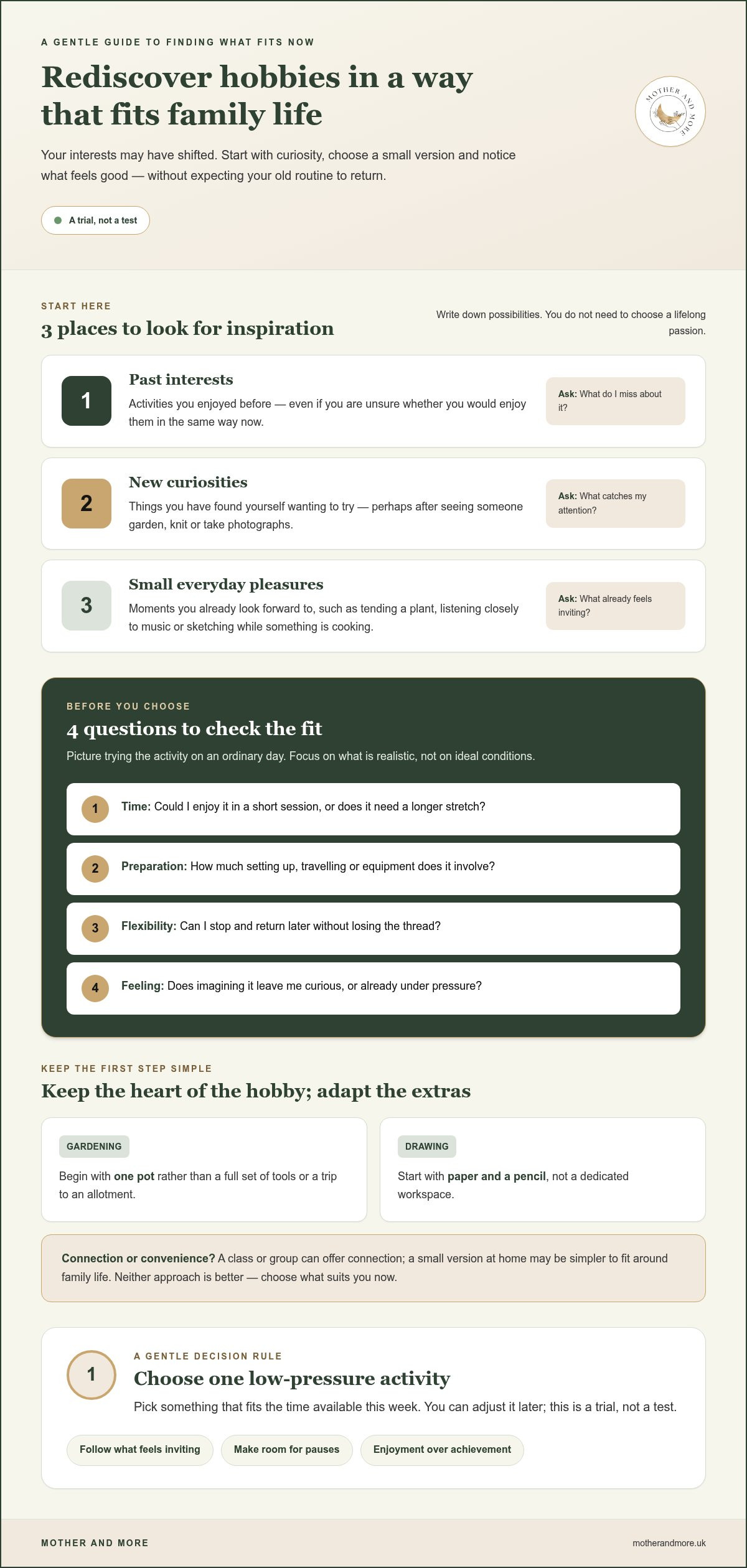
How to restart a hobby in small, encouraging steps
Starting again can feel surprisingly loaded. You might wonder whether you’ll enjoy it as much as before, or feel pressure to make it a regular part of life. Take that weight off. Your first attempt isn’t a test of talent or commitment. It’s a chance to see how the activity feels in your life now.
Choose one idea, make it small, give it a try, then reflect without judgement. That’s enough of a process for rediscovering hobbies after having a baby.
Choose one idea. Pick the activity that feels most inviting, not the one you think you ought to do.
Make it small. Decide on a manageable first version, such as reading a chapter or gathering the materials for a creative project.
Try it. Give it a go when an opportunity arises, without expecting perfect conditions or a particular result.
Reflect kindly. Notice what you enjoyed, what felt difficult and whether you’d like to try a different version.
Plan a first attempt that feels genuinely manageable
Make the plan specific enough to help, but flexible enough to survive a change of pace. Choose what you’ll try, when you might fit it in and what you need beforehand. If you’d like to draw, for example, leave a sketchbook and pencil somewhere easy to reach. Avoid building your first attempt around an ideal routine that may not happen.
It can help to have a softer alternative ready. If there isn’t time to work on a larger project, you could spend a few minutes choosing an idea or setting out what you’ll need next time. This isn’t a substitute you have to complete. It’s another way to stay connected to the interest when the original plan doesn’t fit.
Reflect, adjust and count small returns as progress
Afterwards, ask yourself three gentle questions: Did I enjoy any part of that? Was it easy enough to begin? How did I feel afterwards? You might feel refreshed, absorbed, restless or simply glad you tried. There’s no correct answer, and one session doesn’t have to decide whether this hobby belongs in your life.
Use what you notice to shape your next attempt. Shorten the session, simplify the set-up, try it at a different time or pause for now. You can also choose something else. An uneven rhythm is normal when family life changes from day to day; consistency isn’t proof that an interest matters to you. Returning when it feels possible counts.
If reflecting on what you want from this new season feels difficult, explore life coaching for mothers as a space to consider your identity, confidence and wellbeing.
How to keep hobbies part of family life as your needs change
A routine that works for your family now may need to shift as your baby grows. Sleep, childcare, work and the shape of your days can all change, so treat your hobby rhythm as something you’re allowed to revisit, not a promise you must keep unchanged. Rediscovering hobbies after having a baby is an ongoing conversation with yourself: what feels enjoyable, and what fits this season?
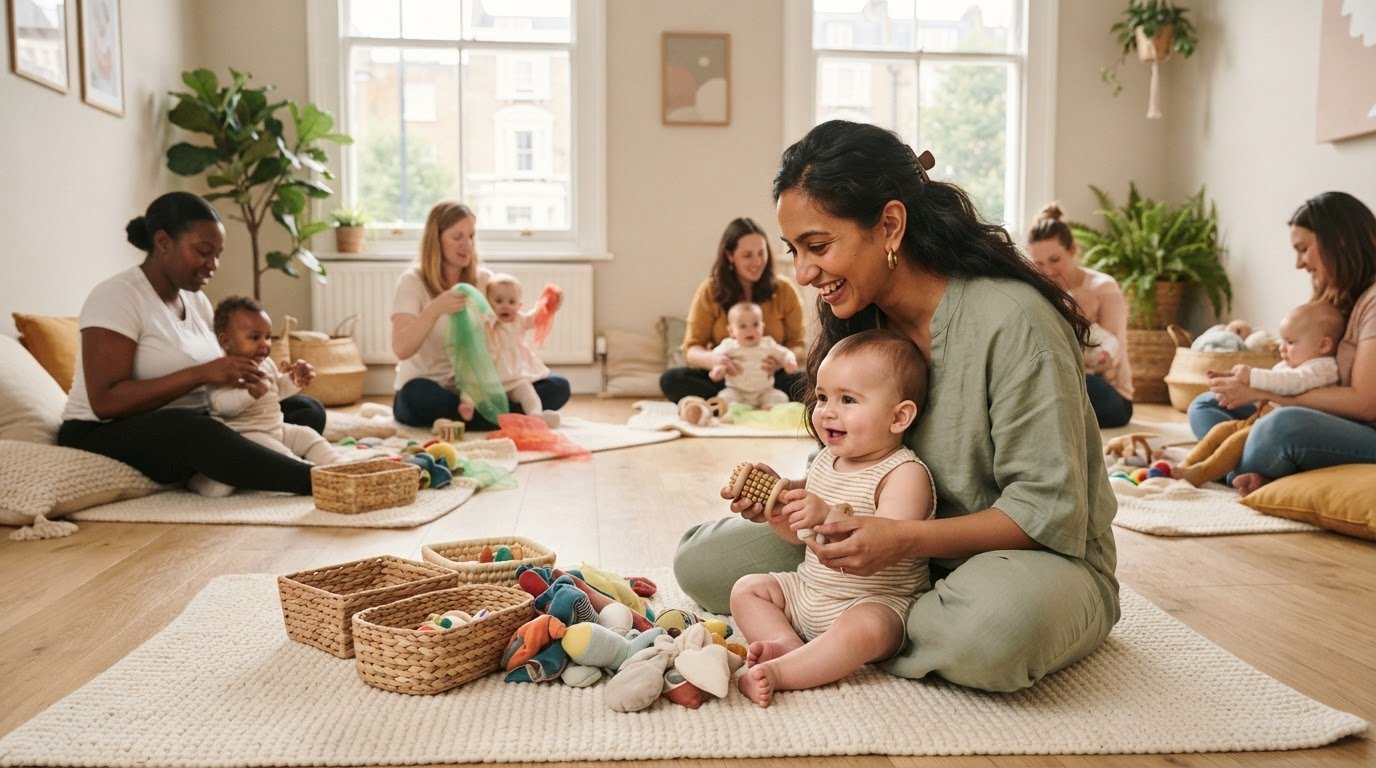
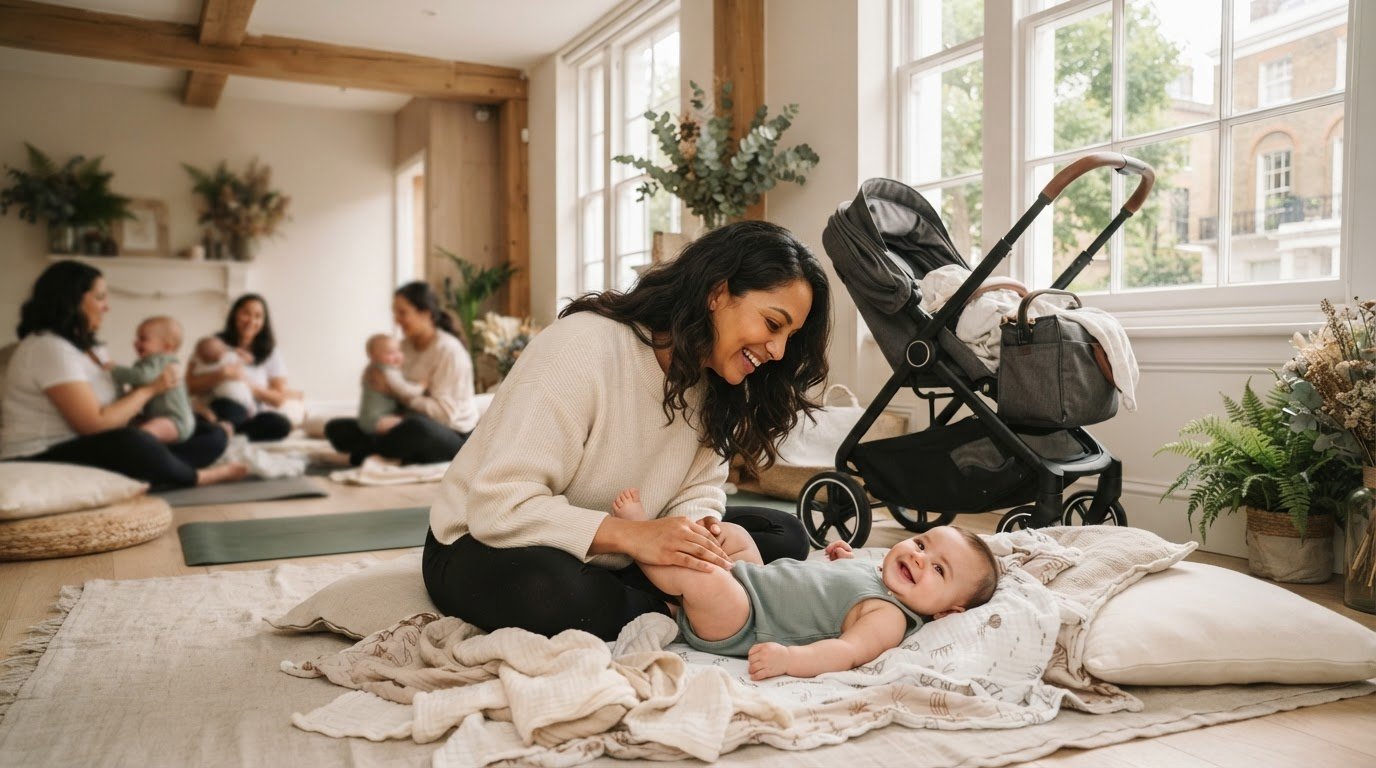
Some interests may naturally become shared family activities, while others may remain time just for you. Both have value. If you’d like ideas for doing something alongside your baby, Mother And More runs baby massage and baby yoga classes for parents and infants in East London. But your hobby doesn’t need to involve your child to belong in family life.
Build a rhythm that can flex with family life
A light recurring cue can make it easier to remember your interest without turning it into a rigid timetable. You might aim for a short creative session on a particular evening, or keep a weekend window in mind for getting outdoors. Treat the cue as an invitation, not a rule. If that moment doesn’t work, you haven’t failed.
Let the rhythm change with your circumstances. A hobby that fits during one season might need a shorter format or a different time when work or childcare arrangements shift. Check in with yourself when your baby’s sleep changes, your support network looks different or your household routine is rearranged. Ask: does this still feel enjoyable, and is the way I’m making space for it realistic? Adjusting the plan is a sign of responsiveness, not a lack of commitment.
It may help to focus on the experience rather than the result. A walk can be worthwhile without reaching a particular distance; a creative project can bring pleasure even if it stays unfinished. Skills may develop and finished pieces may follow, but they don’t have to measure whether your time mattered. Let enjoyment, curiosity or the quiet feeling of reconnecting with yourself count, too.
Know when a little support could help you reconnect
Sometimes the practical plan isn’t the difficult part. It can be hard to work out what you want for yourself amid all the changes. Life coaching can offer a reflective space to explore identity, confidence and personal priorities, and to consider small steps that feel aligned with your life now. It isn’t clinical psychological therapy, and hobbies aren’t a replacement for professional support if you’re experiencing persistent or serious mental health concerns.
You don’t have to turn personal time into another goal to reach. Let it be a small, kind way of staying connected to yourself as family life evolves. If you’d value support as you reflect on your identity and wellbeing, Mother And More’s life coaching for mothers can offer a space to explore those questions.
Give yourself permission to begin again
Your next step doesn’t need to be a promise to take up a hobby forever. It can be a small invitation to notice what you enjoy and let that interest grow, change or rest as family life shifts. Rediscovering hobbies after having a baby isn’t about fitting your old self into a new routine. It’s about making space for the person you’re becoming, one gentle choice at a time.
If you’d like a thoughtful space to explore what matters to you in this chapter, Mother And More offers life coaching for mothers. Founder Rebecca Beazley is an accredited life coach and former social worker. Mother And More has supported more than 2,000 local families and hundreds of mothers across the UK.
Explore life coaching for mothers with Mother And More. You’re allowed to start small, follow what feels meaningful and find your own way forward.
Frequently Asked Questions
Is it normal to lose interest in hobbies after having a baby?
Yes, it can be a common response to a major life change. Your attention, sleep and emotional energy may be directed towards caring for your baby, leaving less room to feel engaged with other things. Rediscovering hobbies after having a baby can take time, and your interests may shift. If a loss of interest extends to most things or comes with persistent low mood or anxiety, speak with your GP or health visitor for support.
When is a good time to start a hobby again after having a baby?
There’s no universal date or milestone. A good time is whenever you feel curious enough to try something and can do so in a way that feels manageable. If your chosen hobby involves physical exertion after birth, follow advice from your midwife, GP or other healthcare professional about returning to activity. For a gentler pastime, you might begin with something that asks little of your concentration, then see how it feels.
Can I enjoy a hobby while my baby is with me?
Yes, some hobbies can be adapted for time with your baby, although your attention may come and go. You could listen to an audiobook during a pram walk, sing while playing or spend a few minutes tending plants when your baby is settled nearby. Choose an activity and set-up that allow you to respond to your baby’s needs, and let the session end whenever it needs to. A brief, interrupted moment can still be enjoyable.
How can I try a hobby without spending much money?
Start with what you already have or can borrow. Use library books to explore an interest, try a recipe with ingredients in your cupboard or sketch with basic paper and pens before buying specialist materials. In London, local library and council websites can help you look for community activities and groups in your area. Treat the first attempt as a trial, so you can discover whether you enjoy the activity before investing in equipment or regular sessions.
What if I feel guilty taking time for a hobby?
Feeling guilty doesn’t mean you’re doing anything wrong. It may help to ask what the guilt is saying: are you worried someone else needs you, or that personal time should be earned? Your enjoyment matters alongside your caring responsibilities. If it helps, talk with someone you trust about sharing time fairly, or choose an activity that feels restorative rather than demanding. You don’t have to justify every moment that brings you pleasure.
Should I return to an old hobby or try something completely new?
There’s no need to choose one path for good. An old hobby may feel comforting, while something new can suit who you are now. You could revisit a familiar interest in a different format, such as reading short stories instead of longer books, and stay open to a fresh curiosity too. Notice which option feels appealing rather than choosing the one you think you should prefer. You’re allowed to change your mind as you learn what fits.
Comments