

Baby Massage for Constipation and Reflux: A Gentle Guide to Soothing Your Little One
It is 3 AM. You are pacing the hallway again, heart heavy as you watch your little one arch their back in distress. You have tried the winding, the upright carrying, and the endless rocking; yet that tiny tummy still feels tight and unsettled. It is a lonely, exhausting feeling to watch your baby struggle whilst you feel powerless to fix it. You aren't alone in this. We know how overwhelming it feels to seek out baby massage for reflux and digestive support, only to be met with conflicting advice when all you want is for your infant to feel comfortable and for your home to feel calm once more.
There is a gentler way forward that begins with your own two hands. Learning baby massage offers more than just physical relief; it creates a rhythmic dialogue of touch that regulates your baby's nervous system and your own. This guide will show you how expert-led techniques can naturally improve digestive regularity and ease discomfort whilst deepening your emotional bond. We will explore simple, soothing strokes that help you move from a place of worry to one of quiet confidence, ensuring both you and your baby find the comfort you deserve.
Table of Contents
Understanding Infant Constipation and Digestive Discomfort
Watching your baby struggle with a tight, firm tummy is one of the hardest parts of early parenthood. It isn't just about the physical symptoms; it's about the way the tension ripples through your home, stealing your sleep and your peace of mind. You might notice your little one straining with a red face, or perhaps their nappies have become unexpectedly infrequent. These moments of discomfort often stem from an immature digestive system finding its rhythm, or perhaps a recent transition between breast milk, formula, or the first tastes of solid food.
While these issues are common, they are never "just" a phase when you're the one holding a crying infant at midnight. Many parents find that Infant massage provides a practical, loving way to intervene. It helps bridge the gap between feeling helpless and feeling empowered. If you're also managing the arching and spitting up associated with silent or active reflux, incorporating baby massage for reflux into your daily rhythm can offer a holistic way to settle their sensitive system whilst providing much-needed comfort.
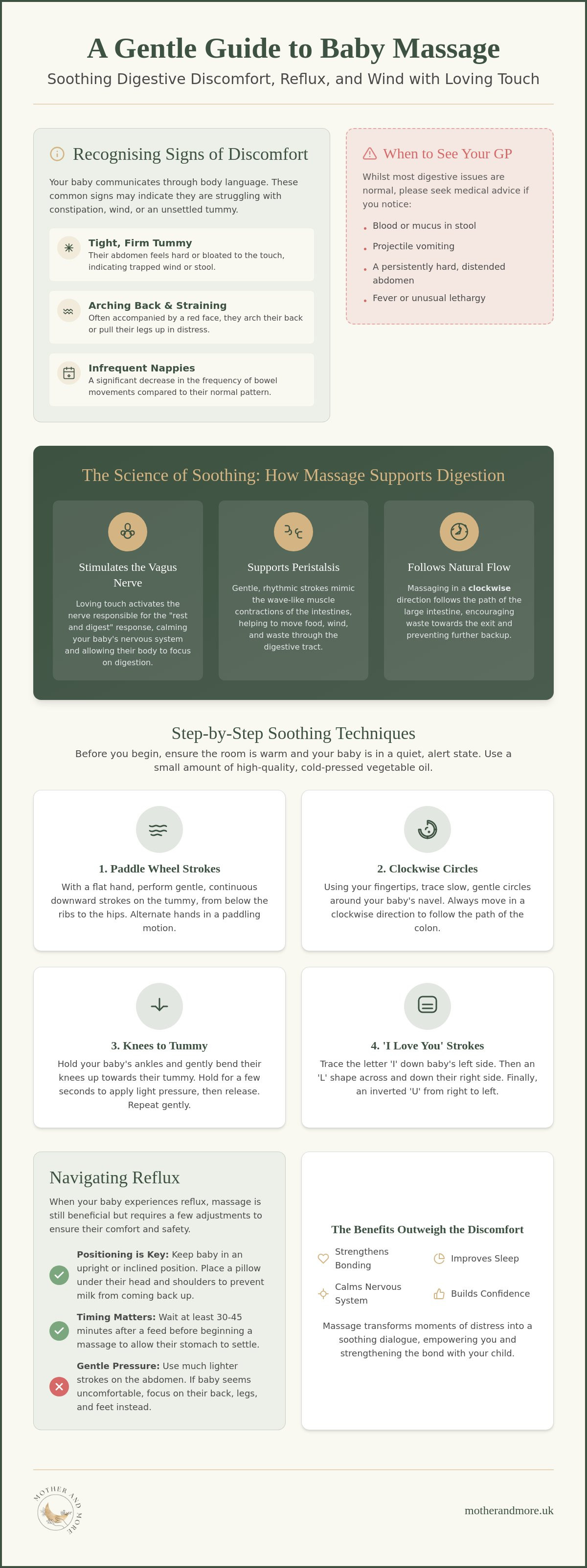
It's vital to trust your intuition. Whilst most digestive wobbles are a normal part of growing up, some signs require a chat with your GP. Please seek medical advice if you notice "red-flag" symptoms such as blood or mucus in their stool, projectile vomiting, or a persistently hard, distended abdomen. If your baby has a fever or seems unusually lethargic, a professional medical check-up is always the safest path.
Is it Constipation or Normal Infant Development?
Distinguishing between genuine constipation and "normal" infant behaviour can be tricky. Breastfed babies might poo several times a day or go a week without one, as breast milk is so efficiently absorbed. Formula-fed babies tend to be more regular. You might have heard of "grunting baby syndrome," where infants strain and turn purple. Often, they're simply learning how to coordinate their muscles to pass waste. However, waiting it out can be stressful. Taking a proactive approach through touch supports their development whilst offering you a beautiful way to bond during the struggle.
The Link Between Digestive Health and Sleep
A "backed-up" system is a major thief of restorative rest. When a baby's tummy is full of trapped wind or stool, they find it almost impossible to drift into a deep, peaceful sleep. This creates a difficult cycle: discomfort leads to overtiredness, which makes the nervous system more reactive to pain. Using baby massage for sleep as a preventative tool helps clear the physical blockages before bedtime. By soothing the digestive tract, you're clearing the path for longer, more settled stretches of sleep for the whole family.
The Science of Soothing: How Massage Supports Digestion
Touch is your baby’s first language. It is a powerful, biological signal that tells their tiny body they are safe, loved, and protected. When you place your warm hands on your infant's tummy, you aren't just providing comfort; you are engaging in a sophisticated physiological dialogue. This intentional contact speaks directly to the Vagus nerve, a vital highway of the nervous system that governs the "rest and digest" response. By stimulating this nerve, you help transition your baby out of a stressed, "fight or flight" state and into a space where their body can focus on the complex work of processing milk and moving waste.
Understanding how baby massage for reflux works on a physiological level can be incredibly grounding for parents. One of the primary mechanical benefits is the support of peristalsis. This is the rhythmic, wave-like contraction of the muscles in the digestive tract that pushes food and waste along. When a baby’s system is immature, these waves can be uncoordinated or sluggish. Your gentle, external strokes mimic this internal movement, providing a "nudge" to the digestive system to keep things moving effectively. This is particularly helpful for baby massage for gas and wind, as it helps trapped air find its way out more easily.
Stimulating the Gastric System Through Touch
The physical direction of your massage is key to its success. We always work in a clockwise direction, following the natural path of the large intestine. This ensures we are encouraging waste toward the exit rather than causing further backup. Gentle abdominal massage increases blood flow to the gut, which significantly aids in the efficient elimination of waste. By applying light, consistent pressure, you are effectively assisting the bowel in its daily duties. If you're looking for hands-on guidance to perfect these strokes, our East London baby massage courses offer a supportive space to master these techniques alongside other parents.
Reducing Stress Hormones in Parent and Child
Calm is a shared experience. When you are relaxed, your baby senses it through your touch, the rhythm of your breathing, and the tone of your voice. This bidirectional connection is fueled by oxytocin, often called the "love hormone," which floods both of your systems during massage. Oxytocin naturally encourages the abdominal walls to soften and relax. Simultaneously, this process lowers cortisol levels, the hormone associated with stress. When cortisol drops, the tight digestive sphincters that often contribute to reflux can finally release. For a deeper look at how this connection fosters peace, you might enjoy our guide on baby massage for relaxation, which explores the emotional heart of these techniques.
Step-by-Step Massage Techniques for Relieving Constipation
Before you begin, take a moment to settle yourself. Your baby is a mirror to your own energy; if you are rushed, they will feel it. Create a small sanctuary by ensuring the room is toastily warm, the lighting is soft, and you have some high-quality, cold-pressed oil ready. Choosing the best oils for baby massage UK parents trust is essential for protecting delicate skin whilst providing the right glide for your strokes. Place your baby on a comfortable surface where you can make easy eye contact.
Preparation is as much about the heart as it is the hands. We always begin by asking "permission." Rub a little oil between your palms to warm them, show your hands to your baby, and ask if they are ready for their massage. Look for a "quiet alert" state; eyes bright, body relaxed, and receptive. If they are crying or turning away, it is okay to stop and try again later. This respect for their autonomy is the foundation of the Mother and More approach. Whilst we are focusing on the bowel here, a calm start is equally vital when using baby massage for reflux, as any added stress can trigger a flare-up of symptoms.
The 'I Love U' (ILU) Routine
This classic sequence is a gold standard for moving waste through the large intestine. There is substantial scientific evidence for baby massage as an effective intervention for functional constipation, and the ILU routine is at the heart of that success. Always work from your right to your left (the baby's left side):
The 'I' Stroke: Using two fingers, stroke a straight line down the baby's left side (your right) from the ribs to the hip. This targets the descending colon.
The Inverted 'L': Stroke across the top of the tummy from the baby's right to their left, then continue down that left side. This follows the transverse and descending colon.
The Inverted 'U': Start at the bottom right of the baby's tummy, stroke up to the ribs, across the top, and down the left side. This covers the entire path of the large intestine.
Bicycle Legs and Tummy Scooping
Sometimes, the system needs a little mechanical assistance. Bicycle legs act as gentle levers, creating internal pressure that helps "pump" the bowel. Hold your baby's ankles and gently cycle their legs toward their tummy. You can also try "Sun and Moon," where one hand moves in a full clockwise circle (the sun) whilst the other follows in a half-circle (the moon). These rhythmic moves can be seamlessly combined with baby massage for colic and wind to provide a total digestive clearing. These techniques are particularly helpful because baby massage for reflux often requires a more upright or adapted approach, which we will explore in the next section.
Navigating Reflux: Adapting Massage for Sensitive Tummies
Reflux can feel like an invisible thief of peace. One moment your baby is feeding contentedly; the next, they are arching in pain as milk travels back up the oesophagus. This happens because the lower oesophageal sphincter, the tiny valve at the top of the stomach, is still finding its strength. For many parents, the standard advice to lay a baby flat for massage feels impossible. It triggers the very discomfort you're trying to soothe. This is where adapting baby massage for reflux becomes essential. You are not just following a routine; you are listening to your baby's unique needs.
Timing is your greatest ally. The golden rule is to wait at least 45 to 60 minutes after a feed before attempting any abdominal strokes. This allows the stomach to begin emptying, reducing the risk of a "spit-up" during your session. If your baby is particularly sensitive, focus your touch on their legs, arms, or back first. This helps them settle into a state of relaxation before you move toward the tummy. When you do reach the abdomen, remember that baby massage for reflux requires a lighter, more intuitive touch than the deeper pressure sometimes used for constipation.
Reflux-Safe Positioning
You don't have to use a flat mat. In fact, for a reflux baby, an incline is much kinder. Try sitting on the floor with your back against a wall and your knees bent. Rest your baby against your thighs at a 45-degree angle. This position keeps the head above the stomach, using gravity to help keep milk down whilst you perform your strokes. When performing the "I Love U" routine in this seated position, use very light, fingertip pressure. If their tummy feels too tender, shift your focus. Gentle, broad strokes across the chest and down the back can release the tension that often builds up when a baby is constantly bracing against acid discomfort. If you're struggling to find a rhythm that works, our East London baby massage courses provide hands-on guidance for these specific adaptations.
Silent Reflux and Massage
Sometimes the symptoms aren't as obvious as a puddle of milk. Silent reflux can be even more distressing, marked by sudden, sharp crying or a rigid, arched back. These are signs of a body under stress. By using slow, predictable baby massage techniques, you can help break the cycle of physical tension. When a baby is in pain, they tighten their muscles, which can actually worsen the reflux symptoms. Your calm, steady hands send a signal to their nervous system that it is safe to let go. Keep your movements methodical and your voice low. This isn't just about digestion; it's about providing a safe harbour in the midst of their discomfort.
Nurturing Your Confidence: The Mother and More Approach
Becoming a mother is perhaps the most profound transformation you will ever experience. It is a shift from "me" to "mother and more," a transition that is often as beautiful as it is disorienting. When you're managing an infant with digestive struggles, that sense of self can feel even more fragile. Mastering a skill like baby massage for reflux isn't just about easing your little one's physical pain. It is about reclaiming your agency. It is about moving from a place of helplessness to a place of maternal self-efficacy, where you know exactly how to listen to and soothe your child's unique cues.
At Mother and More, we believe that your well-being is just as important as your baby's. We have supported over 2,000 local families through this philosophy, combining professional expertise with a deeply nurturing presence. By integrating life coaching principles into our sessions, we encourage you to be kind to yourself whilst navigating the early months. Caring for a fussy baby is exhausting work. It requires a level of patience and resilience that deserves to be honoured, not judged. You aren't just a "fixer" for your baby's discomfort; you are a person undergoing your own significant evolution.
Finding Sanctuary in East London
There is a unique power in "finding your village" during the postnatal period. In our in-person baby massage classes East London, we create a sanctuary where you can step away from the noise of conflicting online advice. These sessions offer more than just a sequence of strokes. They provide a non-judgemental space where you can share your experiences with other parents who are in the same digestive trenches. Whether you are dealing with silent reflux or stubborn constipation, having a facilitator who truly understands the complexities of maternal identity makes all the difference. You will find that the friendships formed over a shared cup of tea and an unsettled baby often become your greatest source of strength.
Self-Care for the Nurturer
Massaging your baby is a wonderful opportunity for your own nervous system regulation. We teach simple breathing techniques that you can use whilst you work, helping to lower your own stress levels. This is vital, as your baby is incredibly sensitive to your internal state. If you are holding onto "mum guilt" or feeling overwhelmed by their health struggles, we are here to walk alongside you. Our support extends beyond the massage mat through life coaching for mums UK, helping you reclaim your identity and confidence in this new chapter of 2026. You are doing an incredible job, and you deserve to feel supported, seen, and deeply empowered.
Embracing a New Rhythm of Calm Together
You now have the gentle tools needed to transform unsettled moments into a rhythmic dialogue of touch and trust. By understanding how to support your infant's natural digestion and adapting your techniques for baby massage for reflux, you are doing so much more than easing a physical symptom. You are building a foundation of safety and connection that will last a lifetime. Whether it's mastering the 'I Love U' stroke or finding the perfect semi-upright position, your hands have the power to bring peace back to your home.
You don't have to navigate this journey alone. Our small, intimate group sizes in East London provide the perfect sanctuary to refine these techniques under the guidance of an accredited baby massage instructor. Having supported over 2,000 families, we understand the profound value of finding your village during these early months. Book your place at our next Baby Massage Course in East London and join a community that celebrates both your baby's comfort and your own growth as a mother. You are doing a wonderful job; take a deep breath and know that brighter, calmer days are ahead.
Frequently Asked Questions
How often should I do baby massage for constipation?
You can gently massage your baby's tummy two to three times a day when they are struggling with constipation. Consistency is your best friend here. By making it a regular part of your daily rhythm, you help the digestive system find its natural pace. Many parents find that a morning session and a pre-bedtime routine work beautifully to keep things moving comfortably for their little one.
What is the best time of day to massage a baby with reflux?
The best time to perform baby massage for reflux is when your infant is in a "quiet alert" state, usually about an hour after their last feed. This vital gap ensures their tummy has had time to begin processing the milk, which significantly reduces the risk of a flare-up. Choosing a moment when they are calm and receptive helps create a soothing experience rather than a stressful one.
Can I use any oil for baby massage, or do I need something specific?
It is best to choose a high-quality, cold-pressed vegetable oil that is safe for your baby's delicate skin. Edible oils like sunflower or coconut are ideal because they are easily absorbed and free from the harsh chemicals or strong fragrances found in some mineral-based products. Always perform a small patch test first to ensure your infant's skin feels happy and comfortable with your chosen oil.
My baby cries during massage; should I keep going to help their constipation?
Please stop the massage immediately if your baby begins to cry or shows signs of distress. Whilst it's tempting to push through to help their constipation, a stressed baby will tighten their abdominal muscles, making the strokes less effective and potentially upsetting for you both. Pausing and offering a cuddle shows your little one that you respect their boundaries, which is the heart of a nurturing bond.
Is baby massage safe for newborns, or should I wait until they are older?
Baby massage is safe from the very first days of life, although your approach should be incredibly light and brief during the newborn stage. In those early weeks, focus more on gentle "resting hands" and skin-to-skin contact rather than complex sequences. As your baby grows and their digestive system matures, you can gradually introduce the more rhythmic moves that support their bowel health and overall comfort.
How long does it take for massage to help a baby poo?
Some infants may have a bowel movement immediately after a session, whilst others might take a few days of regular practice to see a significant change. Every baby's system is unique. By incorporating these techniques into your daily life, you are supporting the long-term regulation of their digestive system rather than just looking for a one-off quick fix for their physical discomfort.
Can baby massage help with silent reflux as well as regular reflux?
Yes, baby massage for reflux is highly effective for silent reflux because it helps release the physical tension that often accompanies the condition. Even if your baby isn't spitting up, they may still be bracing their muscles against internal acid discomfort. Gentle strokes on the chest and back can help soothe their nervous system and encourage a more relaxed, comfortable state for the whole body.
Do I need to take a professional course to learn these techniques safely?
Whilst you can learn basic moves from guides, joining a professional course offers the confidence that comes from expert, hands-on guidance. In a class setting, you can ensure your pressure and direction are exactly right whilst connecting with other parents in a supportive environment. It is a beautiful way to invest in your own postnatal well-being and your baby's long-term digestive health.



Comments