

Baby Massage for Constipation and Reflux: A Gentle Guide to Soothing Your Little One
Updated: Aug 18
It's 3 AM. You're rocking your little one, heart heavy as they arch their back in visible discomfort. You've tried every winding technique and searched every corner of the internet, yet you still feel overwhelmed by conflicting advice. It's exhausting to watch your baby in pain whilst feeling completely powerless to soothe them. You're likely searching for a solution like baby massage for reflux to finally find some peace for your family. You're certainly not alone; global research suggests that mild gastrointestinal symptoms affect up to 60% of infants under 12 months.
We understand that vulnerable, helpless feeling. This guide will show you how intentional touch can become a rhythmic, natural dialogue between you and your child. You'll discover how gentle, expert-led techniques naturally relieve physical pressure whilst deepening your emotional bond and regulating both of your nervous systems. It's about moving from a place of uncertainty to one of quiet, nurturing authority.
We'll explore specific strokes to improve digestive regularity and soothing movements designed to ease the daily discomfort of reflux. By the end, you'll feel more confident, in control, and equipped to guide your infant toward a more settled, peaceful sleep. Let's begin this journey of touch and healing together.
Table of Contents
Understanding Infant Constipation and Digestive Discomfort
Watching your little one struggle with a firm, bloated tummy can feel like a heavy weight on your heart. You want to help, but sometimes it's hard to know exactly what they're feeling. Infant constipation isn't just about the number of nappies you change; it's about their comfort and peace. You might notice them straining with a red face, or perhaps their tummy feels unusually tight to the touch. These struggles often stem from an immature digestive system that's still learning how to process milk. Transitions, such as moving from breast milk to formula or introducing the first tastes of solid food, can also cause a temporary backlog. Infant massage is a beautiful, time-honoured way to support this development. By using baby massage for reflux and constipation, you aren't just treating a physical symptom; you're offering a reassuring embrace that tells them they're safe whilst their body does its work.
This physical discomfort ripples through the entire home. When your baby is unsettled, the household's sense of calm often evaporates. It's difficult to feel 'in control' when you're met with hours of fussing. By incorporating baby massage for reflux into your daily rhythm, you're proactively managing their digestive health. This gentle intervention doesn't just move waste through the body; it regulates the nervous system for both of you. It's a moment to breathe, connect, and transform a time of tension into one of deep, nurturing bonding.
Whilst most digestive issues are a normal part of growing up, it's vital to trust your instincts. If your baby seems in extreme pain, has a fever, or you notice blood in their stool, please contact your GP. These red flags require professional medical assessment. For the everyday grunts and groans of a developing gut, however, your hands are often the most powerful tool you possess.
Is it Constipation or Normal Infant Development?
Understanding what's 'normal' can be confusing. Breastfed babies might poo after every feed, or they might go several days without a movement. Both can be perfectly healthy. Formula-fed infants tend to be more regular, but their stools are often firmer. You might encounter 'grunting baby syndrome', where your little one goes red and strains. Usually, they're simply learning how to coordinate their muscles. However, waiting for nature to take its course can be stressful. Proactive touch builds your confidence and helps you feel empowered during these sensitive early months.
The Link Between Digestive Health and Sleep
There is a profound connection between a settled tummy and a restful night. A backed-up system is a thief of sleep. When a baby's digestive tract is working overtime to move gas or waste, they struggle to reach those deep, restorative layers of rest. This creates a difficult cycle. Discomfort leads to poor sleep, and overtiredness makes them more sensitive to the pain. Integrating a gentle routine, like baby massage for sleep, acts as a preventative tool. It encourages the body to relax before the evening stretch, making it easier for them to drift off without a tummy full of tension.
The Science of Soothing: How Massage Supports Digestion
Touch is more than a comfort; it's a biological language. When you place your warm, steady hands on your baby's tummy, you're communicating safety at a cellular level. This skin-to-skin contact triggers a cascade of physiological responses that go far beyond the surface. It signals to their developing brain that they're protected. This allows their tiny body to shift from a state of high alert into the essential 'rest and digest' mode. It's a moment of profound connection. A biological anchor in a busy world.
Central to this process is the Vagus nerve, a vital highway connecting the brain to the digestive system. By stimulating this nerve through gentle touch, we encourage peristalsis. This is the rhythmic, wave-like muscle contraction that moves waste and gas through the intestines. For infants whose systems are still maturing, this mechanical help is invaluable. In fact, studies on infant massage for constipation highlight how regular sessions can significantly improve bowel frequency and reduce physical distress. It's about working with their body, not against it.
As you massage, your baby's body releases oxytocin, the hormone of love and bonding. This doesn't just strengthen your emotional tie; it physically relaxes the abdominal wall. A soft, relaxed tummy makes it much easier for trapped gas to pass. It's a holistic way to approach baby massage for reflux, as reducing abdominal tension can help settle the entire gastric system. When the body is at ease, digestion can flow as nature intended.
Stimulating the Gastric System Through Touch
External pressure, when applied with intention, mimics the internal movement of the bowel. We always work in a clockwise direction, following the natural path of the large intestine. Abdominal massage increases blood flow to the gut to aid waste elimination. This focused warmth and movement provide the gentle nudge an immature system needs to find its rhythm. If you're looking for hands-on support, joining one of our baby massage courses can help you master these strokes with confidence.
Reducing Stress Hormones in Parent and Child
Calm is a shared experience. It's bidirectional. When you're relaxed, your baby feels that stability. High levels of cortisol, the stress hormone, can cause digestive sphincters to tighten, which often makes reflux symptoms feel more intense. By lowering cortisol through rhythmic touch, those muscles can finally release. This peace is the heart of our practice. You can explore this further in our baby massage for relaxation guide, which focuses on the deep connection between your own state of mind and your baby's comfort.
Step-by-Step Massage Techniques for Relieving Constipation
Before you begin, create a sanctuary of calm. The room should be beautifully warm and the lighting soft to help your baby feel safe and receptive. Choosing the right medium is essential for a smooth, nurturing experience. We recommend exploring the best oils for baby massage UK to find a pure, cold-pressed option that's kind to their delicate skin. Warm a little oil between your palms; the gentle sound of your hands rubbing together will soon become a familiar, soothing cue for your little one.
Always ask your baby for permission before you start. Look into their eyes, speak softly, and explain what you're about to do. We only practice these techniques when they are in a 'quiet alert' state. This means they are calm, bright-eyed, and engaged with you. If they turn away, arch their back, or become fussy, it's a sign to stop and try again later. Respecting these boundaries is the foundation of the trust you're building together.
The 'I Love U' (ILU) Routine
The 'I Love U' routine is a classic sequence designed to guide stool through the colon. It's a rhythmic dialogue between your hands and their tummy. Follow these three steps in order:
The 'I' Stroke: Use your flattened fingers to stroke a straight line down the left side of your baby's tummy (this is your right-hand side). This focuses on the descending colon.
The Inverted 'L': Stroke across the top of the tummy from their right to their left, then continue down that same left side. This moves waste from the transverse to the descending colon.
The Inverted 'U': Trace a large arch. Start low on their right side, stroke up, across the top, and back down the left. This follows the entire path of the large intestine.
Bicycle Legs and Tummy Scooping
Think of your baby's legs as gentle levers. By cycling them slowly towards the tummy, you create a soft internal pressure that helps release trapped gas. This is a vital part of baby massage for reflux because clearing the lower digestive tract reduces the upward pressure on the stomach. Hold their ankles lightly and move their legs in a rhythmic, cycling motion, occasionally pressing both knees gently towards their chest for a few seconds.
Complement this with the 'Waterwheel' or tummy scooping technique. Use the sides of your hands to scoop down from just below the ribcage towards the pelvis. It should feel like a steady, flowing wave. Combining these movements with our advice on baby massage for colic and wind provides a total digestive clearing. These strokes are powerful tools that help your baby find comfort and help you feel more 'in control' as a parent. When you use baby massage for reflux and constipation, you are actively helping their system find its natural, peaceful rhythm.
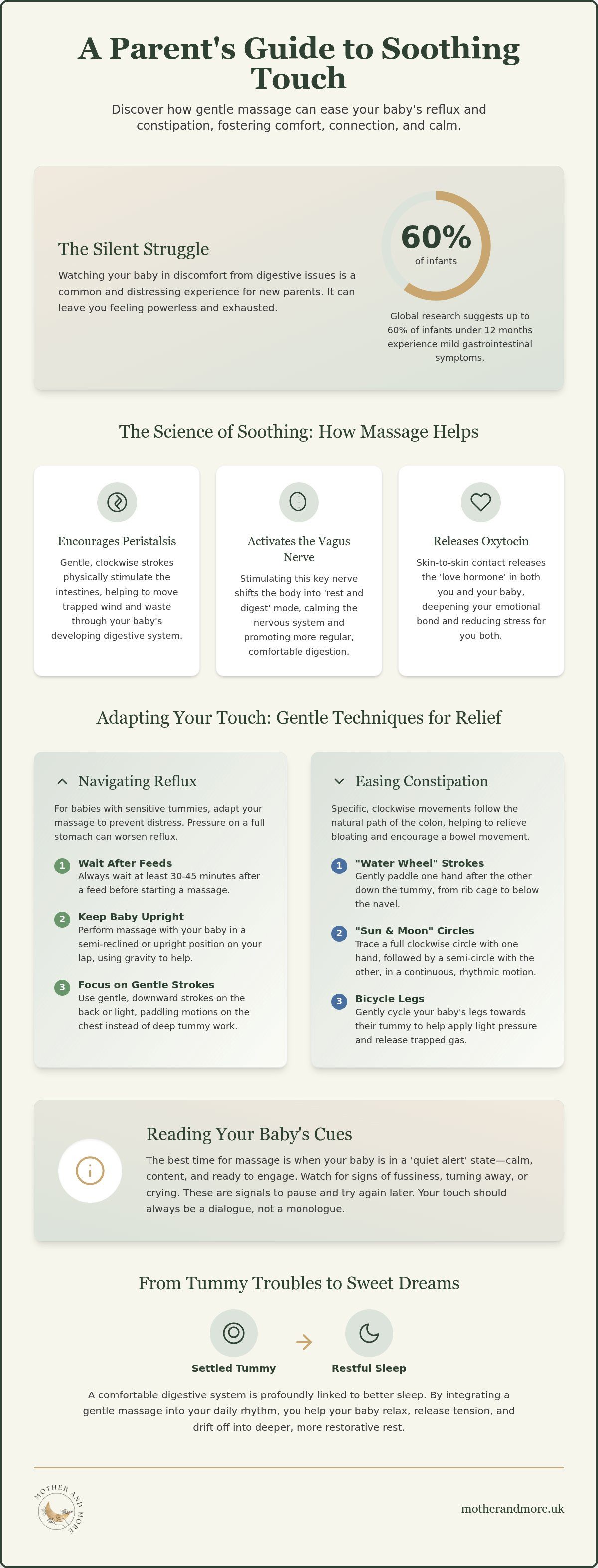
Navigating Reflux: Adapting Massage for Sensitive Tummies
Gastro-oesophageal reflux (GOR) is an incredibly common, though often distressing, experience for families. It occurs because the lower oesophageal sphincter, the tiny valve at the top of the stomach, is still maturing. This means milk can easily travel back up into the food pipe. For many infants, this is simply a physiological phase. Research suggests it affects between 40% and 65% of healthy babies, usually peaking at around 4 months of age. Whilst it's a normal part of development, it isn't always comfortable. Using baby massage for reflux requires a gentle, adapted approach that respects their sensitivity and keeps them feeling secure.
The biggest hurdle for parents is often the 'reflux dilemma'. Most traditional massage is performed whilst a baby lies flat on their back, yet for a baby with GOR, this position can trigger immediate discomfort. Lying flat allows stomach acid to rise more easily, leading to that familiar arching and fussiness. Timing is also paramount. The golden rule is to wait at least 30 to 45 minutes after a feed before starting any tummy-focused work. This gives the milk time to settle, reducing the risk of a 'spit-up' during your session. It's about finding that window of opportunity when they are comfortable and receptive.
You can still perform the 'I Love U' stroke by adapting it for a seated or semi-upright position. By supporting your baby against your chest or on your lap, you can gently trace the strokes whilst gravity helps keep their stomach contents where they belong. This modification ensures that baby massage for reflux remains a soothing experience rather than a stressful one. If you'd like to learn these adaptations in person, we invite you to join our East London baby massage classes for hands-on, expert guidance from a supportive community.
Reflux-Safe Positioning
Creating a safe space for a sensitive tummy means rethinking your traditional setup. Try using a nursing pillow to prop your baby up at a 45-degree angle, or nestle them into the crook of your legs whilst you sit on the floor. This elevation is key to their comfort. We also avoid deep abdominal pressure immediately after they've had milk. Instead, focus your touch on their chest and back. Rhythmic strokes down the spine can help relax the whole body. This relaxation helps the digestive sphincters to function more effectively without the interference of physical tension.
Silent Reflux and Massage
Silent reflux can be even more confusing for parents because there is no obvious 'sick'. You might simply see your baby arching their back, swallowing hard, or crying suddenly after a feed. These are biological signals of discomfort. Gentle baby massage techniques can help break the cycle of tension that often makes reflux symptoms feel more intense. Keep your movements slow, predictable, and incredibly soft. By maintaining a steady, rhythmic pace, you signal to their nervous system that they are safe. This allows their body to move out of a 'fight or flight' response and back into a state of ease.
Nurturing Your Confidence: The Mother and More Approach
Becoming a parent is perhaps the most significant transition you'll ever navigate. It's a shift from 'me' to 'mother and more', a journey that is as much about your own evolution as it is about your baby's growth. When you're faced with a fussy, uncomfortable infant, it's natural to feel your confidence waver. However, mastering a skill like baby massage for reflux offers more than just physical relief for your little one. It builds your maternal self-efficacy. It gives you a practical, loving way to respond to their needs, transforming feelings of helplessness into a sense of quiet authority and connection.
At Mother and More, we believe that your emotional state is the foundation of your baby's calm. Rebecca Beazley founded this space to bridge the gap between clinical advice and the lived emotional reality of new motherhood. By integrating life coaching principles into our sessions, we encourage you to be kind to yourself whilst you care for your child. You aren't just 'fixing' a digestive issue; you're nurturing a lifelong bond. This holistic focus is why we've been proud to support over 2,000 local families on their path to postnatal confidence.
Building this confidence often involves seeking out a wider network of professional support. For those who want to explore how specialised care can assist during the early weeks, you can visit Loving Touch Doulas to discover how professional doula services provide additional reassurance during the postnatal period.
Finding Sanctuary in East London
There is a unique power in 'finding your village'. Our in-person baby massage classes East London provide a sanctuary where you can step away from the noise of conflicting online advice. These sessions offer a non-judgemental space to share the reality of the 'digestive trenches' with others who truly understand. The role of our facilitators is to hold space for you, ensuring you feel seen and supported as you learn to soothe your baby's reflux. Many of our parents find that the friendships formed over a shared struggle with wind and sleep are the ones that last a lifetime.
Self-Care for the Nurturer
We often forget that the nurturer also needs nurturing. Whilst you're performing baby massage for reflux, try to incorporate simple breathing techniques for yourself. A long, slow exhale can settle your own nervous system, which in turn signals safety to your baby. It's also vital to acknowledge and release the 'mum guilt' that so often accompanies infant health struggles. You are doing an incredible job in a challenging season. For those looking to explore their identity further, our life coaching for mums UK offers a dedicated path to reclaiming your confidence and sense of self. Remember, you're not just a mother; you're a woman navigating a beautiful, complex transformation.
This transformation often requires dedicated time for your own physical and mental restoration. Seeking out expert wellness providers such as Body 'N' Balance can offer the professional support needed to recharge, with treatments that focus on both beauty and deep physiological relaxation to support your postnatal recovery.
Embracing a Calmer Future for You and Your Baby
You now possess the gentle tools needed to transform a season of digestive struggle into a rhythmic dialogue of healing. By adapting baby massage for reflux and mastering the clockwise flow of the ILU routine, you're actively supporting your infant's immature system. These techniques offer more than physical relief; they provide a sanctuary of calm for both of you. You've learned that your touch is a biological signal of safety, helping to regulate the Vagus nerve and encourage natural waste elimination whilst building your own maternal confidence.
We invite you to deepen this practice within a supportive community. Book your place at our next Baby Massage Course in East London to receive expert guidance from an accredited instructor. Having supported over 2,000 local families, we specialise in small, intimate group sizes that prioritise your peace of mind and your baby's comfort. You don't have to navigate these early months alone. We are here to help you find your village.
Trust in the power of your hands and the depth of your bond. You are doing a wonderful job, and brighter, more settled days are just a few strokes away.
Frequently Asked Questions
How often should I do baby massage for constipation?
You can practice baby massage for constipation once or twice a day when your baby is calm and receptive. Consistency is the most effective way to support an immature digestive system. A regular routine helps the body anticipate the rhythmic stimulation, which makes it much easier for waste to move through the large intestine naturally.
What is the best time of day to massage a baby with reflux?
The best time to practice baby massage for reflux is between feeds, ideally waiting at least 45 minutes after they have finished their milk. This window ensures the stomach contents have had time to settle, reducing the risk of triggering a spit-up. Many parents find a mid-morning or early evening session fits best into a soothing daily rhythm.
Can I use any oil for baby massage, or do I need something specific?
You should use a pure, cold-pressed vegetable oil rather than mineral-based or heavily scented products. Oils such as sunflower, coconut, or grapeseed are incredibly gentle on delicate skin and safe if your baby happens to suck their fingers. We always recommend performing a small patch test on their leg 24 hours before your first full session to ensure no sensitivity.
My baby cries during massage; should I keep going to help their constipation?
You must stop the massage immediately if your baby begins to cry or shows signs of distress. Massage is a dialogue based on trust and consent; forcing a technique when they are unhappy can create a negative association with touch. Instead, offer a reassuring cuddle and try again when they are in a more settled, 'quiet alert' state.
Is baby massage safe for newborns, or should I wait until they are older?
Baby massage is safe from birth, though we recommend keeping sessions very short and gentle in the first few weeks. Newborns have sensitive nervous systems and can easily become overstimulated by too much touch. Focus on soft, feather-like strokes and simple skin-to-skin contact until they reach around six weeks of age, when their digestive systems are slightly more robust.
How long does it take for massage to help a baby poo?
It can take anywhere from a few minutes to several hours for a massage to encourage a bowel movement. Some babies respond almost immediately to the 'I Love U' stroke, whilst others may need a few consistent daily sessions before their system finds its rhythm. Every infant is unique, so patience and a gentle approach are your best tools for success.
Can baby massage help with silent reflux as well as regular reflux?
Yes, baby massage for reflux is highly beneficial for silent reflux as it helps break the cycle of physical tension. Even without visible sick, silent reflux can cause significant internal discomfort and back arching. Rhythmic touch encourages the body to move into a 'rest and digest' state, which helps the entire gastric system function more smoothly and comfortably.
Do I need to take a professional course to learn these techniques safely?
Whilst you can learn basic strokes at home, joining a professional course ensures you are performing techniques safely and with the correct pressure. An accredited instructor can help you adapt movements for your baby's specific needs, such as reflux-safe positioning. It also provides a wonderful opportunity to build your village and connect with other local parents in a supportive environment.



Comments