

Baby Massage for Teething Relief: A Nurturing Guide
It's 3 am, and the rhythmic creak of the nursery chair is the only sound in the house whilst your little one sobs against your shoulder. You have tried the chilled rings and the endless cuddles, yet that persistent teething ache remains, leaving you feeling helpless and deeply exhausted. It's a heavy, lonely feeling when you just want to take their pain away. Using baby massage for teething relief offers a way to move through these difficult nights with a gentle, holistic tool that focuses on connection rather than just clinical fixes.
I know how much you long for a calmer, more settled baby and the confidence to know exactly how to help them. This guide will show you how to use soothing facial strokes and specific reflexology points to ease gum tension and encourage relaxation. We will explore how these nurturing movements can strengthen your bond whilst providing much-needed comfort. You will also find the latest 2026 safety advice on which remedies to avoid, ensuring your parenting toolkit is both effective and beautifully safe.
Table of Contents
Understanding the "Teething Season" and the Power of Touch
The "teething season" usually begins between 4 and 7 months, though every little one follows their own unique rhythm. You might notice flushed cheeks, a sudden increase in dribbling, or a desperate need to chew on everything in sight. It's a transformative time. the process of teething can feel like a marathon for both of you, especially when sleep becomes a distant memory. This is where baby massage for teething relief becomes a sanctuary of calm amongst the chaos. It offers a way to soothe the physical ache whilst providing the emotional security your baby craves during this big developmental shift.
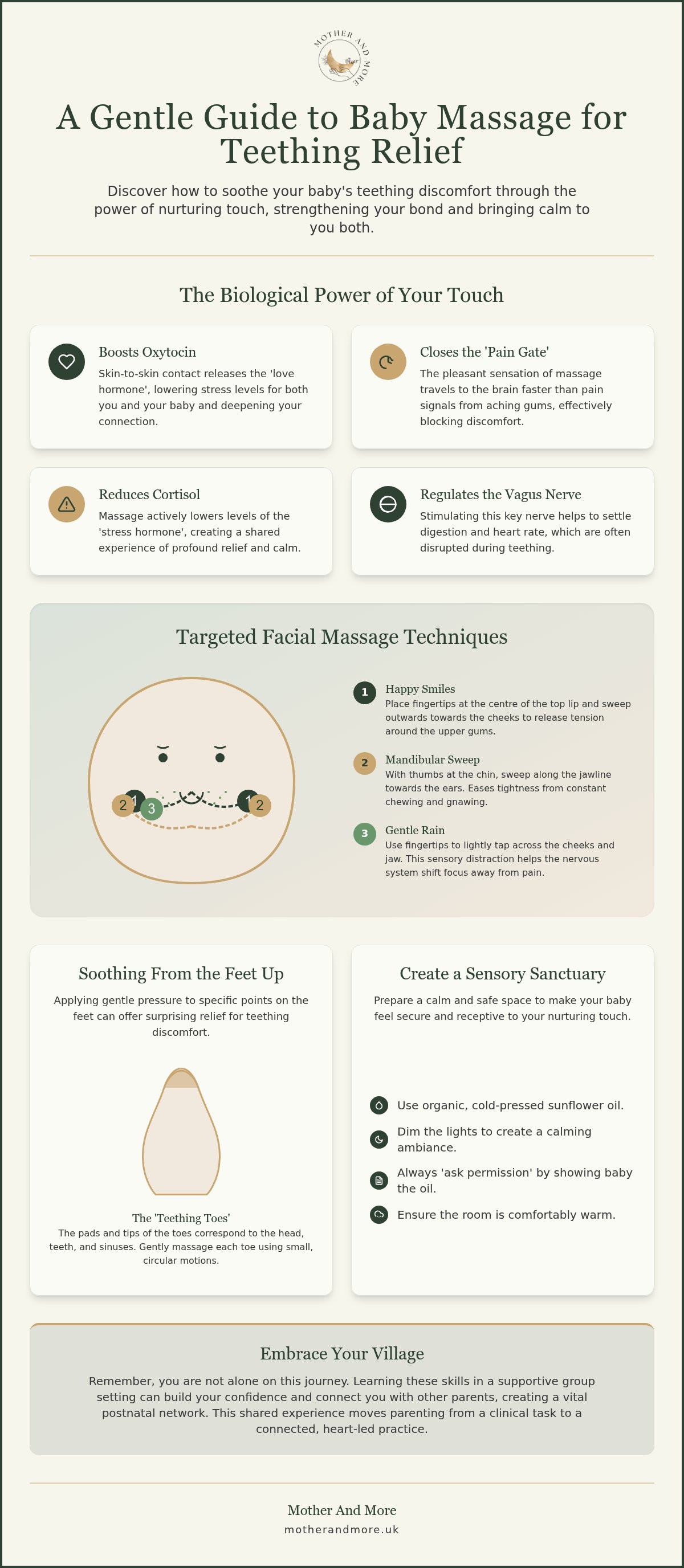
When you place your hands on your baby, something magical happens. Skin-to-skin contact triggers the release of oxytocin, often called the "love hormone." This beautiful chemical lowers cortisol levels, the body's stress signal, for both you and your baby. It's a shared experience of relief. Instead of feeling helpless as you watch them struggle, you are actively participating in their comfort. This nurturing touch is a powerful, natural alternative to clinical gels, focusing on the deep bond between parent and child.
The Biological Connection: How Touch Blocks Pain
Physical touch does more than just soothe the soul; it actually changes how the brain perceives discomfort. Think of it like a "gate" in the nervous system. When you massage your baby, the pleasant sensations of your touch travel faster to the brain than the slow throb of aching gums, effectively closing the gate on pain. Massage also stimulates the vagus nerve, which helps regulate digestion and heart rate, both of which can be unsettled during teething. Co-regulation is the heart of this process, where your steady, calm presence acts as a lighthouse, helping to settle your baby’s overwhelmed nervous system.
Why Traditional Teething Remedies Benefit from Massage
Whilst rings and toys have their place, they are often external fixes for an internal distress. Using baby massage for teething relief creates a state of deep receptivity, making your baby more likely to accept a chilled teething ring or settle into a nap. It is about creating a safe space first. Before you begin, always "ask permission" by showing your baby the oil and watching for their cues. A simple signal, like rubbing your hands together or a specific gentle word, tells them that a moment of nurturing is about to begin. This respects their autonomy and builds a foundation of trust that lasts a lifetime.
Facial Massage Techniques for Targeted Teething Relief
The face is where your baby carries the weight of their teething discomfort. It is also the centre of their communication with you. When you use baby massage for teething relief on these delicate areas, you are doing more than just easing a physical ache. You are offering a reassuring, steady presence. Start by ensuring your hands are warm and your touch is whisper-light. Always maintain soft eye contact. This helps your baby feel safe and seen whilst you work, turning a moment of distress into one of deep connection.
The "Happy Smiles" stroke is a beautiful place to begin. Place your fingertips at the centre of the top lip and sweep outwards towards the cheeks, as if drawing a wide smile. This movement helps to gently stretch the tissues around the gums where pressure often builds. Following this, try the "Gentle Rain" technique. Use your fingertips to lightly tap across the cheeks and jawline. This rhythmic sensation acts as a sensory distraction. It helps the nervous system to shift its focus away from the throb of the gums. To Soothe Your Baby's Discomfort effectively, keep your movements slow and intentional, avoiding the eyes and nose entirely.
Soothing the Jaw and Gums
The mandible, or lower jaw, often becomes incredibly tight from the constant need to chew and gnaw. You can help release this tension with the "Mandibular Sweep." Place the pads of your thumbs at the centre of the chin and sweep along the jawline towards the ears. You might feel a slight resistance near the Temporomandibular Joint (TMJ). This is the small hinge located just in front of the ear canal. Because babies use these muscles so intensely during the teething phase, the TMJ can become quite tender. Using gentle, circular rotations with your thumb pads here can provide profound relief and help your baby relax their jaw.
Relieving Sinus Pressure and Congestion
Many parents notice that teething often comes with a runny nose or slight congestion. This happens because the inflammation in the gums can affect the surrounding sinus passages. The "Eyebrow Stroke" is a wonderful way to address this. Starting at the bridge of the nose, sweep your fingers along the eyebrows towards the temples. It’s a soothing, grounding movement. However, facial massage is very intimate. If your baby turns their head away, becomes restless, or starts to fuss, it is a clear signal to pause. Respecting these boundaries is a vital part of the nurturing process. If you’d like to explore these techniques in a supportive space, our baby massage courses offer a sanctuary to learn and grow together.
Reflexology Points: Soothing Teething from the Feet Up
Sometimes, when your baby's mouth is too sore to touch, the feet offer a gentle "back door" to relief. Reflexology operates on the beautiful principle that our feet act as a map for the entire body. By applying gentle pressure to specific points, you can send signals of comfort to the areas that need it most. This is particularly useful when using baby massage for teething relief because it allows you to soothe their pain without needing to go near their sensitive gums. It is a quiet, rhythmic language of love spoken through your fingertips.
The most important areas to explore are the "Teething Toes." The tips and sides of all ten little toes correspond directly to the upper and lower gums. Additionally, the "Jawline Reflex" sits on the tops of the feet, located in the fleshy area just below where the toes meet the foot. Working this area can help release the physical tension that builds up from constant chewing and gnawing. Finally, the Solar Plexus point, nestled right in the centre of the foot just below the ball, is the ultimate "reset button" for a frazzled, overstimulated nervous system.
The "Toe-Tip" Technique for Gum Pain
To support your baby through a particularly rough patch, focus your attention on the very tips of their toes. You can use a "caterpillar walk" movement, where you inch your thumb across the tip of each toe, or a very gentle, static thumb press. Pay special attention to the big toe. It holds the reflex for the upper jaw and the head area, which is often where the most intense pressure is felt during the teething process. Aim for about 10-20 seconds on each toe. It is a slow, methodical process that invites your baby to breathe and soften into your touch.
Calming the Nervous System via the Feet
Teething isn't just about physical pain; it’s about the irritability and exhaustion that come with it. Locating the "Calm Point" (Solar Plexus) helps reduce that prickly sense of being overwhelmed. Gently press your thumb into the centre of their sole and hold it for a few deep breaths. You can also try "Ankle Circles," cupping the heel and rotating the foot very slowly to promote circulation and a feeling of groundedness. These techniques are perfect for integrating into a baby massage for sleep routine. It helps transition your little one from a state of high alert to one of quiet peace before bed.
By focusing on the feet, you are giving your baby’s face a rest whilst still providing significant baby massage for teething relief. It is a holistic approach that acknowledges how the whole body is connected. This rhythmic, grounding work can be done anywhere, from the changing mat to the sofa, making it a versatile tool in your parenting toolkit. It’s about finding those small, intentional pockets of peace amongst the challenging days, helping you both feel more settled and secure.
Creating a Soothing Environment for Teething Relief
A successful session of baby massage for teething relief depends as much on the space you create as the strokes you use. When a baby is in pain, their nervous system is already on high alert. Reducing "sensory noise" is essential. Dim the lights, turn off the television, and perhaps play some soft, rhythmic music. This allows your baby to focus entirely on the sensation of your touch. It’s about creating a sanctuary where the outside world fades away, leaving just the two of you in a bubble of safety and calm.
Your own state of mind is equally important. Babies are incredibly sensitive to our energy. If you are feeling frazzled or tense, they will pick up on that vibration. Before you begin, take a few moments for the "Parental Breath." Deep, slow inhalations signal to your own body that you are safe, which in turn signals safety to your baby. Timing also matters. Try to avoid massaging when your baby is very hungry or immediately after a large feed. Finding that "quiet alert" state ensures they are receptive to the nurturing work you are about to do.
The Best Oils for Facial Massage
When working so close to the mouth and nose, the quality of your oil is paramount. Avoid mineral oils or anything heavily scented, as these can be irritating or overwhelming for a sensitive baby. Organic, cold-pressed vegetable oils like sunflower or safflower are ideal. They are edible, safe, and light on the skin. Always conduct a patch test on a small area of your baby's arm 24 hours before a full massage to ensure skin compatibility. Remember, "less is more" when it comes to facial work. You want just enough glide to prevent dragging the skin without making it too slippery to maintain control.
Self-Care for the Teething Parent
The sound of "teething screams" can be deeply triggering, often leaving parents feeling exhausted and emotionally drained. It is okay to acknowledge that this phase is hard. Whilst you are performing the massage, try simple grounding exercises, like feeling the weight of your feet on the floor. If you find yourself feeling consistently overwhelmed by the shifts in your identity or the demands of motherhood, exploring life coaching for mums uk can provide the deeper postnatal support you deserve. Taking care of yourself is not a luxury; it is the foundation of your ability to care for your little one.
Learning these techniques in a supportive environment can make all the difference to your confidence. If you are looking for a guided experience to master these skills, our in-person baby massage courses offer a premium, sensory space to connect with your baby and other local parents.
Finding Your Village: Why In-Person Classes Make a Difference
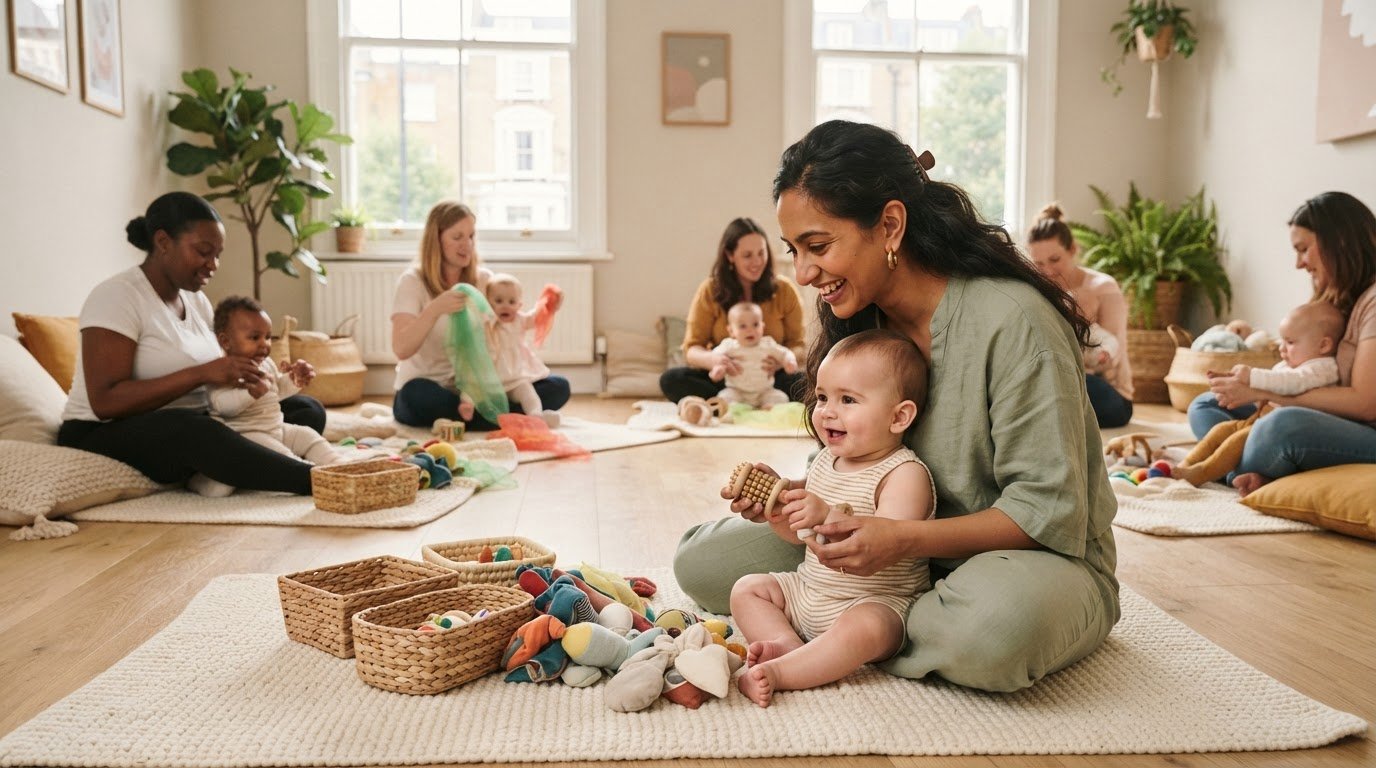
Whilst digital guides offer a wonderful starting point, there is an irreplaceable magic in learning baby massage for teething relief within a physical community. Teething can be a lonely, isolating experience. It often leaves you feeling tethered to your home and drained by broken sleep. Stepping into a warm, sensory space changes the narrative. It is the moment you look across the room, catch the eye of another parent, and feel that profound "it is not just me" realisation. This shared experience is the heartbeat of a true village.
Professional guidance ensures that your journey is both effective and safe. In a guided session, an instructor demonstrates techniques on a doll, allowing you to remain the sole expert on your own baby. This setup provides the space to refine your pressure and rhythm under a watchful, supportive eye. You gain the confidence to know that your touch is exactly what your baby needs. In East London, we have supported over 2,000 local families, creating a sanctuary where parents can reclaim their calm amongst the challenges of early parenthood.
What to Expect in a Mother And More Class
Our sessions are far more than a technical workshop; they are a premium, sensory embrace for both of you. We blend the physical art of massage with gentle yoga and honest, heart-to-heart conversations about the realities of motherhood. We believe that your identity and wellbeing are just as important as your baby's development. If you are looking for a local resource to start this journey, our baby massage classes east london provide the perfect environment to learn and grow.
Beyond Teething: A Holistic Postnatal Journey
The skills you learn today for baby massage for teething relief are the foundation for a lifetime of connection. As your little one grows, these strokes evolve into yoga and playful movement, supporting their physical milestones and emotional intelligence. Early bonding through touch has long-term benefits for child behaviour, creating a secure attachment that lasts well beyond the nursery years. To explore this complete support system, consider joining a mother and baby wellness class. It is an invitation to walk a path of self-discovery and empowerment alongside your child, supported by a mentor who understands every step of the way.
Embracing a Calmer Path Through Teething
The journey through the "teething season" doesn't have to be a lonely one. By integrating gentle facial strokes and targeted reflexology into your daily rhythm, you are doing more than just soothing sore gums. You are building a foundation of trust and emotional security that will last a lifetime. Using baby massage for teething relief allows you to transform moments of distress into opportunities for deep, nurturing connection. You now have a toolkit of techniques, from the "Happy Smiles" stroke to the "Teething Toes" reflexology points, to help your little one find peace.
At Mother And More, we have supported over 2,000 local families in finding their own sanctuary amongst the challenges of early parenthood. Our small, nurturing groups in the heart of East London are led by accredited life coach Rebecca Beazley; ensuring you receive both professional expertise and a warm, supportive presence. You deserve a space where you can reclaim your confidence whilst bonding with your baby. 🌸
Book your place at our next Baby Massage Course in East London and join a community that truly understands. You are doing a wonderful job, and we are here to walk alongside you.
Frequently Asked Questions
Is baby massage safe for a baby who is currently cutting a tooth?
Yes, baby massage is perfectly safe and highly recommended during the teething phase. It provides a natural way to manage discomfort without relying solely on medicinal interventions. Whilst you should avoid applying direct, heavy pressure to very inflamed gums, gentle facial strokes and reflexology help to soothe the nervous system. This holistic approach encourages your baby to relax, making the physical sensation of a tooth cutting through feel less overwhelming.
How often should I perform massage for teething relief?
You can use baby massage for teething relief as often as your little one finds it comforting. Many parents find that two or three short sessions a day work best, particularly during a difficult flare-up. You don't need to commit to a long routine; even five minutes of focused, rhythmic touch can make a world of difference. Consistency is key, as it helps your baby recognise the signals for relaxation and rest.
What is the best oil to use for massaging a baby’s face?
The best choice for facial work is an organic, cold-pressed vegetable oil such as sunflower or safflower oil. These oils are light, odourless, and safe if a small amount accidentally reaches your baby's mouth. Avoid mineral oils or heavily scented products, as these can be irritating to sensitive skin and overwhelming for a baby's delicate senses. Always remember to perform a patch test 24 hours before your first full session to ensure total compatibility.
Can I use reflexology on my baby’s feet for teething pain?
Reflexology is an incredible tool for teething, especially if your baby's face feels too tender for direct touch. By gently working the tips of the toes, you can stimulate the reflex points that correspond to the upper and lower jaws. It is a wonderful way to provide relief from a distance. Many parents find this particularly effective during evening "witching hours" when a baby might be too overstimulated for facial massage.
What should I do if my baby starts crying or rooting during the massage?
If your baby starts to cry or shows signs of rooting, you should pause the massage immediately and attend to their needs. Rooting is a clear signal of hunger, whilst crying is their way of telling you they have had enough sensory input for now. Respecting these boundaries is vital for building a foundation of trust. You can always try again later when they are in a "quiet alert" state and more receptive to touch.
Can baby massage help with the sleep problems caused by teething?
Yes, baby massage for teething relief is highly effective at improving sleep quality during this challenging developmental stage. The rhythmic strokes help to lower cortisol levels and boost oxytocin, which naturally prepares the body for rest. By easing the physical tension in the jaw and face, your baby is more likely to settle into a deeper, more restorative sleep. It is a beautiful way to transition from the day's discomfort into a peaceful night.
Are there any times when I should avoid massaging my teething baby?
You should avoid massage if your baby has a fever, an undiagnosed rash, or has had immunisations within the last 48 hours. It is also best to wait at least 45 minutes after a feed to prevent any tummy discomfort. If your baby is clearly distressed or pushing your hands away, honour their communication and stop. Massage should always be a pleasurable, bonding experience for both of you, never something that feels forced.
How long does it take for baby massage to show results for teething?
Many parents notice an almost immediate calming effect, with their baby's breathing slowing and their body softening within minutes. However, the cumulative benefits of massage build over time as your baby learns to associate your touch with safety and relief. With regular practice, your baby's relaxation response will become quicker. You are not just fixing a temporary problem; you are teaching them how to regulate their own nervous system for the long term.


Comments