

Baby Yoga for Motor Skills: A Nurturing Guide to Your Infant's Physical Development
Updated: Jul 13
You find yourself on the living room rug, watching your little one reach for a favourite toy, and a tiny flicker of worry settles in your chest. Are they moving enough? Is their neck strength where it should be? It's a feeling so many of us share during those long, quiet afternoons at home. We want to help them grow, yet the fear of doing too much or using the wrong technique can feel heavy. 🌸 Integrating baby yoga for motor skills into your daily rhythm isn't just about physical milestones; it's a soft, intentional way to say "I'm here" through the rhythmic language of touch.
I understand that deep desire to feel confident in your parenting intuition whilst navigating the complexities of your new identity. You deserve a space where expertise meets empathy, far away from clinical charts and comparison. In this guide, we'll explore gentle, safe movements designed to support sitting and crawling. You'll discover how these playful stretches can build your baby's physical foundation and, perhaps more importantly, create a beautiful emotional sanctuary for you both to thrive within.
Table of Contents
Understanding Baby Yoga for Motor Skills: More Than Just Gentle Stretches
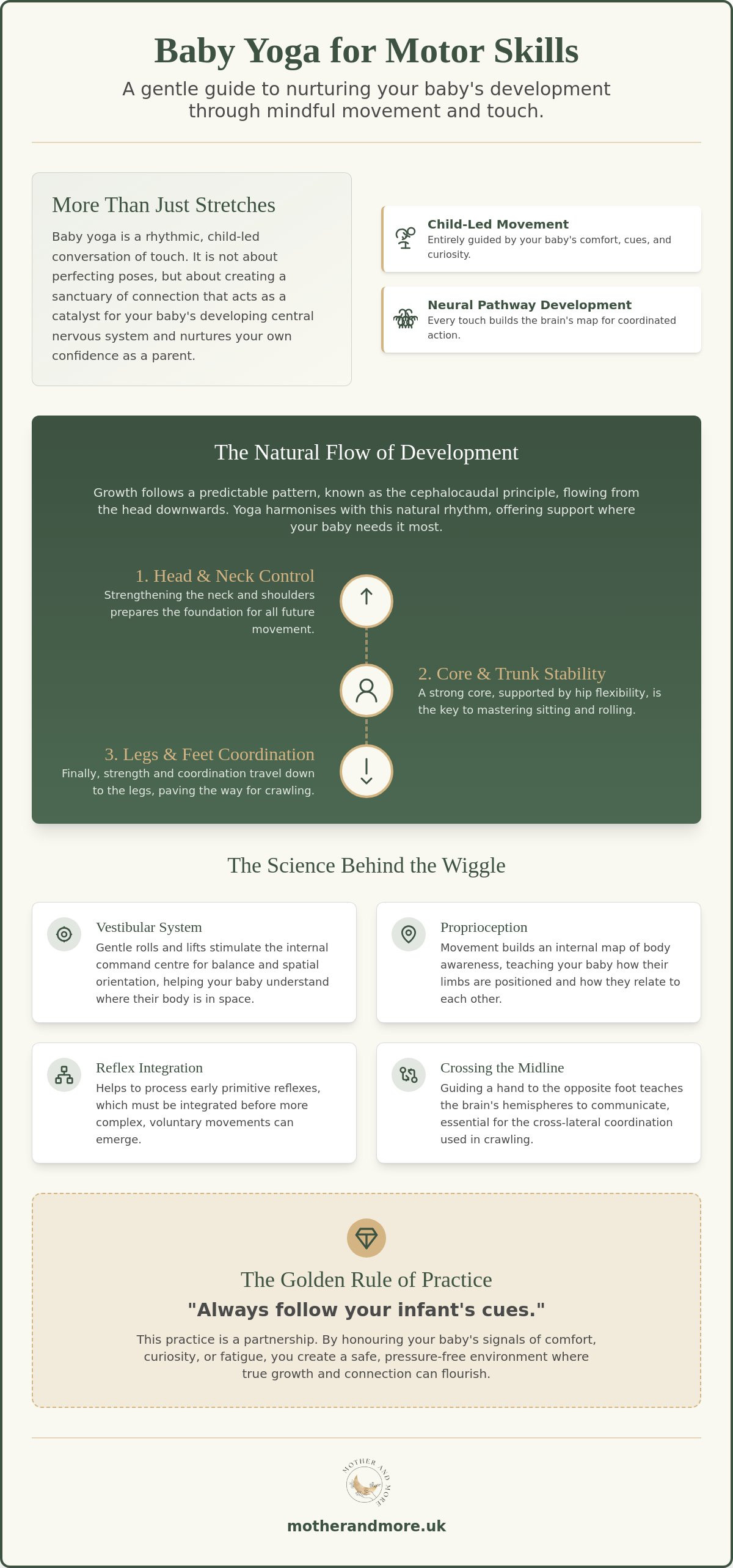
At its heart, baby yoga is a rhythmic, child-led dialogue between you and your infant. It's a conversation of touch. Unlike the structured classes you might attend yourself, this practice is entirely guided by your baby's cues, comfort, and curiosity. It's about presence. By using baby yoga for motor skills, you're not just helping your little one move; you're acting as a catalyst for their developing central nervous system. Every gentle stroke and guided stretch sends a message to the brain, building the neural pathways that will eventually lead to those big milestones like rolling, sitting, and crawling.
In a world where babies often spend long periods in "containers" such as car seats, bouncers, or strollers, yoga offers a vital window of active play. These moments of floor-based movement are essential for physical freedom. As your baby's core strengthens through these playful interactions, something beautiful happens to you as well. That lingering anxiety about whether they're "on track" begins to soften. You start to trust your own hands and your baby's unique pace. The practice becomes a sanctuary where your confidence as a parent grows alongside your baby's physical strength.
The Science of Sensory-Motor Development
Every gentle roll or lift in a yoga session stimulates the vestibular system, which is the internal command centre for balance and spatial orientation. This is a fundamental part of motor skill development, helping your baby understand where their body ends and the world begins. Through rhythmic movement, we also support:
Proprioception: Building an internal map of body awareness and limb position.
Reflex Integration: Helping to process early primitive reflexes, such as the tonic neck reflex, which must be integrated before complex movements can emerge.
Neurological Mapping: Using repetitive, rhythmic motion to hardwire the brain for coordinated action.
Nurturing the Bond Through Movement
At Mother and More, we believe that eye contact and vocal encouragement are not just "extras"; they are the "yoga" itself. When you look into your baby's eyes and mirror their expressions, you're co-regulating their nervous system. This creates a deep sense of safety, which is the only state in which true learning and physical growth can occur. It's a holistic approach that acknowledges the shifts in your own identity too.
These sessions aren't just about the baby's hamstrings or core; they're about your postnatal recovery and emotional well-being. By focusing on emotional intelligence and the "village" aspect of parenting, we ensure that the practice feels like a reassuring embrace. It's a space where you can breathe, connect, and rediscover yourself whilst supporting your baby's journey toward their first independent steps.
Building Foundations: How Baby Yoga Supports Gross Motor Development
Infant growth follows a beautiful, predictable blueprint known as the cephalocaudal pattern. This means development naturally flows from the head downwards to the toes. First, your baby masters neck control, then the strength moves into the shoulders and trunk, and finally down to the legs and feet. Using baby yoga for motor skills allows us to work in harmony with this biological rhythm. It offers gentle resistance and support exactly where your baby is currently growing. By focusing on the shoulder girdle and neck through guided poses, we're preparing the physical foundation they'll need for the eventual transition into crawling.
Hip flexibility and pelvic stability are equally vital, acting as the silent heroes of the sitting milestone. Without a supple range of motion in the hips, finding that upright balance point can feel frustrating for a little one. Yoga helps here by encouraging gentle, rhythmic movements that open the hips and stabilise the pelvis. This strength is what allows a baby to move confidently from "tummy time" into their first rolls. It's a journey of building core power through play, ensuring they have the strength to support their own weight as they begin to explore the world from a new perspective.
Strengthening the Core for Sitting and Crawling
During our sessions, we often explore "diagonal" movements, such as gently guiding a hand towards the opposite foot. These patterns are essential for brain development. They prime the nervous system for the cross-lateral coordination your baby will eventually use to crawl. We also practice a gentle "bridge" pose for babies, which encourages healthy spinal alignment and builds strength along the posterior chain. Core stability is the anchor for all future gross motor skills, providing the steady base from which every other movement grows.
Balance and Spatial Awareness
When we sway, lift, or gently tilt our babies during a yoga sequence, we're helping them map their centre of gravity. This practice supports physical development by stimulating the vestibular system, which is the body's internal compass for balance. Interestingly, physical balance is often deeply linked to emotional regulation. A baby who feels secure and "centred" in their body is often better equipped to navigate the big emotions that come with early childhood. This holistic connection is a cornerstone of our baby yoga east london curriculum. If you'd like to experience this nurturing approach first-hand, joining one of our Baby Yoga Classes is a wonderful way to find your village whilst supporting your baby's growth.
The Fine Details: Dexterity, Coordination, and Sensory Processing
Whilst the big movements like rolling and crawling often steal the spotlight, the smaller, more intricate actions are just as transformative. It’s a fascinating ripple effect. Your baby’s ability to pick up a tiny crumb or point at a favourite book begins much further back than their fingertips. It starts in the shoulders. Without the stability of a strong shoulder girdle, which we nurture through baby yoga for motor skills, the hands don't have the steady base they need to operate. By strengthening the "gross" foundation, we're actually unlocking the "fine" potential of their dexterity.
Bilateral coordination is another quiet miracle we practice on the mat. When you guide your baby to move both arms or both legs in a symmetrical, rhythmic fashion, you're teaching their brain to organise and sequence information. This isn't just physical exercise; it's a sensory-rich experience. Adding songs and varied textures into the mix helps refine their hand-eye coordination, turning a simple stretch into a multi-dimensional learning moment. It’s about more than just movement; it’s about helping your baby feel "at home" in their own skin.
Crossing the Midline: Why it Matters
Crossing the midline is the ability to move a hand or foot across the centre of the body to the opposite side. It sounds simple, but it’s a vital neurological bridge. This action forces the two hemispheres of the brain to communicate, laying the groundwork for complex future skills like reading, writing, and even getting dressed. In our classes, we use "cross-over" stretches, gently bringing a hand to the opposite knee. This doesn't just support physical growth; it encourages the cognitive links that help your baby process the world as one integrated whole.
Sensory Integration and Tactile Awareness
The mat is a landscape of discovery. Skin-to-skin contact and the feel of different fabrics during yoga help your baby develop a healthy tactile sense. For some infants, the world can feel a little overwhelming or "too loud" in a sensory way. Gentle, predictable yoga movements provide a safe way to process touch and motion at their own pace. This focus on sensory harmony is why many parents find baby massage for relaxation such a beautiful companion to their yoga practice whilst they navigate these early months. Both offer a sanctuary where touch becomes a tool for calm, confidence, and connection.
A Gentle How-To: 5 Baby Yoga Poses to Practise at Home
Creating a sanctuary for movement at home doesn't require a dedicated studio or expensive equipment. It's about the atmosphere you cultivate amongst the laundry piles and the daily rhythm of your home. Find a warm, quiet corner where you can spread a soft blanket on the floor. Dim the lights if the afternoon sun is too bright; put your phone on silent. This is a time for you to truly arrive. Before you begin, take a deep, grounding breath. Centre yourself first, because your baby mirrors your energy. When you feel calm, your baby feels safe to explore.
The "Golden Rule" of baby yoga for motor skills is simple: your baby is the teacher. This is a rhythmic dialogue, not a forced exercise routine. Always follow your baby's cues. If they turn their head away, become fussy, or seem over-stimulated, we stop. We respect their "no." Integrating these gentle movements into your evening can also be a beautiful bridge to rest. Many parents find that these poses fit perfectly within a baby yoga for better sleep routine, helping to settle the nervous system before bed. ✨
The Step-by-Step Home Routine
1. The 'Sunbeam' Stretch: Gently guide your baby’s arms out to the sides in a wide "V" shape. This encourages chest expansion and deeper breathing, helping them feel open and relaxed.
2. 'Happy Baby' (Ananda Balasana): Whilst your baby is on their back, gently bring their knees towards their chest and hold their feet. This classic pose is wonderful for hip flexibility and can help relieve trapped wind.
3. The 'Little Tiger' (Tummy Time Yoga): Place your baby on their tummy with their forearms supporting them. Encourage them to look up at your face or a favourite toy to strengthen the neck and back muscles.
4. 'Bicycle Legs': Gently pedal your baby's legs in a slow, rhythmic motion. This supports lower body coordination and is a favourite for aiding digestion.
5. The 'Gentle Sway': With your baby securely in your arms or lying on a blanket, move them slowly from side to side. This develops the vestibular system and provides a soothing, grounding sensation. 🌿
Tips for a Successful Session
Timing is everything when it's time to practise baby yoga for motor skills. It's best to avoid yoga immediately after a feed to prevent spit-up; wait at least 30 to 45 minutes. Similarly, if your baby is already over-tired or hungry, the mat won't feel like a sanctuary. Use your voice as a tool for connection. Singing a favourite nursery rhyme or narrating the movements in a low, soothing tone makes the experience engaging and predictable for them. Observe more, do less; this simple shift allows your baby the space to lead their own physical discovery. If you would like to deepen this connection in a supportive group environment, you can explore our local Baby Yoga Classes to find your village.
Finding Your Village: Why In-Person Baby Yoga Classes in East London Make a Difference
The shift into motherhood is perhaps the most profound transformation you'll ever navigate. It's a time of immense beauty but also of quiet shifts in who you are. Whilst your baby is busy learning to roll and reach, you are busy becoming a mother. For many, simply getting out of the house with a nappy bag and a newborn feels like a milestone in itself. It is a brave, vital step toward reclaiming your world and finding your feet in this new landscape. 🌿
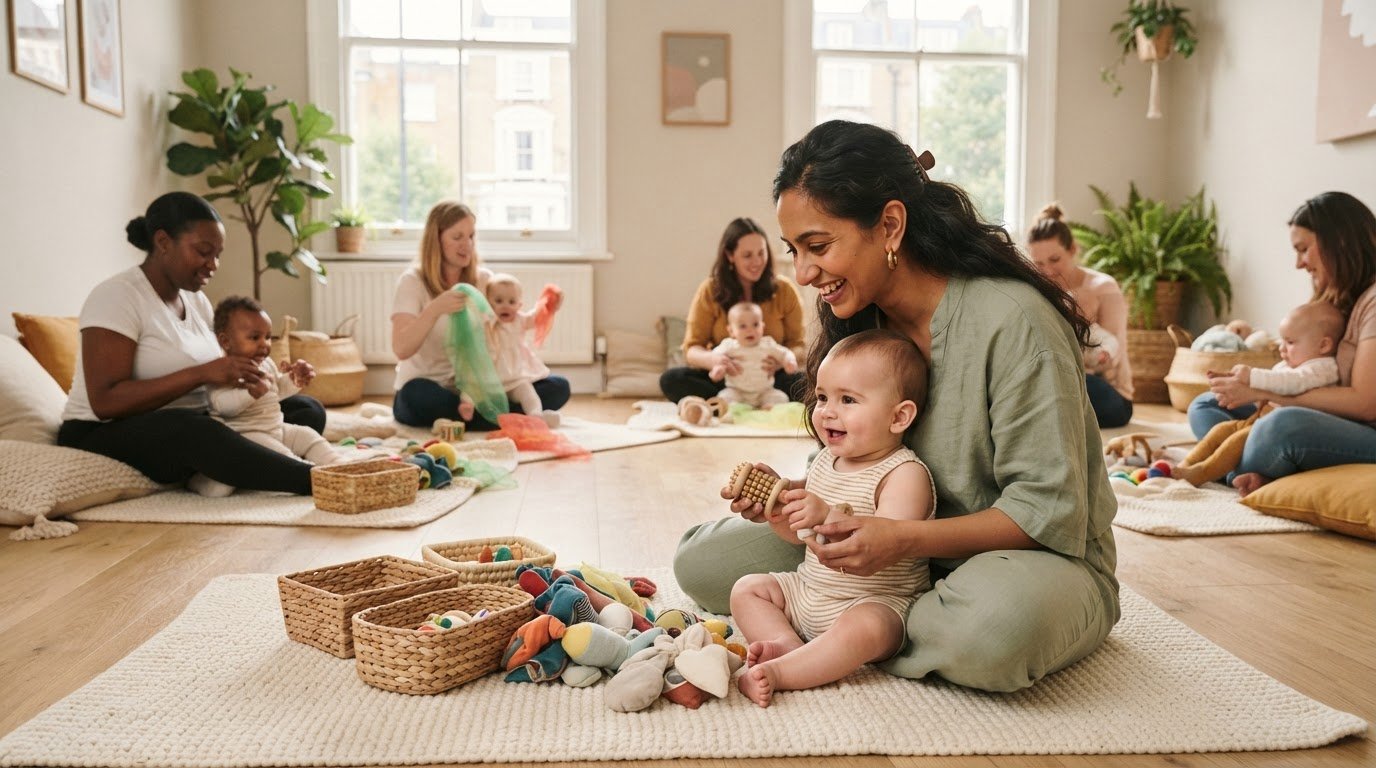
At Mother and More, our classes in Hackney and Walthamstow Village are designed to be a sanctuary. They offer a soft place to land amongst the noise of new parenthood. Under the expert guidance of Rebecca Beazley, an accredited life coach and former social worker, you'll find a space where your baby’s physical progress is celebrated without the pressure of "keeping up". Practising baby yoga for motor skills in an in-person setting allows for real-time adjustments and the reassurance that you are doing exactly what your baby needs. We have supported over 2,000 local families in East London, helping parents identify developmental stages whilst honouring their own emotional journey.
Beyond the Physical: Emotional Support for You
It’s about more than just physical milestones. For many of our members, these classes act as a gateway to wellbeing coaching for new mums uk, providing a bridge between infant care and maternal self-care. We speak openly about the heavy weight of "mum guilt" and the anxiety that often comes when we compare our baby's progress to others. In our sessions, you'll find a non-judgmental, inclusive environment where shared experiences become the foundation of lasting friendships. You are not alone in the middle-of-the-night worries or the afternoon fatigue; your village is right here.
What to Expect in a Mother and More Class
Every session is a thoughtful blend of infant development, maternal relaxation, and genuine social connection. We keep our class sizes small. This ensures that you receive individual attention and that every movement is performed safely and with confidence. You can expect:
Expert Guidance: Professional insights into your baby's physical milestones and your own postnatal recovery.
A Calm Atmosphere: A premium, intentional space that feels like a reassuring embrace.
Community Connection: Time to chat, share, and build a local support network in East London.
Whether you are looking for baby yoga for motor skills or a place to simply "be" with your infant, we invite you to join us. Our community is waiting to welcome you. To begin your journey and find the support you deserve, you can browse our current Baby Yoga Classes and book your place in our next term. ✨
Your Path to Confident Parenting and Connection
You've taken a beautiful first step today by exploring how baby yoga for motor skills can transform your daily rhythm. It's a journey that moves far beyond physical milestones; it's about the rhythmic dialogue of touch that deepens your bond. You now understand that core stability acts as the anchor for every future movement, and that your own intuition is the most powerful guide you have. 🌸
At Mother and More, we believe you shouldn't have to navigate this transition in isolation. Our inclusive and nurturing environment has already supported over 2,000 London families, providing a safe space to grow together. Led by accredited life coach and baby expert Rebecca Beazley, our sessions offer the professional guidance you need to celebrate your baby's unique pace whilst rediscovering your own identity. You deserve a village that holds you as much as you hold your baby. ✨
Book your place in our next Baby Yoga course in East London
We can't wait to welcome you into our community and watch you both thrive.
Frequently Asked Questions
Can baby yoga really help my baby crawl sooner?
Baby yoga doesn't necessarily force a baby to crawl sooner, but it ensures they have the physical readiness to do so when they are ready. By focusing on baby yoga for motor skills, we strengthen the core and shoulder girdle. This provides the stability required for cross-lateral movement. Our goal is to support a healthy developmental path rather than rushing a specific date on a calendar.
How often should I practise baby yoga for motor skills at home?
Integrating short bursts of 5 to 10 minutes into your daily rhythm is far more effective than one long session. You might find that a few gentle stretches during a nappy change or before a bath work best. Consistency helps your baby become familiar with the movements. It turns these playful exercises into a predictable and soothing part of their day whilst building their strength.
Is baby yoga safe for newborns, or should I wait until they are older?
It's generally best to wait until your baby has had their 6 to 8-week postnatal check before starting a formal practice. Whilst very gentle touch is wonderful from birth, their spine and joints need time to settle first. Waiting ensures that both you and your little one are physically ready to enjoy the movements safely and comfortably, allowing you to focus on bonding during those early weeks.
What should my baby wear for a yoga session?
Soft, stretchy clothing that allows for a full range of motion is the best choice for your little one. A simple cotton bodysuit or a well-fitting sleepsuit works perfectly for most sessions. We recommend keeping their feet bare during the class. This allows them to use their toes for sensory feedback and provides better grip as they begin to explore weight-bearing poses on the mat.
What happens if my baby cries or falls asleep during a yoga class?
Please don't worry if your baby needs to sleep, feed, or have a quiet cry during a session. Our classes are entirely baby-led, and we embrace the beautiful unpredictability of infant life. If they fall asleep, you can simply watch the movements and learn the techniques to try at home later. There is never any pressure to "perform" or keep up with the rest of the group.
Can baby yoga help with physical issues like flat head syndrome or torticollis?
While baby yoga for motor skills is not a clinical treatment, it can be a supportive tool alongside professional medical advice. Poses that encourage tummy time and gentle neck rotation can help babies with torticollis or flat head syndrome by reducing time spent in one position. However, always consult your GP or a paediatric physiotherapist before using yoga to address any specific medical concerns you may have. For specialised rehabilitation and professional guidance, Core Physiotherapy PLT offers expert support in managing physical health and recovery.
Do I need to be good at yoga myself to do this with my baby?
You don't need any previous yoga experience or a high level of flexibility to enjoy these classes. The focus is entirely on your baby's movements and the beautiful emotional connection between you both. I will guide you through every step with clear, gentle instructions. It's a space for you to relax and learn alongside your baby in a completely non-judgmental and supportive environment.
How does baby yoga differ from standard baby gym or sensory classes?
Unlike high-energy sensory classes that often focus on external stimulation, baby yoga is a more rhythmic and internal practice. It specifically targets the development of the nervous system and physiological foundations like core strength and balance. It offers a calmer, more intentional pace that allows you to focus deeply on your baby's subtle cues and physical progress without the distraction of loud music or bright lights.
Comments