

Career change coaching for mums in the UK
Updated: 24 hours ago
Motherhood can change what you need from work without making your experience any less valuable. Career change coaching for mums in the UK can help you find clarity, explore a new direction and approach the transition to or from parental leave more thoughtfully. It gives you space to consider what matters now and identify practical next steps.
If you feel uncertain, stretched between family and career, or wonder whether your old role still fits, you’re not alone. You don’t need a perfect plan before you begin. Coaching can help you make sense of what has changed, recognise the strengths you bring and shape a direction that feels right for you.
This article explains what coaching involves, how it can support career clarity and a change of direction, and how to approach the transition around parental leave. It also offers guidance on choosing coaching support, so you can take a next step at a pace that feels right.
Table of Contents
Yes, but can career coaching help ME?
Career coaching can help you examine uncertainty, returning to work and whether your current direction still fits. Before engaging a coach, read the agreement and check the session scope, fees, cancellation and refund terms, privacy arrangements, and how either party can end the work.
Navigating career uncertainty after maternity leave
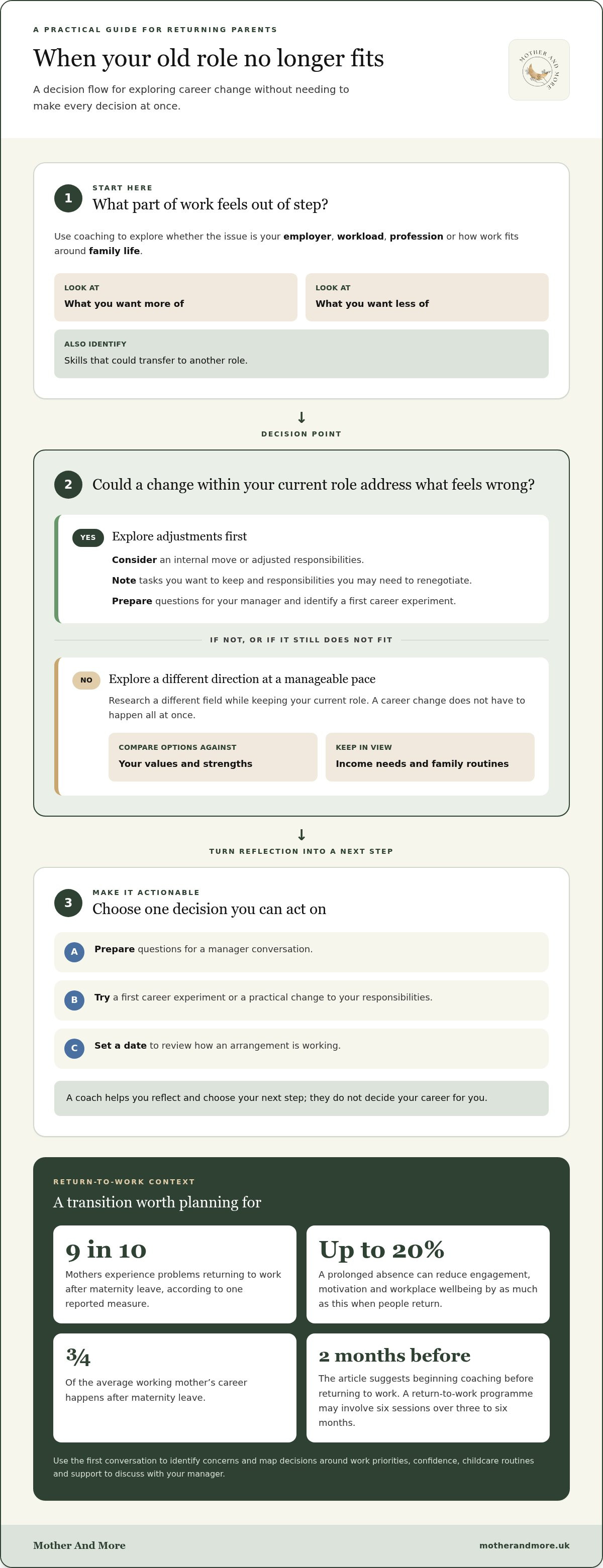
Returning after maternity leave can bring questions about confidence, identity and what you want from work. One reported measure is that 9 out of 10 mothers experience problems returning to work after maternity leave. A prolonged absence can also reduce engagement, motivation and workplace wellbeing by as much as 20% when people return.
Coaching offers a structured way to separate practical concerns from longer-term career questions. For example, list what feels difficult about returning, then sort each point into what you can influence, what needs a conversation at work and what may call for a different role. This turns a broad worry into manageable next steps.
Before leave begins, coaching can help you identify the support and working conditions that would make your return more workable. Note the tasks you want to keep, responsibilities you may need to renegotiate and questions to raise with your manager. These notes can make later conversations clearer.
Changing career direction when returning
Returning to work can reveal that the role you left no longer suits your priorities. Coaching can help you explore whether the issue is your employer, workload, profession or the way work fits around family life. Consider what you want more of, what you want less of and which skills could transfer to another role.
A career change doesn’t have to happen all at once. You might first explore an internal move, adjust your responsibilities or research a different field while keeping your current role. Career change coaching for mums in the UK can help you compare these options against your values, strengths, income needs and family routines.
For parents returning from leave, useful coaching focuses on decisions you can act on: prepare questions for a manager, identify a first career experiment or set a date to review how an arrangement is working. A coach helps you reflect and choose your next step, rather than deciding your career for you.
Coaching during the transition to and from parental leave
Coaching can help you prepare for leave, plan your return and make room for career ambition after becoming a parent. Three quarters of the average working mother’s career happens after maternity leave, so this transition can shape a substantial part of your working life.
For a practical starting point, begin coaching two months before returning to work. Use the first conversation to identify your main concerns, then map the decisions that need attention: priorities at work, confidence, childcare routines and support to discuss with your manager. A return-to-work programme may consist of six coaching sessions over three to six months, allowing time to prepare and reflect as circumstances change.
Parenthood doesn’t have to mean setting aside progression or ambition. Coaching can help you define what growth means now, whether that’s pursuing a promotion, developing a skill or finding a role that better fits family life. Bring a real decision to a session, such as whether to accept a new project or ask for clearer priorities. Then weigh its effect on your wellbeing, energy and longer-term goals.
Parenthood can also affect how partners share responsibilities and discuss work. Individual coaching can help you clarify what you need and prepare for a specific conversation at home. For example, set aside time to compare work commitments, care routines and recovery time, then agree which practical change to try first. This supports your own reflection; it isn’t couples counselling.
Organisational support matters too. Before returning, write down arrangements that would help you do your role well, such as predictable priorities, a phased handover or regular check-ins. Take those points into a conversation with your manager or HR team. In London and elsewhere in the UK, focus on your actual role and working pattern, rather than a generic template for every working parent.
Maternity coaching can connect personal reflection with workplace preparation. Between sessions, try one small action: draft questions for your manager, update your career goals or discuss a revised household routine. Bring what happened to the next session and adjust your plan based on real experience rather than expectation.
If you’d like individual space to explore your next steps, one-to-one life coaching can support reflection on confidence, identity and work after becoming a parent.
Career change coaching and career clarity
Coaching gives you a structured space to examine career choices and decide what progress means now. It can connect your ambitions with the realities of family life, without assuming that balance looks the same for everyone.
Clarifying life and career goals
Start by writing down what you want work to provide, such as purpose, flexibility, progression or financial stability. Then separate essential needs from preferences. For example, a senior role may offer greater influence but involve responsibilities that don’t fit your current routine.
In coaching sessions, guided questions and careful listening help you explore your own answers rather than receive ready-made advice. Think of a recent workday: note what gave you energy, what drained it and what you would change. Those details can reveal which goals fit your values and family life.
What career change coaching involves
Career change coaching is a goal-focused process that helps you make progress in your professional life. Sessions may use reflection, deep listening and questions to explore your skills, motivations and possible directions. You and your coach can turn a broad aim, such as “find work that fits better”, into a practical next step.
Booking a free career clarity call
If a coach offers a free career clarity call, use it to discuss the decision you’re facing and understand their approach. Prepare an example, such as feeling stalled in your current role, and ask how sessions could help you explore options. Notice whether the conversation feels focused and respectful.
Use the call to clarify practical details, including the session format, proposed goals and what continued coaching involves. A short introductory conversation can help you decide whether the coach’s style suits your needs. It isn’t a substitute for a full session or a promise of a particular career outcome.
Career coaching costs and available options
The cost of coaching depends on the format, session length and level of support, and is provided after a quote request. Before committing, compare what the fee covers, how sessions are arranged and whether the overall structure fits your goals and budget.
To explore free or subsidised support, consider whether your employer has a learning or development budget, or whether a coach offers an introductory conversation. Ask what each option includes and whether it supports career decisions specifically. A clear comparison helps you weigh affordability against the time and focus you want.
Career coach’s professional and personal background
A coach’s professional background can shape the questions they ask about your work. Look for experience relevant to your decision, such as changing industries, returning after leave or developing leadership skills. In an introductory conversation, describe one career crossroads and ask how the coach would help you explore it. Their response can show whether their approach feels practical and attentive.
Credentials and experience provide useful context, but neither tells you everything about how sessions will feel. Ask how the coach structures conversations, sets goals and helps you review progress. For example, if you hope to move into leadership, a useful process might explore your strengths, what the role requires and one step towards testing your interest. Clear answers help you understand their working style.
A coach’s personal experience of parenthood may help them understand some pressures, but it doesn’t replace relevant coaching skills. Ask how they make space for different family arrangements and career choices. Notice whether they listen without assuming you want reduced hours, a new profession or the same ambitions you had before becoming a parent.
Family routines can shape which career options are workable. Before a session, sketch a typical weekday, including work commitments, school or nursery arrangements and time for rest. Then mark one point of strain, such as a late meeting that clashes with collection. This concrete example helps you explore whether you need a boundary, a different routine or a change in role.
Career and personal development coaching can help you see how your identity and priorities are changing. Bring one example of work that felt meaningful and one that felt draining. A coach can help you compare what each involved, such as collaboration, autonomy or responsibility, and use those patterns to shape goals that fit your life now.
For a leadership decision, separate what you think you should want from what genuinely interests you. Write down the parts of senior responsibility that appeal, such as mentoring colleagues, and those that concern you, such as competing demands on your time. Taking both seriously gives you a fuller basis for deciding what development would be worthwhile.
Finally, notice whether a coach helps you leave with a clear action rather than a list of expectations. After discussing a possible career shift, that action might be speaking with someone in the field or identifying a skill to develop. Review what you learn at the next session. A coach’s background matters, as does whether their process helps you make grounded choices.
Career crossroads and identifying motivations
A career crossroads can feel especially complex when becoming a parent has shifted your identity and priorities. Rather than rushing towards a new job title, name the decision in front of you. Are you seeking more meaning, a different working pattern, stronger progression or a role that better fits family life? Defining the question gives your reflection a useful starting point.
Try a simple exercise before your next coaching conversation: write down three recent work moments that felt satisfying and three that left you drained. For each, note the task, the people involved and how it made you feel. You may notice that mentoring colleagues energises you while constant deadlines do not. These details help reveal what you want more of in your next chapter.
Values can guide decisions when several career options seem possible. Choose the principles that matter most now, such as creativity, stability, contribution or autonomy. Then compare each possible direction against them. A familiar job title may offer security but little flexibility; a different field may better match your values while requiring new skills. Coaching helps you consider those trade-offs without judging your choices.
Your strengths offer another way to explore a crossroads. List work you do confidently, feedback you’ve received and challenges you’ve handled. A parent returning from leave might recognise strengths in planning, communication or adapting quickly, then consider where those abilities could transfer. Treat this as evidence, not a fixed label. The aim is to identify possibilities to investigate, rather than decide everything at once.
Turn those reflections into career needs and goals. Separate essentials, such as a workable commute or predictable hours, from preferences, such as a particular sector. Then choose one exploratory action: update a skills profile, speak with someone in a role that interests you or research a course. Review what you learn. This small step makes a broad transition more tangible and helps you decide what to do next.
Career exercises can uncover a gap between what you think you should want and what genuinely matters. Write two short statements: “I believe success means…” and “I feel most engaged when…”. Compare them, then bring any tension into coaching. For instance, you may value leadership but not want a role built around constant availability. That distinction can help you seek progression on more fitting terms.
If working with babies feels meaningful, explore whether baby massage instructor training or baby yoga instructor training belongs among your possible paths. Consider what attracts you to teaching, what skills you’d want to use and how the work might fit your priorities. Keep it as an option to explore, not a decision you must make today.
Mother And More: Baby Massage Courses
Mother And More offers One to One Life Coaching and Group Coaching for mothers considering what comes next. If you’re weighing a career change alongside shifting priorities, coaching gives you dedicated space to reflect on identity, confidence and wellbeing. Explore your questions and decide what feels like a meaningful next step, without needing a complete plan before you begin.
Mother And More also offers Baby Massage Courses and Baby Yoga Classes for parents and their infants. These provide a separate way to spend focused time with your baby, alongside the personal reflection of coaching. Each offering meets a different need, whether you’re exploring your direction or looking for a parent-and-baby class.
To explore the support that feels right for you, visit motherandmore.uk.
Make space for your next chapter
You don’t need to solve your whole working future today. Begin with one question you’re ready to explore, such as what you want more of in your next role or which part of your current work no longer feels right. Writing down your thoughts before a conversation can help you arrive with a clearer sense of what matters.
Career change coaching for mums in the UK can give you thoughtful space to consider your next move alongside the life you’re building now. The aim isn’t to force a dramatic decision. It’s to help you take a grounded step, whether that means exploring an idea or understanding your priorities more clearly.
If you’d like support as you consider what comes next, contact Mother And More to start a conversation. You can take this at your own pace, one considered step at a time.
Frequently Asked Questions
How do I figure out my transferable skills for a career change?
Look at tasks you’ve completed successfully, not just your job titles. Choose a recent project and note what you did, such as resolving a customer issue, organising competing deadlines or explaining complex information. Then describe those abilities in language another industry would recognise. For example, coordinating a team rota demonstrates planning and communication. Compare your examples with responsibilities in roles that interest you, and identify any skills you’d need to develop.
How do I find a more meaningful or fulfilling career?
Start by identifying what “meaningful” would look like in an ordinary working week. You might want to help people directly, make things, solve problems or have more independence. Consider a real example: which task makes you feel engaged, and what matters about it? Explore roles that include more of that activity, then speak with someone familiar with the work to understand its everyday demands. Meaning can come from the work itself, its purpose or its environment.
How do I know if I’m burnt out or just in the wrong career?
Notice whether your exhaustion is mainly connected to your current workload, or whether the work itself feels persistently misaligned with your interests and values. Write down when the feeling appears, what came before it and whether anything offers relief, such as time away from a particular task. These observations can help you discuss the situation with a GP or an appropriate professional. Career coaching can support work-related reflection, but it doesn’t diagnose or treat burnout.
Looking for a coach?
Begin with the decision you want help making, then look for a coach whose approach addresses that need. If you’re weighing a promotion against a career shift, for example, ask how coaching would help you explore both options. A useful first conversation should clarify the coach’s method, session structure and expectations. Mother And More offers One to One Life Coaching and Group Coaching for mothers reflecting on identity, confidence and wellbeing.
How can mums find a career coach specialising in maternity, motherhood or return-to-work?
Look for coaches who explicitly discuss maternity, motherhood or returning to work, then read how they describe working with parents. Seek examples relevant to your situation, such as preparing for a return after leave or reconsidering a role after family routines change. In an introductory conversation, explain your main decision and ask how they would support your thinking. Mother And More provides life coaching for mothers.
What qualifications and professional accreditations should UK career coaches have?
Ask about a coach’s training, relevant experience and any professional accreditation they hold. Find out what the accreditation represents, whether they follow a professional code and how they maintain their practice. You can also ask how they distinguish coaching from other forms of support, and what they do if your needs fall outside their expertise. Consider their answers alongside how clearly they explain boundaries, confidentiality and the coaching agreement.
How can mums balance career coaching with childcare and family responsibilities?
Choose a coaching arrangement that fits the care you already have, rather than planning around an ideal week. Before booking, map your regular commitments and identify a realistic time for a session, plus a quieter moment to reflect afterwards. If childcare changes at short notice, discuss scheduling expectations and cancellation terms in advance. Group Coaching may suit you if shared discussion feels useful; individual coaching lets the conversation centre on your own goals.
What are the best steps to plan a career change after having children?
First, decide what you want the change to improve, such as your working pattern, sense of purpose or development. Next, consider practical needs, including household income, care arrangements and any training a new role may require. Research a possible direction through job descriptions or an informational conversation, then choose a low-risk action to test your interest. Review what you learn before making a larger commitment, and involve your family in practical changes that affect them.



Comments