

Dealing with Loss of Identity in Motherhood: Gentle Steps to Feel Like You Again
What if missing the person you were before motherhood doesn’t mean you love your child any less? When your days revolve around everyone else’s needs, old interests and routines can feel far away. Dealing with loss of identity in motherhood may bring sadness, frustration or guilt, especially if you feel you should be grateful instead of longing for parts of yourself you miss.
You’re not selfish for wanting room to be you, too. Reconnecting doesn’t have to start with a free afternoon or a perfect self-care routine. Small, realistic choices can help you notice what matters, even when family life is busy.
This article explores why motherhood can shift your sense of self and offers practical steps to reconnect with your needs and interests. You’ll also find guidance on when extra support may help and where to begin. There’s no need to rush or return to exactly who you were. You can make space for who you are becoming.
Table of Contents
Dealing with loss of identity in motherhood: what this feeling can mean
You might love your baby deeply and still miss the parts of life that once helped you feel like yourself. Familiar routines may have changed, conversations might now revolve around family logistics, or you may find yourself wondering where your own preferences went. That can feel disorienting. Not every mother feels this way, and there’s no single correct way to experience becoming a parent.
Identity is shaped by relationships, values, interests, roles and choices. Motherhood may add a profound new role while changing how much room you have for others. Identity change in motherhood is an adjustment to a new and evolving sense of self, not evidence of personal failure or a lack of gratitude.
Why motherhood can make familiar parts of you feel distant
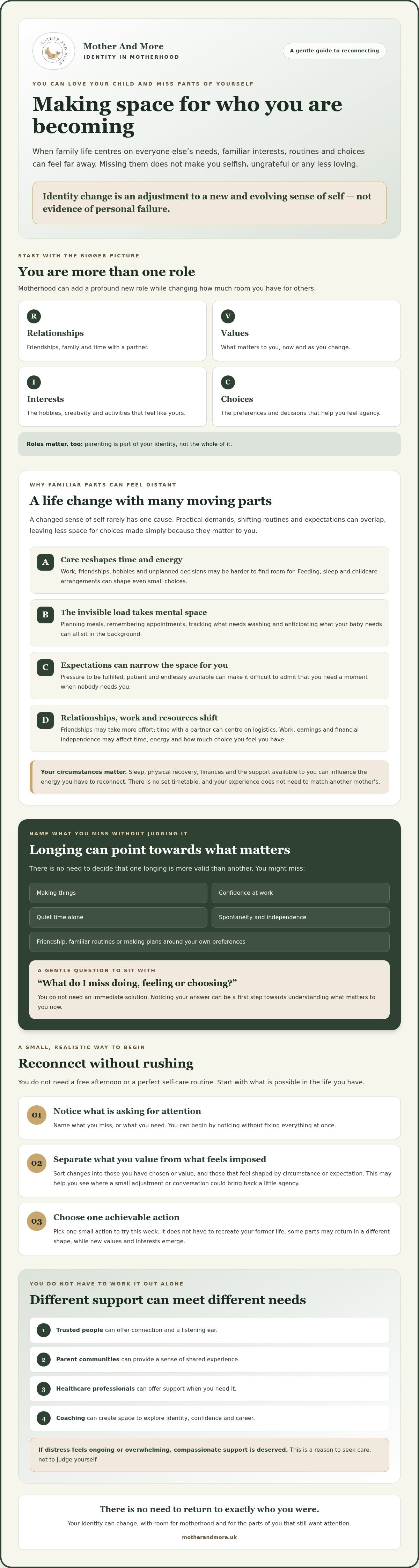
Caring for a baby can reshape the everyday structures that once made your identity feel visible. Time for work, friendships, hobbies or unplanned decisions may be harder to find. Even small choices can depend on feeding, sleep or childcare arrangements. The transition to motherhood, sometimes called matrescence, can involve changes across many areas of life, not just how you see yourself as a parent.
Everyone’s circumstances are different. Sleep, physical recovery, finances and the support available to you can influence how much energy you have to reconnect with familiar parts of yourself. There’s no set timetable for adjusting, and you don’t need to measure your experience against another mother’s.
What might you feel you have lost?
It may help to name what feels out of reach, without deciding that one longing is more valid than another. You might miss making things, feeling confident at work, having quiet time alone or acting spontaneously. Perhaps you miss a friendship, a sense of independence, or the version of yourself who could make plans without first checking what everyone else needed.
Try asking yourself: What do I miss doing, feeling or choosing? You don’t need an immediate solution. Noticing your answer can be a gentle first step towards understanding what matters to you now.
Some parts of your former life may return in a different shape. Others may matter less as new values and interests emerge. Your identity isn’t necessarily disappearing. It may be changing, with room for motherhood alongside the parts of you that still want attention.
Why identity can shift after becoming a mother
A changed sense of self rarely has one cause. Caring for a baby can reshape your time and energy, while expectations from family, work and wider culture may influence what you feel you should prioritise. These pressures can overlap, leaving less space for choices made simply because they matter to you. That isn’t a personal failing. It’s a response to a life that has changed in practical and emotional ways.
When personal choice narrows and invisible labour expands, it can become harder to recognise yourself beyond what you do for others.
The invisible load and the pressure to be a perfect mother
Some family care is easy to see; much of it happens in the background. You might keep track of nappies, plan meals, book appointments, remember what needs washing and anticipate what your baby will need when you leave the house. Even when tasks are shared, the planning and remembering can take up mental space.
Alongside this, the idea that a “good” mother should feel fulfilled, patient and endlessly available can make ordinary ambivalence difficult to admit. You may adore your child and still wish for a moment when nobody needs you. That feeling doesn’t cancel out your love. Families organise care in different ways, so this isn’t about assigning blame to a partner or assuming every household works the same way. It’s about noticing whether the demands around you leave room for your needs, too.
How relationships, work and changing routines affect identity
Friendships may take more effort to maintain, and time with a partner can become centred on logistics. Work can shift as well. Returning to employment might reconnect you with familiar skills, colleagues or a sense of professional purpose, while bringing new pressures around time, childcare and energy. Changes to earnings or financial independence can also affect how much choice you feel you have.
Not every change feels unwelcome, and not every choice is fully within your control. Try sorting the changes into two groups: those you’ve chosen or value, and those that feel imposed by circumstance or expectation. This won’t solve everything, but it may help you see where a small adjustment or conversation could bring back a little agency.
If reflecting with someone would help you explore those choices, one-to-one life coaching for mothers can offer space to think through identity, confidence and career transitions. Coaching is reflective support, not clinical psychological therapy, and it may be one option alongside trusted relationships or healthcare support.
Is losing your identity in motherhood normal, or a sign to seek help?
There isn’t one “normal” way to feel after becoming a mother. Your sense of identity may shift, settle or keep changing, and that experience alone can’t tell you whether you have a mental health condition. Dealing with loss of identity in motherhood is not, by itself, a diagnosis. What matters is how you’re feeling overall and whether distress is making everyday life hard to manage.
You don’t need to prove that things are “bad enough” before asking for support. If you’re worried, speak with your GP, midwife or health visitor. Explain what has changed, how it’s affecting you and what feels hardest, even if you’re not sure what help you need. They can listen and help you consider appropriate next steps.
When this may be part of a wider struggle
Sustained low mood, intense anxiety or difficulty functioning are reasons to seek professional advice, particularly if you feel increasingly overwhelmed or unlike yourself. These experiences can have different causes, and identity changes alone don’t establish what’s going on. You don’t have to wait until your feelings become unbearable. Reaching out early is a valid act of care, not a judgement on your parenting.
If you’re worried about your safety or have thoughts of harming yourself or someone else, seek urgent professional help. If there’s immediate danger, call 999 or go to A&E. In England, you can also call NHS 111 for urgent advice; elsewhere in the UK, contact your local urgent mental health service or healthcare professional.
Choosing support that fits what you need
Different kinds of support serve different purposes. A GP, midwife or health visitor can help you discuss emotional or mental health concerns and guide you towards assessment or care. Psychological therapy is provided by an appropriately qualified professional and may help with mental health difficulties. If you’re unsure what’s right, start with a trusted health professional.
Life coaching is different. It offers reflective space to explore identity, values, confidence or future choices, but it isn’t clinical assessment or psychological therapy and shouldn’t replace professional healthcare when symptoms or safety concerns are involved. You might choose coaching to think through what matters to you while seeking healthcare support for distress. Before deciding whether it feels suitable, you can ask about a practitioner’s approach and qualifications. Support can’t promise a particular outcome, but asking for help is a meaningful step towards being cared for.
How to reconnect with yourself in small, realistic steps
Reconnecting with yourself doesn’t need to become another task you have to get right. Think of it as a series of small experiments, not a checklist. If you’re dealing with loss of identity in motherhood, start with what feels possible in your life now rather than waiting for a clear diary or a perfect routine.
Start by noticing what you miss and what matters now
Pause for a moment and ask yourself: when do I feel most like me? What gives me a little energy, and which values, interests or relationships would I like to give more room? Your answers might point towards something familiar, such as reading or seeing a friend, or something new that has become meaningful since having a child. Both belong in the picture.
If writing feels like too much, jot down a few words on your phone or record a short voice memo. There’s no need to analyse everything. You’re gathering clues about what you need and what you’d like to keep close.
Make space through one small experiment
Choose one action that feels achievable this week. It could be listening to a favourite album while you make lunch, sketching for ten minutes, messaging a friend or taking a short walk with a podcast. Keep it low-pressure and easy to adapt. The aim isn’t to recreate your old routine, but to notice how a small piece of personal choice feels now.
Sometimes making room means asking for practical help. Try a clear, specific request of someone you trust: “Could you take the baby for half an hour on Thursday so I can go for a walk?” or “Could you handle dinner tonight while I have a little time to myself?” If that kind of help isn’t available, consider whether a smaller action can fit into a moment you already have.
Notice, ask, try. Notice what matters; ask for the support or space that could help; try one small step. Afterwards, reflect on how it felt. If it didn’t work, adjust the timing, the activity or the support you need. That isn’t failure. Repeat the experiment if it helps, change direction if it doesn’t, or leave it for another week. Progress doesn’t have to look consistent.
If you’d value guided space to explore what matters to you and what a manageable next step could be, explore one-to-one life coaching for mothers with Mother And More.
Finding supportive connection as you shape your identity in motherhood
You don’t have to work everything out on your own. Support might come from a trusted friend, a parent community, a healthcare professional or a coach. Different kinds of connection meet different needs: sometimes you want someone to listen; sometimes you need practical help; at other times, you may want space to think about what comes next.
Build a circle of support that feels safe and practical
Start small. Is there one person who can hear how you’re feeling without rushing to reassure you or solve it? You might say, “Could you listen for a few minutes? I don’t need advice just yet.” If practical help would make a difference, ask for something specific, such as picking up a few groceries or taking the baby while you rest or have time for yourself.
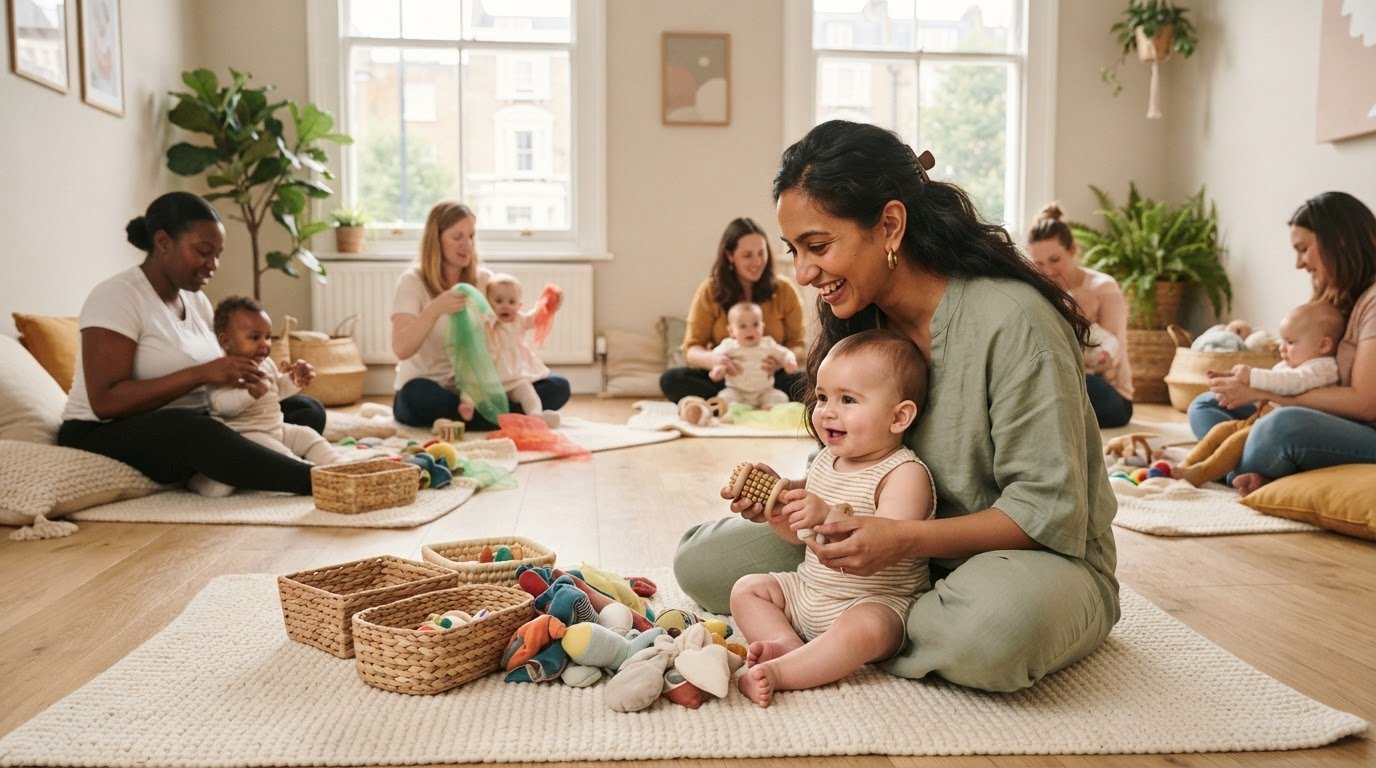
A parent group or mother-and-baby activity may offer connection with others at a similar stage, if that feels comfortable for you. In London, Mother And More offers baby massage courses and baby yoga classes, which may be a way to explore wellbeing alongside your baby. You can also read a Mother And Baby Wellness Classes guide to consider what kind of class might suit your needs.
When coaching may help you reflect on what comes next
If you’re dealing with loss of identity in motherhood and want space to explore your values, confidence or life transitions, coaching may help you reflect on what matters and consider possible next steps. Mother And More offers one-to-one and group life coaching for mothers. Coaching isn’t clinical assessment or psychological therapy, and it isn’t a substitute for healthcare support if you’re experiencing significant distress or have concerns about your mental health.
If you’re unsure which kind of help fits, a GP, midwife or health visitor can be a useful starting point for health concerns. For reflective support around identity or future choices, a Life Coaching for Mums UK guide may help you understand what coaching involves and decide whether it feels right for you.
There’s no single route back to yourself, and you don’t need to take every step at once. Choose the kind of connection that feels most helpful now, whether that’s a conversation with someone you trust, a healthcare professional or time to explore coaching. Let support meet you where you are.
Take one gentle step towards feeling like yourself again
Dealing with loss of identity in motherhood doesn’t mean you’re failing or that you love your child any less. Your sense of self can change as responsibilities and routines shift. Reconnecting can begin with something small: noticing what matters to you, asking for practical support and trying one manageable step.
You don’t have to find your way alone. Mother And More offers one-to-one and group life coaching for mothers, as well as baby massage courses and baby yoga classes in East London. Founded by accredited life coach and former social worker Rebecca Beazley, the business has supported over 2,000 local families and hundreds of mothers across the UK. Coaching offers reflective support, not clinical psychological therapy.
If you’d like to explore what kind of support might suit you, explore supportive coaching and classes with Mother And More. You don’t need to have everything figured out first. A small step towards yourself still counts.
Frequently Asked Questions
Is it normal to feel like you have lost your identity in motherhood?
It can happen, though mothers’ experiences differ. Major changes to your time, roles, routines and choices may affect how you see yourself, especially when familiar interests or relationships have less room. Missing parts of your earlier life doesn’t mean you love your child any less. If the feeling is persistent, overwhelming or worrying, consider talking with someone you trust or a health professional. You deserve support without judgement.
How long does loss of identity in motherhood last?
There’s no single timetable. Your sense of self may keep evolving as your child grows and your routines, responsibilities and circumstances change. Rather than waiting for a particular date to feel like yourself again, notice what feels hardest now and what might help. If distress is affecting your wellbeing or daily life, speak with a trusted health professional. You don’t have to wait until you feel unable to cope.
Can you miss your old life and still love being a mother?
Yes. Love, grief, relief and frustration can exist alongside one another, sometimes in the same day. Missing your autonomy, friendships or interests doesn’t measure your love for your child or your ability as a parent. Try meeting the feeling with curiosity rather than guilt: what do you miss, and what small part of it might you welcome now? If it feels difficult to hold alone, consider sharing it with someone you trust.
How do I find myself again after having a baby?
Start with one small reflection: what matters to you, or what gives you a little energy? Then choose a manageable activity, such as listening to music you enjoy, or make a specific request for help so you can have a little time. The aim isn’t to return unchanged to a previous self. Adapt your experiment around your energy, care responsibilities and circumstances, and adjust it if it doesn’t feel right.
What causes a loss of identity after becoming a mother?
There isn’t one cause, and every mother’s experience is different. Changes to routines, responsibility, relationships, work and time for personal interests may all affect how you recognise yourself. Expectations of perfect motherhood and the often-unseen planning and remembering involved in family life can add pressure. These are possible influences, not a diagnosis or a complete explanation. Your own circumstances matter, and it’s okay if your experience doesn’t match someone else’s.
Could feeling lost as a mother be postnatal depression or anxiety?
Feeling unsure about your identity alone can’t establish a mental health diagnosis, though identity concerns may occur alongside other difficulties. If low mood, anxiety or distress is persistent or worrying, speak with your GP, midwife or health visitor. If you’re in immediate danger, call 999 or go to A&E. In England, NHS 111 can help with urgent mental health needs; elsewhere in the UK, contact your local urgent mental health service.
Can life coaching help with identity changes in motherhood?
Coaching may offer structured space to reflect on your values, confidence and possible next steps. It isn’t clinical psychological therapy, and it shouldn’t replace healthcare advice if you have mental health concerns. Before choosing a coach, check their credentials, approach and whether the support suits your needs. In London, Mother And More offers one-to-one and group life coaching for mothers, founded by accredited life coach and former social worker Rebecca Beazley.


Comments