

How to Stop Feeling Touched Out as a Mum: Gentle, Practical Steps
What if needing a little space from your child’s touch isn’t a sign you’re pulling away, but a sign you’ve had very little room to reset? If you’re searching for how to stop feeling touched out as a mum, you may be carrying a child, answering another call for comfort and longing for a moment when nobody needs to lean on you. It can feel confusing, especially when you love your children deeply.
Feeling touched out doesn’t make you a bad or rejecting mum. Constant contact and caregiving can leave your senses overloaded, and needing a pause is a real need, not a measure of how much you care. You’re allowed to want breathing space.
This article offers small, realistic ways to ease the pressure without adding guilt. You’ll find gentle sensory resets, examples of kind boundaries, ideas for asking for practical support and guidance on when it may help to speak with someone.
Table of Contents
What does feeling touched out as a mum mean?
Feeling touched out means feeling overwhelmed by repeated or prolonged physical contact. Your child may need to be held, fed, carried or comforted throughout the day, with little chance for your body and mind to pause. After a while, even a familiar cuddle or a small hand reaching for you can feel like more than you can manage in that moment.
You might long for quiet, want nobody to climb on you or wish you could answer one fewer request. Noise, tiredness, stress and a steady stream of decisions can all affect how much contact feels manageable. A cuddle may feel lovely in the morning and too much later on. Your capacity can shift without your affection changing.
A broad overview of parenting stress offers context for how the pressures of caring for a child can affect a parent’s wellbeing. Feeling overwhelmed by touch may be one part of a demanding day, rather than a judgement on your relationship.
How might feeling touched out show up?
You may tense when your child climbs into your lap, feel irritated by repeated requests to be picked up, or want distance after feeding or carrying them for a long stretch. Perhaps you crave a quiet moment alone, feel suddenly snappy or simply want nobody to touch you for a while. These reactions can be uncomfortable, but they don’t automatically mean anything is wrong with you or your bond.
You can welcome closeness and still reach a point where you need space. Both things can be true.
Does wanting space mean you are a bad mum?
No. Needing a pause is a human response to ongoing demands, not proof that you’re a poor parent or love your child less. A temporary wish for less contact says something about what you need right now; it doesn’t define the strength of your connection.
Touch overload is a signal that you may need space, not a verdict on your parenting. If you’re wondering how to stop feeling touched out as a mum, begin by recognising the feeling without judging yourself for it. There isn’t one technique that makes difficult feelings disappear for every mum. For now, noticing that your capacity has been reached can help you work out what might help next.
Why can constant touch leave mums feeling overwhelmed?
Repeated contact can feel more demanding when there’s little opportunity to pause between one need and the next. You may be physically close to your child for much of the day while also tracking what needs doing, what they might need next and how to keep everything moving. Even welcome affection can start to feel like another demand when there’s no room to reset.
Touch is only one part of the picture. Background noise, interrupted rest, household tasks and a steady stream of decisions can all draw on your energy. Often it’s the accumulation, rather than one particular sound, request or moment of contact, that leaves you craving quiet.
What can make touch feel like too much?
Limited privacy and long stretches of physical closeness may contribute, especially if you rarely get a moment when nobody needs your attention. A lively room, toys playing, conversation and competing requests can add to the sensory load. For some mums, the demands of a particular day are enough to make touch harder to manage. There isn’t one universal cause, and this feeling alone doesn’t point to a diagnosis.
Small demands can gather quietly until your senses have little room left to take in one more thing. Recognising that build-up can help you respond with curiosity rather than blame.
Why can it change from one day to another?
Your capacity may shift depending on how much rest you’ve had, how stressful the day feels and what else is asking for your attention. A day with more interruptions or fewer chances to recover may feel different from a calmer one. Your circumstances matter, so your experience doesn’t need to match someone else’s.
You can enjoy closeness and still want less contact at another time. Affection doesn’t have to feel welcome every minute to be genuine. If you’re exploring how to stop feeling touched out as a mum, notice what tends to build up: for example, noise, a particular part of the day or several hours without a pause. You don’t need to judge the feeling before you understand what’s contributing to it.
If you’d value space to reflect on your boundaries, identity and wellbeing, coaching support for mothers can offer a place to explore what might help you feel more resourced.
How to stop feeling touched out in the moment: gentle steps
When everything feels like too much, you don’t need a perfect routine or a long stretch of free time. Try a small reset, adapting each step to what’s safe and possible right now. The aim isn’t to make every difficult feeling disappear, but to give yourself enough room to choose what you need next.
What can you do when everything feels like too much?
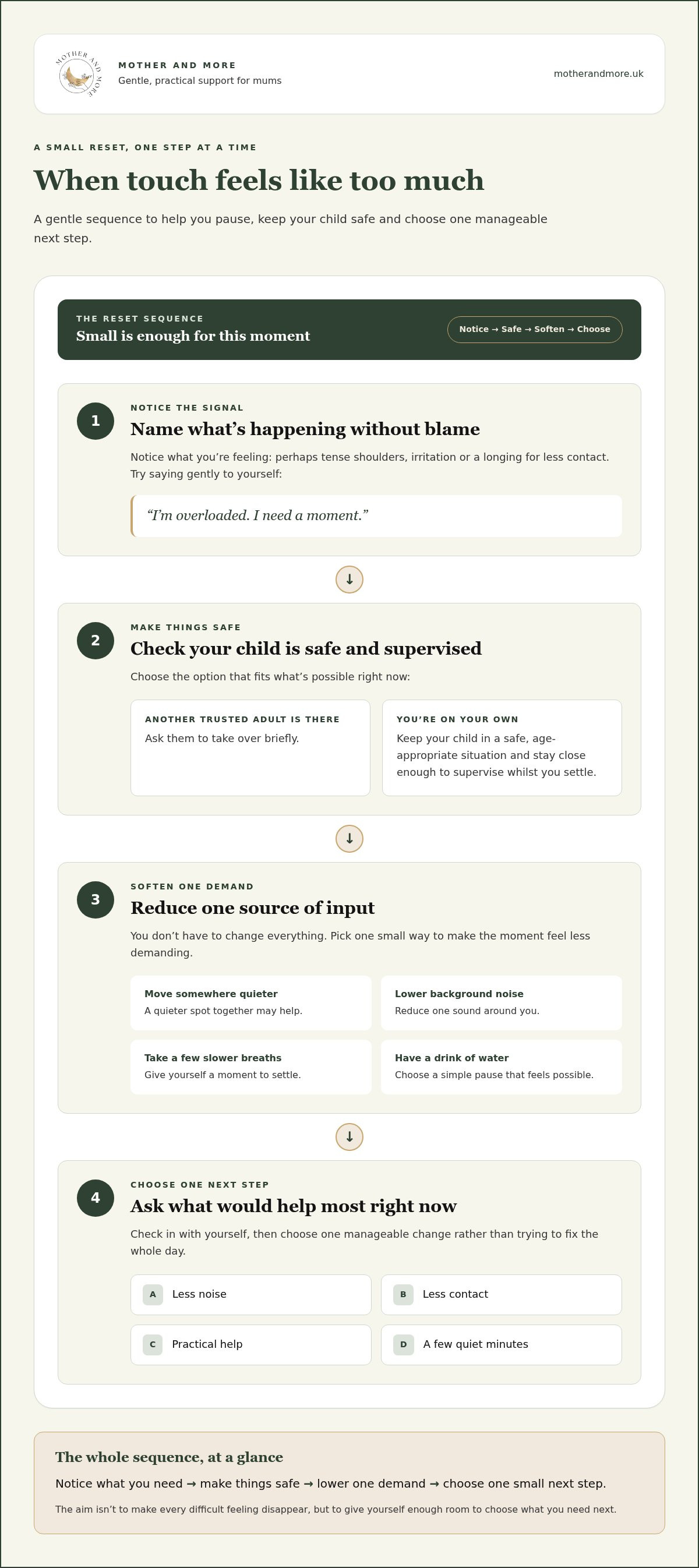
Start by noticing the signal. Perhaps your shoulders are tense, you’re becoming irritable or you’re longing for less contact. Name it gently to yourself: “I’m overloaded. I need a moment.” This can help you respond with care rather than expecting yourself to push through automatically.
Next, make sure your child is safe and appropriately supervised. If another trusted adult is there, ask them to take over briefly. If you’re on your own, keep your child in a safe, age-appropriate situation and stay close enough to supervise while you take a moment to settle.
Then reduce one source of input. You might move to a quieter spot together, lower background noise, take a few slower breaths or have a drink of water. Ask yourself what would help most right now: less noise, less contact, practical help or a few quiet minutes? Choose one manageable change rather than trying to fix the whole day.
Notice what you need, make things safe, lower one demand, then choose one small next step. This sequence can be a useful starting point as you explore how to stop feeling touched out as a mum. It doesn’t have to solve everything to offer a little breathing space.
How can you ask for a short break?
If someone you trust is available, try being clear and specific: “I need ten quiet minutes; could you take over now?” You could ask for one practical thing, such as holding the baby while you wash your face, taking over playtime or handling the next request. A direct ask makes it easier for the other person to understand what support would help.
There may not be another adult available in that moment. That doesn’t mean you’ve failed to ask or that you’re doing anything wrong. Choose the smallest safe pause you can manage, even if it’s a few slower breaths while your child is settled nearby. Small moments count.
If you’d like ongoing space to reflect on boundaries and wellbeing, life coaching for mothers can support that exploration.
Does needing space make you a bad mum? Set kind, workable boundaries
No. Being a loving mum doesn’t mean being physically available every moment. A kind boundary isn’t a withdrawal of affection. It can give you a chance to notice your own limits and reconnect with more ease. You’re allowed to have needs alongside your child’s.
Boundaries can be small and flexible. You might choose a chair for feeding so you’re not also carrying your child, or make one part of the day quieter by switching off background noise. There’s no need to create a perfect routine. Adjust one repeated demand or source of stimulation, then notice whether it makes the day feel a little more spacious.
How can you set a gentle boundary with your child?
Use simple, warm words that recognise your child and explain what you need: “I love being close to you. I need a little space for a moment, but I’m staying here.” Depending on their age and circumstances, you could offer to sit nearby, hold hands instead of cuddling, or say when you’ll reconnect. Adapt the words and alternatives to your child’s needs. A boundary should feel safe and realistic for both of you.
How can your family share the sensory and caregiving load?
If you have a partner or another trusted adult to share care with, talk about breaks before you’re at your limit. A predictable handover, such as one person taking over after a meal or during part of the evening, can make it easier to anticipate time to reset. Be specific about what would help: fewer interruptions, a quieter room or someone else handling a particular task.
Shared caregiving can also grow through conversation and learning together. Explore workshops for new dads and connection as one way to support understanding and involvement. If you’re reflecting on how motherhood is changing your sense of self and the boundaries you need, life coaching for mums and identity offers space to explore those questions.
There may be days when routines fall apart or support isn’t available. That doesn’t mean you’ve failed. Choose one adjustment that feels possible and let it be enough for now. To explore your boundaries and wellbeing with ongoing reflective support, find life coaching for mothers.
When feeling touched out keeps returning: support and next steps
If this feeling keeps coming back, noticing its patterns may help you understand what support could make a difference. You might gently note when it tends to arise, what was happening beforehand and what brings even a little relief. Perhaps it follows interrupted rest, a noisy stretch of the day or several hours without a pause. There’s no need to track everything or judge yourself. A few observations can help you see what your own experience is asking for.
As you consider how to stop feeling touched out as a mum, remember that small adjustments and support can work alongside one another. You don’t have to wait until you’ve reached breaking point to talk about how you’re feeling.
When should you seek extra support?
If the distress persists, feels difficult to manage or affects your day-to-day life, consider talking with your GP or health visitor. You can describe what you’ve noticed, how long it’s been happening and how it’s affecting you. You don’t need a diagnosis or the perfect words before asking for a conversation.
If you feel in immediate danger or are concerned about someone’s safety, seek urgent help by calling 999 or going to A&E.
What kind of support might help you feel less alone?
Different kinds of support can meet different needs. A trusted person may offer a listening ear, while practical help with caregiving can create time to rest or reset. Mother And More runs baby massage and baby yoga classes in East London, offering parents and infants a shared space for connection and wellbeing. Find out more about Mother and baby wellness classes.
If you’d like space to reflect on boundaries, maternal identity and wellbeing, coaching can help you explore those themes. It’s a non-clinical form of reflective support, distinct from therapy, and isn’t a substitute for clinical care when that’s needed. Mother And More’s life coaching for mothers is offered by founder Rebecca Beazley, an accredited life coach and former social worker.
You’re welcome to Explore support for mothers with Mother And More if it feels right for you. You can begin with what feels manageable, and you deserve support along the way.
Make space for yourself, one gentle step at a time
Feeling touched out isn’t a measure of your love or your ability as a mum. Constant contact, noise and caregiving demands can leave you needing a pause. Notice what tends to build up, lower one source of stimulation where you can, and try a kind boundary that suits you and your child.
Learning how to stop feeling touched out as a mum doesn’t mean you have to manage everything alone. If the distress keeps returning or feels hard to carry, speaking with your GP or health visitor can be a helpful next step. Reflective coaching may also give you space to explore boundaries, identity and wellbeing.
Mother And More was founded by Rebecca Beazley, an accredited life coach and former social worker, and has supported over 2,000 local families and hundreds of mothers across the UK. Explore Mother And More’s support for mothers, including life coaching and baby classes in East London.
Your need for space matters, too. Take the next step at your own pace.
Frequently Asked Questions
Is feeling touched out as a mum normal?
Yes, many parents can feel overwhelmed by frequent contact, particularly when caregiving leaves little room for quiet or recovery. “Touched out” describes an experience, not a diagnosis, and it doesn’t mean you love your child less. Notice what might be contributing, such as noise, tiredness or a demanding day. If the distress persists or feels hard to manage, consider speaking with your GP or health visitor.
Can feeling touched out affect my bond with my baby?
Wanting less contact for a while does not, by itself, mean your bond with your baby is damaged. You can love closeness and still need a pause from being held, climbed on or needed. Take space in a way that feels safe, then reconnect when you feel ready. If worries about bonding or your wellbeing continue, talk with your GP or health visitor for individual guidance.
How do I tell my child I need space without upsetting them?
Use calm, simple words suited to your child’s age and needs, such as, “I’m here with you, but I need a little space right now.” Where it feels appropriate, offer to sit nearby or do something together without cuddling or climbing. Children may respond differently, and that’s okay. If another trusted adult is available, you could ask them to take over for a short while. A boundary isn’t rejection.
What can I do when I feel touched out and have no help?
Support isn’t always available at the moment you need it. If you’re wondering how to stop feeling touched out as a mum when you’re on your own, choose one small, safe reset: reduce background noise, take a few slower breaths or sit down while your child is safely settled. What helps will vary. When you can, plan a pause for later or ask someone you trust for practical help.
Can being touched out be a sign of postnatal depression?
Feeling touched out alone can’t establish a diagnosis, and people may experience it for different reasons. If low mood, anxiety or distress persists, worsens or starts affecting everyday life, speak with your GP or health visitor for guidance based on your circumstances. You don’t need to work out what the feeling means before asking for support. This article is educational and isn’t a clinical assessment.
How can my partner help when I feel touched out?
Try describing how you feel without blame, then ask for one specific change: “I’m feeling overwhelmed by contact. Could you take over bath time so I can have a quiet break?” If it suits your household, agree a predictable handover so you know when a pause is coming. Family arrangements differ, and if a partner isn’t available, another trusted person may be able to offer practical support.



Comments