

Infant Massage Techniques for Parents: A Nurturing Guide to Connection
It’s 3 AM. The house is silent except for the rhythmic, heartbreaking sound of your baby’s tears, and you feel that familiar, heavy ache of helplessness in your chest. You’re exhausted, perhaps a little anxious, and wishing there was a way to truly understand what your little one needs. We’ve all been there. It’s completely natural to feel disconnected when sleep is scarce and the crying won’t stop. You want to help, but you worry about doing things "wrong" or whether you have the right infant massage techniques for parents to settle them. 🤍
This guide is here to hold your hand and offer a sense of calm. You’ll discover how the power of touch can support your baby’s development, improve their sleep, and help you honour your baby’s unique cues to deepen your emotional bond. We’ll walk through safe, simple strokes and the mindful approach that turns a daily routine into a moment of pure connection and confidence.
Table of Contents
What is Infant Massage and Why Does it Matter?
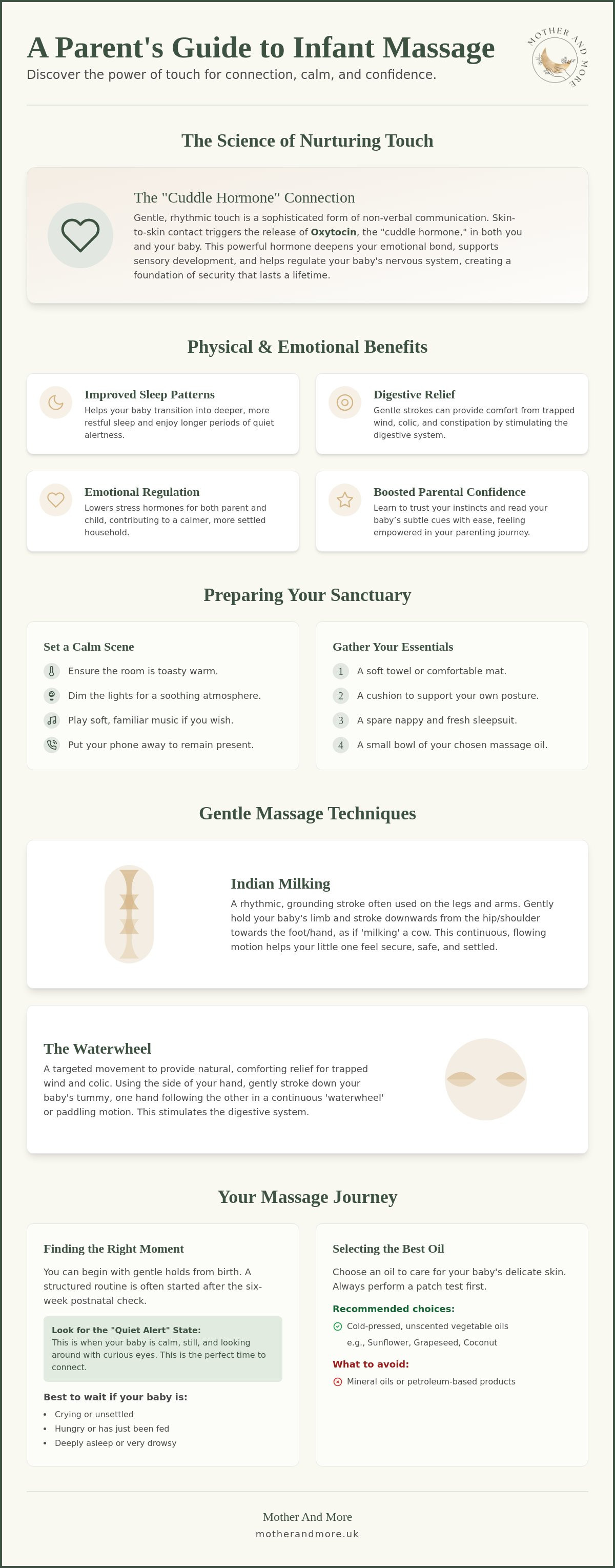
Infant massage is far more than just a sequence of physical movements. It is a gentle, rhythmic stroking of your baby’s body with your hands, a quiet ritual that invites a profound sense of calm into your home. Whilst it might look like a simple activity, it is actually a sophisticated form of non-verbal communication amongst new families. Through the power of touch, you are telling your baby they are safe, loved, and heard. It is a language of love that speaks when words aren't enough. 🤍
The science behind this connection is truly beautiful. Skin-to-skin contact triggers the release of oxytocin, often known as the "cuddle hormone," in both you and your baby. This isn't just about feeling good. A 2026 study highlighted a significant positive effect of infant massage on the development of infants aged 1-3 months. By using infant massage techniques for parents, you are actively supporting your baby’s sensory development and helping to regulate their nervous system, creating a foundation of security that lasts a lifetime.
The Physical and Emotional Benefits
The benefits of this practice ripple through every aspect of your baby’s well-being and your own identity as a parent. You may notice:
Improved sleep patterns: Helping your baby transition into deeper, more restful sleep and longer periods of quiet alertness.
Digestive relief: Gentle strokes can offer comfort from trapped wind, colic, and constipation by stimulating the digestive system.
Emotional regulation: Lowering stress hormones for both parent and child, creating a more settled household.
For many, the most transformative benefit is the boost in parental confidence. In those quiet moments, the noise of the outside world fades. You begin to trust your instincts, learning to read your baby’s subtle cues with ease. It’s a powerful way to reclaim your sense of self and feel empowered amongst the whirlwind of early parenthood.
When to Start Your Massage Journey
You can begin your massage journey almost immediately. Very gentle, still-touch holds are wonderful from birth, though many parents choose to start a more structured routine after their six-week postnatal check. The most important factor isn't the date on the calendar, but rather finding the right moment in your baby’s day. 🕊️
Try to look for your baby’s "quiet alert" state. This is when they are calm, still, and looking around with curious eyes. If they are crying, hungry, or deeply asleep, it is best to wait. Learning to recognise these behavioural states is a skill in itself. Remember, it is never too late to start. Whether your baby is six weeks or six months old, building this favourite daily habit will always be a gift to your relationship.
Preparing Your Sanctuary: Setting the Scene for Connection
Before you begin exploring specific infant massage techniques for parents, it is vital to create a space that feels like a sanctuary. This isn't just about the physical room; it's about the energy you bring to the moment. Ensure the room is toasty warm, as babies lose heat quickly when undressed. Dim the lights, put your phone in another room, and perhaps play some soft, familiar music. When the environment is quiet, you can truly hear what your baby is telling you. 🕊️
Your own state of mind is the foundation of this practice. If you are rushing or feeling anxious, your baby will sense that tension through your touch. Take three slow, deep breaths. Feel your shoulders drop. By centring yourself, you create a safe emotional container for your little one. It's also about finding the right rhythm in your day. Aim for a window when your baby is content but not immediately after a feed, which can cause digestive discomfort, or whilst they are rubbing their eyes in exhaustion.
Gather everything you need beforehand so you don't have to break the connection:
A soft towel or comfortable mat for your baby to lie on.
A cushion or stool to support your own posture.
A spare nappy and a fresh sleepsuit for afterwards.
A small bowl of your chosen massage oil.
Having these essentials within reach allows you to remain entirely present. If you're looking for more hands-on guidance in a supportive environment, our baby massage classes in East London offer a beautiful way to learn these preparations amongst a community of other parents.
Selecting the Best Baby Massage Oil
Choosing an oil is an act of care for your baby’s delicate skin. Many parents find that cold-pressed, unscented vegetable oils like sunflower, grapeseed, or coconut oil are favourite choices. These are often edible and easily absorbed, making them safer than mineral oils or petroleum-based products which can sometimes irritate newborn skin. Always perform a simple patch test on a small area of your baby’s leg and wait twenty-four hours to ensure there is no sensitivity before your first full session.
Communication and Consent
Massage is a dialogue, not something we do "to" a baby. It is a practice we do "with" them. Before you start, place a little oil on your hands and rub them together near your baby’s ears so they hear the familiar sound. Ask, "May I give you a massage?" and look for engagement cues like eye contact, relaxed limbs, or a soft coo. If they turn away, arch their back, or begin to cry, they are communicating a need for space. Respecting these disengagement cues builds a profound sense of trust and bodily autonomy from the very start. Use a gentle, reassuring voice to narrate each stroke, keeping them feeling safe and involved.
Step-by-Step Infant Massage Techniques for Parents
Once you have set your sanctuary and received your baby’s gentle permission, you can begin the rhythmic dance of touch. It is often best to start with the legs. This is a grounding way to begin, as the legs are generally less sensitive than the tummy or face. By starting here, you allow your baby to get used to the sensation of your hands whilst feeling safe and secure. These infant massage techniques for parents are designed to be a slow, mindful conversation between your hands and your baby’s skin. 🤍
Begin with the "Indian Milking" technique. Hold your baby’s ankle with one hand and, with your other hand, create a soft C-shape around the thigh. Gently glide your hand down from the thigh to the ankle in a steady, rhythmic motion. Repeat this several times, then switch hands. It should feel like a firm but tender embrace. This stroke helps to move energy down the body, encouraging a sense of relaxation and peace.
Move your focus to the chest for the "Butterfly" stroke. Place both of your hands together at the centre of your baby’s chest. Gently stroke outwards and upwards, following the curve of the ribcage, as if you are tracing the wings of a butterfly. This movement opens up the breathing space and can be incredibly soothing for a baby who feels a little congested or overwhelmed. For the arms, try "Squeezing and Twisting." Gently hold the arm at the shoulder and move your hands down towards the wrist, using a soft wringing motion. It is a wonderful way to encourage those tiny, often-clenched hands to finally let go and relax.
Focusing on the Tummy and Back
The tummy is a sensitive area where many babies hold their discomfort. The "I Love You" stroke is a favourite sequence amongst parents for aiding digestion. Trace the letter "I" on your baby’s left side (your right), followed by an inverted "L," and finally an inverted "U" across the abdomen. Always follow this with gentle, clockwise circles. This direction follows the natural path of the bowel, helping to move trapped wind or ease constipation. For the back, wait until your baby is happy in tummy time. Use the "Swooping" technique, gliding your hands from the base of the neck all the way down to the bottom. It’s a long, continuous stroke that feels deeply reassuring and helps to strengthen their developing back muscles.
Facial and Head Massage
Tiny faces can hold a surprising amount of tension, especially after a long day of new experiences or a spell of crying. Use your thumbs to trace very gentle strokes across the eyebrows, moving from the centre outwards. This simple movement can help release the stress held in the brow. If your little one is struggling with teething, try making small, soft circles around the jawline to soothe the ache. Finally, the "Open Book" stroke on the forehead is a beautiful way to end. Place your thumbs in the centre of the forehead and stroke outwards towards the temples, as if you are smoothing the pages of a favourite book. It brings a sense of calm and clarity, often acting as a gentle signal that it is time to rest. 🕊️
Targeted Techniques for Common Discomforts
Early parenthood often feels like a series of puzzles, especially when your little one is struggling with physical discomfort. Whilst general bonding is a beautiful foundation, specific infant massage techniques for parents can act as a natural toolkit for those more challenging days. Whether it's the sharp cries of wind or the restless nights of teething, these intentional movements provide a gentle way to offer relief without feeling helpless. By focusing your touch, you are doing more than just soothing a symptom; you are showing your baby that you are there to help them navigate their world. 🤍
A baby’s digestive system is incredibly immature, often taking many months to fully coordinate. This is why so many families find themselves searching for effective baby massage for colic and wind. One of the most effective strokes for this is the "Waterwheel." Place your hands horizontally across your baby’s tummy and use the side of your palms to glide downwards, one hand after the other, as if you are moving water over a wheel. This rhythmic, downward pressure helps to guide trapped gas through the system and provides a physical release for a bloated, tight abdomen.
For constipation, the "Sun and Moon" stroke is invaluable. Your right hand creates a full circle (the sun) clockwise around the navel, whilst your left hand follows with a half-moon shape on the right side of the tummy. This movement mirrors the natural path of the large intestine, encouraging waste to move along. You can also try the "Knees to Tummy" position, gently pressing your baby’s knees towards their chest and holding for a few seconds. This simple posture helps to release physical tension in the lower back and pelvis, often leading to a much-needed release. Remember, consistency is your greatest ally. A daily practice helps prevent the build-up of discomfort before it becomes overwhelming.
Massage for Relaxation and Better Sleep
As evening draws in, massage becomes a sensory bridge between the stimulation of the day and the stillness of the night. Integrating these movements into a baby massage for sleep routine signals to your baby’s nervous system that it is safe to let go. Slow, grounding strokes on the legs and back help to lower cortisol levels and encourage the release of melatonin, the hormone responsible for sleep. 🕊️
Try combining your touch with a favourite lullaby or the soft, steady hum of your voice. This multi-sensory approach creates a powerful anchor for rest, making the transition to the cot much smoother. If you are feeling isolated or unsure about your technique, joining a supportive group can make all the difference. Our Baby Massage Courses are designed to help you master these skills whilst finding your village in a warm, non-judgmental space.
Finding Your Village: Why In-Person Classes Matter
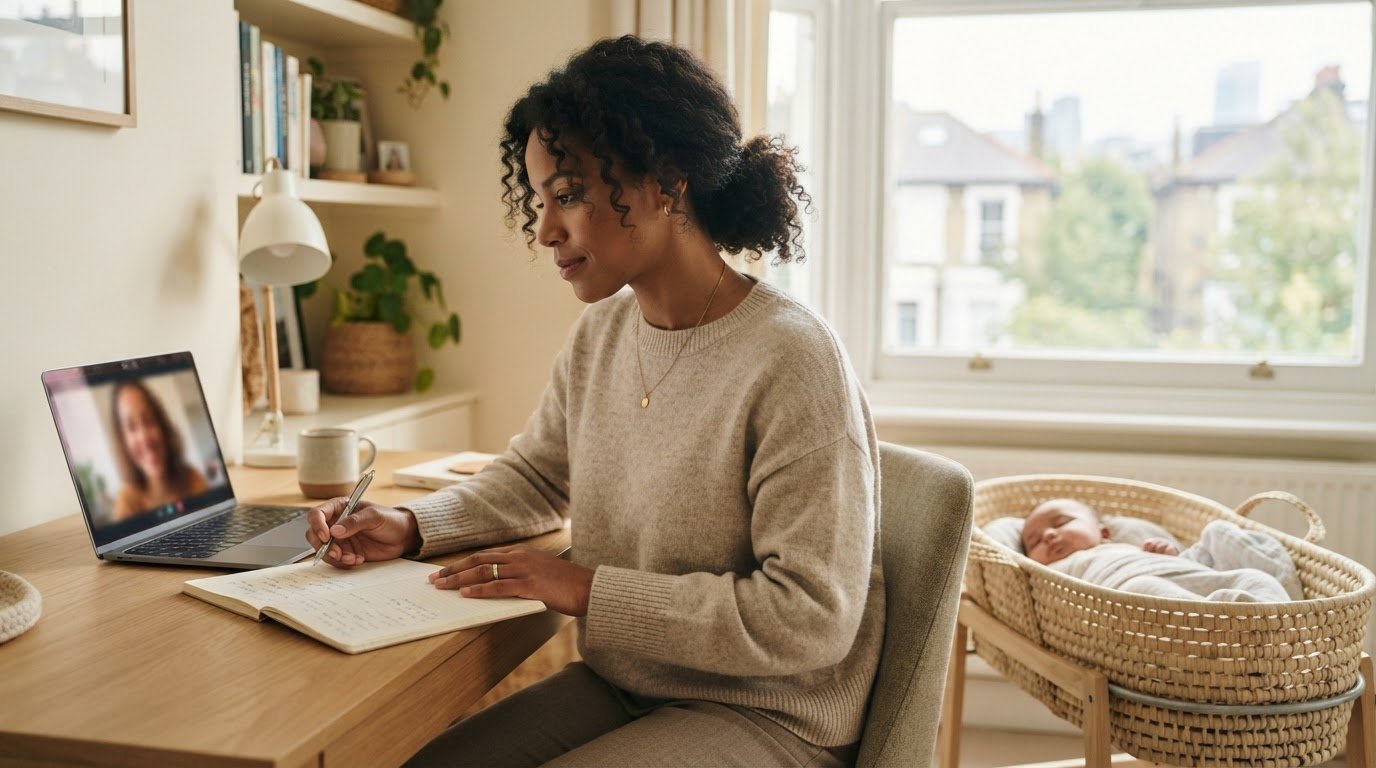
Whilst digital guides provide a wonderful foundation, there is something irreplaceable about the physical presence of a group. Learning infant massage techniques for parents from a screen can sometimes feel clinical or isolating. This is particularly true when you are already spending so much of your day within the four walls of your home. In-person classes offer hands-on guidance that ensures your touch is exactly where it needs to be. More importantly, they provide a sanctuary where the physical technique is just the beginning. It is a space where the shared silence of a room full of babies, or the collective exhale of parents who truly understand, creates a sense of belonging that no video can replicate. 🤍
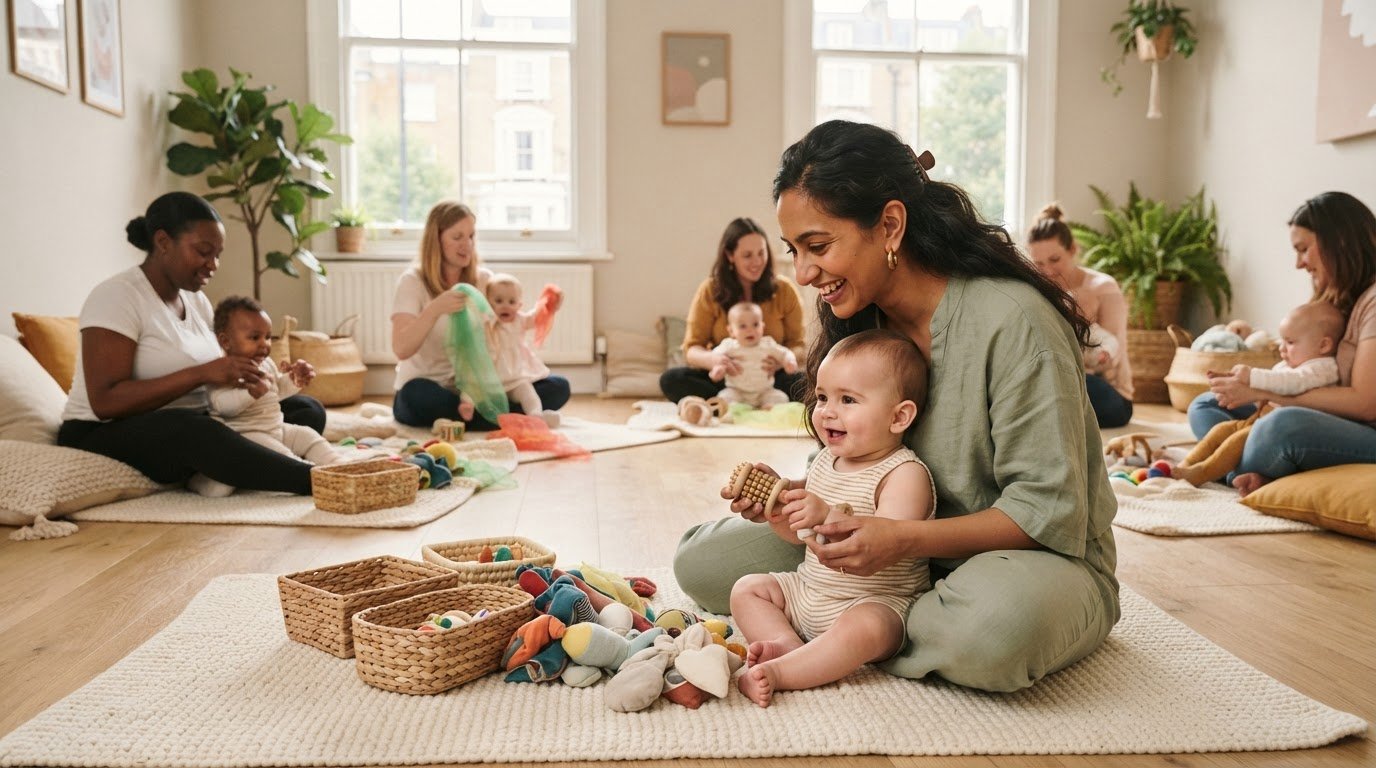
Our baby massage classes east london are designed to be that essential village. We have supported over 2,000 local families, providing a safe space to discuss the complexities of this life transition. It isn't just about the strokes. It's about the emotional shift you are experiencing as you walk through these early months. Amongst the rhythmic movements, there is time to breathe, to share, and to realise that you aren't alone in your worries or your exhaustion. Shared experience is a powerful healer, turning a solitary struggle into a collective journey of growth.
The Mother And More Approach in East London
Rebecca Beazley brings a unique perspective as an accredited life coach and former social worker. Her approach blends professional expertise with deep empathy, acknowledging that your identity is evolving just as fast as your baby. In a typical 5-week course, we look at the holistic wellbeing of both you and your little one. These sessions are a powerful tool for reclaiming identity after motherhood. We help you move from feeling overwhelmed to becoming a confident, empowered individual who understands her own needs as much as her baby's. 🕊️
Nurturing Your Own Wellbeing
We often forget that massage is a mindfulness practice for the parent, too. As you focus on the warmth of your baby’s skin and the steady rhythm of your hands, your own heart rate slows. It is a moment of self-discovery amongst the chaos of nappies and sleepless nights. We believe that you cannot pour from an empty cup. By dedicating this time to your connection, you are also filling your own reservoir of patience and peace. Your wellbeing matters just as much as your little one's. Join our next Baby Massage course in East London to find your village and start this nurturing journey with us.
Embrace the Language of Nurturing Touch
Your journey into infant massage is a beautiful evolution of both your baby's comfort and your own parental confidence. By integrating infant massage techniques for parents into your daily rhythm, you've discovered a powerful way to settle the nervous system and ease the physical strain of colic or trapped wind. You now understand that creating a sanctuary and respecting your baby's cues are the foundations of a lifelong bond built on trust and mutual respect. 🕊️
You don't have to navigate these early transitions in isolation. In the heart of East London, we provide a sanctuary where you can step away from the noise of the world and into a supportive community. Led by accredited life coach Rebecca Beazley, Mother And More has supported over 2,000 London families through our small, nurturing groups. It's a space to master your technique whilst finding your village and reclaiming your sense of self. 🤍
Are you ready to deepen your connection in a space designed with your wellbeing in mind? Book your place at our East London Baby Massage Sanctuary. You're doing a wonderful job, and we're here to hold space for you as you grow.
Common Questions About Infant Massage
Is infant massage safe for all babies?
Yes, infant massage is safe for most babies, but it's always wise to check with your GP or health visitor if your little one has a specific medical condition or was born prematurely. We always recommend waiting at least 48 hours after immunisations to allow any tenderness to subside. Avoid massaging any areas with skin infections or rashes. This gentle practice is about listening to your baby, so their comfort is always the priority. 🤍
How long should a typical baby massage session last?
A typical session usually lasts between 5 and 20 minutes, though this depends entirely on your baby’s mood and age. Newborns might only manage a few minutes of gentle touch, whilst older babies may enjoy a longer routine. There is no need to rush; if your baby becomes restless or overstimulated, it is perfectly fine to stop. Even a few minutes of connection can be deeply beneficial for you both.
What is the best oil to use for infant massage in the UK?
The best choice for delicate skin is an edible, cold-pressed, and unscented vegetable oil, such as sunflower, grapeseed, or coconut oil. These are easily absorbed and free from the harsh chemicals found in some mineral oils. In the UK, many parents find these natural options to be a favourite for daily use. Always remember to perform a patch test on a small area of skin 24 hours before your first full session.
Can I massage my baby if they have a cold or fever?
You should avoid massage if your baby has a fever, as it can inadvertently raise their body temperature further. If they just have a gentle cold, a very soft chest or back massage might offer some comfort, but only if they seem happy to be touched. Always follow your baby’s lead; if they are feeling poorly, they may simply want a quiet cuddle instead of a structured session.
How often should I practice these techniques at home?
Practising infant massage techniques for parents daily is a wonderful way to build a predictable, soothing routine. Many families find that a session after bath time or before bed helps to signal that it is time for rest. However, there is no "right" frequency. Whether you do it every day or a few times a week, the most important thing is that it feels like a joyful, pressure-free moment of connection.
What if my baby cries during the massage?
If your baby begins to cry, the most nurturing response is to stop the massage and offer them comfort. Crying is their way of communicating that they’ve had enough or aren't in the right mood today. You can try again at another time when they are in a "quiet alert" state. Respecting their boundaries in this way builds a profound sense of trust and shows them that their voice is always heard.
Can dads and partners also learn these massage techniques?
Absolutely, and we passionately encourage it. Massage is a beautiful way for dads and partners to build their own unique bond with the baby, especially if they are away at work during the day. It provides a practical tool for them to settle and soothe their little one, boosting their confidence in their parenting skills. We even offer dedicated workshops for dads to help them find their own rhythm in a supportive environment.
Do I need to wait until after the 6-week check to start?
You don't need to wait for the 6-week check to begin gentle touch. Whilst many structured infant massage techniques for parents are best introduced after six weeks, you can use "still touch" and very soft strokes from the moment your baby is born. This early skin-to-skin contact is vital for bonding. Just ensure you are always following your baby’s cues and keeping the sessions very brief and gentle in those first few weeks. 🕊️
Comments