

Reclaiming Identity After Motherhood: A Nurturing Guide to Finding Yourself Again
Updated: Jul 13
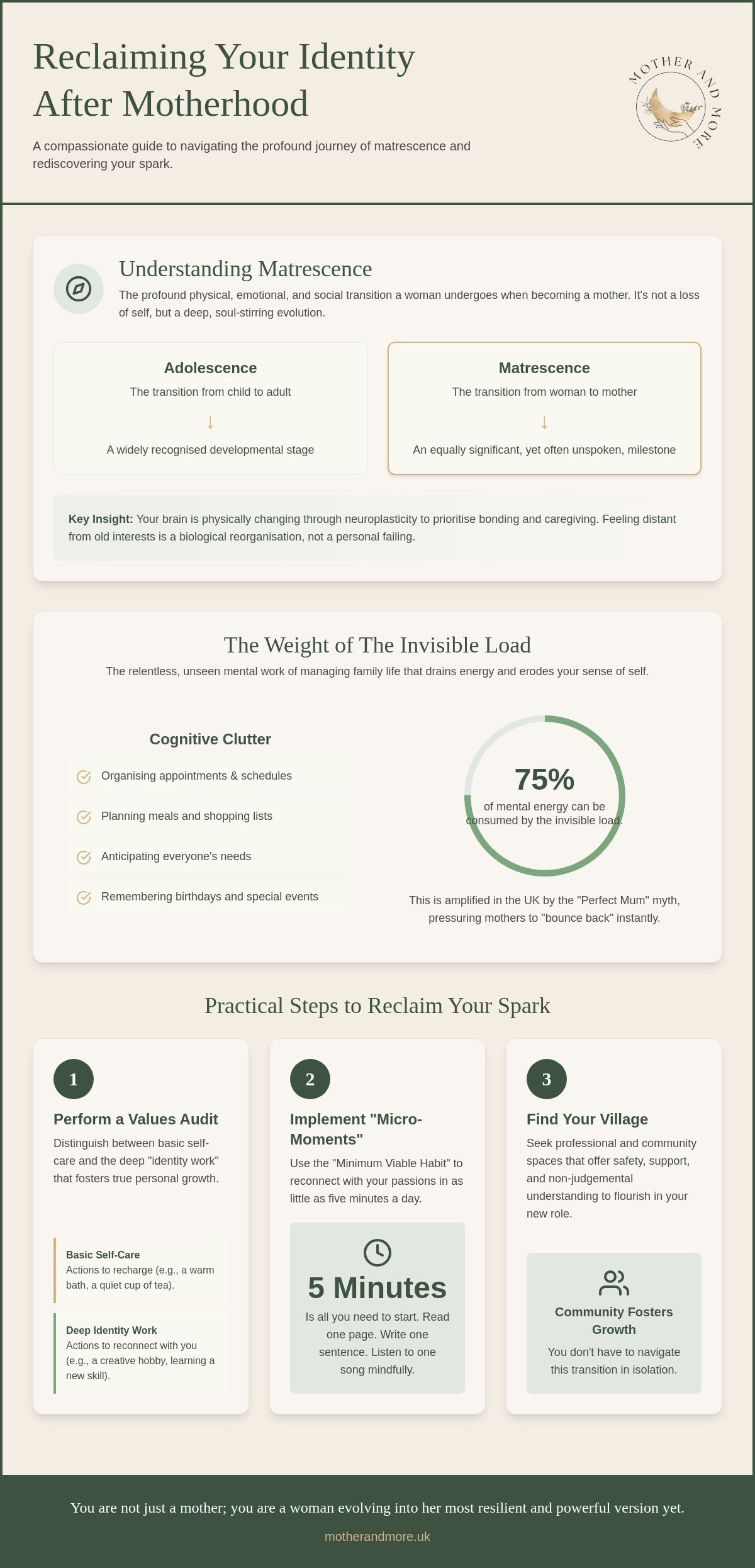
You're standing in the kitchen, tea getting cold for the third time today, and you suddenly realise you can't remember the last thing you did just for you. Not for the baby, not for the house, but for the woman who existed before the nappies and the sleepless nights. It's a heavy, quiet feeling. You're not alone in this. Feeling like you've become "just a mum" isn't a sign of failure; it's a natural part of a profound transition called matrescence. 🌿
The journey of reclaiming identity after motherhood isn't about going back to who you were. It's about integrating your old passions with your new, powerful role. I promise to help you navigate this shift with grace and self-compassion. You'll discover practical ways to rediscover your spark and shed the guilt of wanting time for yourself, whilst embracing the mother you've become. We'll explore small, nurturing steps to help you regain your professional confidence and look forward to a future where you feel vibrant, excited, and whole again.
Table of Contents
Understanding Matrescence: Why Reclaiming Identity After Motherhood is a Journey, Not a Destination
Mapping Your Evolution: Identifying Your Needs Beyond the Nappy Bag
Practical Steps to Rediscover Your 'Unicorn Space' and Passions
Finding Your Village: How Professional Support and Community Foster Growth
Understanding Matrescence: Why Reclaiming Identity After Motherhood is a Journey, Not a Destination
Have you ever looked in the mirror and wondered where she went? The woman who loved spontaneous weekend trips or spent hours lost in a novel. Reclaiming identity after motherhood often feels like trying to find a path through a thick mist. It's quiet. It's confusing. And it's entirely normal. You might feel a strange sense of guilt for missing your old life, but that doesn't mean you love your child any less. It simply means you're human.
This profound shift has a specific name: matrescence. Just as adolescence marks the transition from child to adult, matrescence is the physical, emotional, and social birth of a mother. The term was first introduced by the anthropologist Dana Raphael, who recognised that becoming a mother is a developmental milestone as significant as puberty. It isn't an overnight event. It's a deep, soul-stirring evolution that touches every corner of your being, from your hormones to your very sense of purpose.
The Biological Shift of the Motherhood Transition
Your brain is actually changing. During pregnancy and early motherhood, your "maternal brain" undergoes remarkable neuroplasticity. It's pruning away old connections to make room for new ones that prioritise your baby's survival and bonding. If your old interests feel a bit "grey" or distant right now, don't worry. Your cognitive centre is simply reorganising. You haven't lost your intelligence or your spark; your focus has just been redirected by nature to help you navigate this new landscape.
Moving from 'Identity Loss' to 'Identity Evolution'
Instead of trying to find your "old self", let's focus on building a new one. Matrescence is the developmental bridge that connects your past experiences with your future potential. You don't have to navigate this transition in isolation. Many women find that one to one life coaching for mums provides the dedicated, non-judgmental space needed to untangle these complex feelings. It's about looking forward with curiosity. You're not just a mother; you're a woman who is evolving into her most resilient and powerful version yet. ✨
The Invisible Load and the 'Perfect Mum' Myth in the UK
You're likely carrying a weight that doesn't have a physical shape. It's the invisible to-do list that runs like a ticker-tape through your mind from the moment you wake until you finally close your eyes. This is the mental load. It isn't just about doing the laundry; it's about remembering that the toddler needs new shoes by Thursday and that the health visitor is arriving on Tuesday morning. When your mind is crowded with this cognitive clutter, there's very little room left for personal dreaming or creative thought. ☁️
The process of reclaiming identity after motherhood is often stalled by this constant mental management. It drains your energy before you've even had a chance to think about what you might want for yourself. In the UK, this is amplified by a "Superwoman" narrative that expects us to "bounce back" almost instantly. We're often surrounded by social media images of perfectly tidy homes and serene "beige" aesthetics. This toxic positivity masks the messy, exhausting reality of matrescence, making us feel that if we aren't thriving in every moment, we must be failing. It's a myth that serves no one.
How the Mental Load Erases Personal Agency
The mental load is the planning, the remembering, and the relentless organising of family life. It's exhausting. Because this work is invisible, it often goes unacknowledged, even by ourselves. When every "spare" thought is dedicated to the household, your own agency begins to slip away. You stop being the protagonist of your own life and become the manager of everyone else's. I invite you to take a gentle breath and audit your day. Which of these mental tasks can be shared with a partner? Which can be simplified? Reclaiming your space starts with clearing the clutter that doesn't belong to you.
Challenging the UK's 'Superwoman' Narrative
The UK childcare landscape adds a unique layer of pressure. With the average cost of a full-time nursery place for a child under two in England reaching approximately £7,441 per year (even with funding), the financial weight is significant. This often leads to a "return to work" guilt or a feeling of being trapped by logistics. You might feel you have to prove you haven't "lost your edge" professionally, whilst simultaneously being the primary caregiver at home. 🌿
Breaking free from this narrative requires firm boundaries and a shift in perspective. It's about recognising that you deserve to exist outside of your roles as "employee" and "mother". Exploring life coaching for mums uk can be a transformative way to navigate these cultural pressures. It provides a sanctuary to dismantle the "Perfect Mum" myth and start reclaiming identity after motherhood on your own terms. You don't have to do it all, and you certainly don't have to do it alone.
Mapping Your Evolution: Identifying Your Needs Beyond the Nappy Bag
Once you've acknowledged the weight of the mental load, the next step in reclaiming identity after motherhood is turning your gaze inward. For a long time, your needs may have been secondary to the rhythmic demands of feeding, sleeping, and soothing. It's common to reach a point where you feel like a stranger to yourself. However, this isn't because you've disappeared. It's because you've evolved. The woman you were before children still exists, but she's now integrated with a version of you that is more resilient, patient, and complex than ever before. 🌿
To begin this mapping process, we must distinguish between self-care and identity work. Self-care is maintenance; it's the hot shower, the nutritious meal, or the early night that keeps your "engine" running. Identity work, however, is about growth. It's the intentional act of pursuing things that make you feel like a whole person. This might mean revisiting an old hobby with fresh eyes or exploring a new interest that didn't even exist on your radar before you became a mother. Rediscovering where you feel "competent" outside of your parenting role is a powerful way to rebuild your self-esteem.
The Self-Audit: Questions to Ask Your New Self
Reclaiming your spark requires a gentle investigation. Grab a notebook and find a quiet five minutes to sit with these questions. Be honest and kind to yourself as you answer:
What brings me joy that has nothing to do with my children? Think about the activities that make time move differently, whether it's gardening, coding, or simply listening to a specific genre of music.
Where do I feel most like 'me' in my current week? Identify the moments where you aren't just "Mum". Is it during a work meeting, a solo walk, or whilst chatting with a friend about non-baby topics?
What did I used to love that no longer fits, and that's okay? You're allowed to outgrow previous versions of yourself. Letting go of old expectations makes room for new passions to bloom.
Rediscovering Your Inner Strength
Your identity isn't just about what you do; it's about the qualities you carry. Confidence coaching for mothers can be an incredible tool to help you bridge the gap between "Mum" and "Me", providing the structure to see your worth clearly again. When we focus on our inner strength, we create a solid foundation for reclaiming identity after motherhood. ✨
Try listing three non-parenting strengths you possess. Perhaps you're a brilliant strategic thinker, an empathetic listener, or someone with a sharp, dry wit. These traits haven't vanished. They're part of the unique tapestry of who you are. By acknowledging these strengths, you start to see that you are, and always have been, more than enough.
Practical Steps to Rediscover Your 'Unicorn Space' and Passions
Finding an hour for yourself might feel like a fantasy right now. If you're waiting for a clear, quiet afternoon to begin reclaiming identity after motherhood, you might be waiting a long time. Instead, let's embrace the concept of "Micro-Moments". This is your "Unicorn Space" adapted for the reality of nursery runs and laundry piles. It's about the Minimum Viable Habit. Can you commit to just five minutes of sketching, writing, or learning a new skill? Five minutes of focused curiosity is infinitely more powerful than sixty minutes of "someday". 🌿
The key is to lead with curiosity rather than the pressure of mastery. You don't need to be "good" at your new hobby; you just need to enjoy the process of doing it. Whether you are trying something new at home or attending a social sip and paint Portsmouth event, the focus should be on joy. Communicate this need clearly to your partner or support network. It isn't about asking for a favour; it's about sharing the responsibility of family life so you can maintain your mental well-being. When you explain that this time helps you feel more like yourself, it becomes a shared goal for the whole family.
Creating Boundaries for Creative Curiosity
Claiming even 15 minutes of uninterrupted time whilst at home requires a gentle but firm boundary. It helps to have a physical "centre" that belongs solely to you. This could be a specific desk, a dedicated craft box, or even just your yoga mat unrolled in the corner. When you are in this space, it signals to your brain—and your family—that this time is yours. Use the mantra "amongst the chaos" to remind yourself that progress doesn't have to be perfect. You can find your spark even when the house isn't tidy. ✨
Navigating the Career Transition
For many women, returning to work is a pivotal moment in reclaiming identity after motherhood. It can feel like a collision between the professional you used to be and the mother you are now. This friction is natural, but it can be managed with the right support. If you're struggling to find your feet in the professional world again, exploring career coaching after baby can provide a nurturing guide to navigating your return.
Maintaining your sense of self during the "9 to 5" shift involves setting boundaries that protect your energy. It's about recognising that your professional skills have likely been enhanced by the resilience and multitasking you've developed as a mother. If you're ready to explore these transitions more deeply, our One to One Life Coaching offers a safe, professional space to untangle your goals and rediscover your confidence.
Finding Your Village: How Professional Support and Community Foster Growth
Trying to navigate the complexities of matrescence in isolation is perhaps the most exhausting way to live. We weren't meant to raise children or rediscover ourselves in a vacuum. Yet, so many of us find ourselves "going it alone", tucked away in our homes and scrolling through digital forums for a sense of connection. True growth happens when we step into physical spaces where we are seen, heard, and held. 🌿
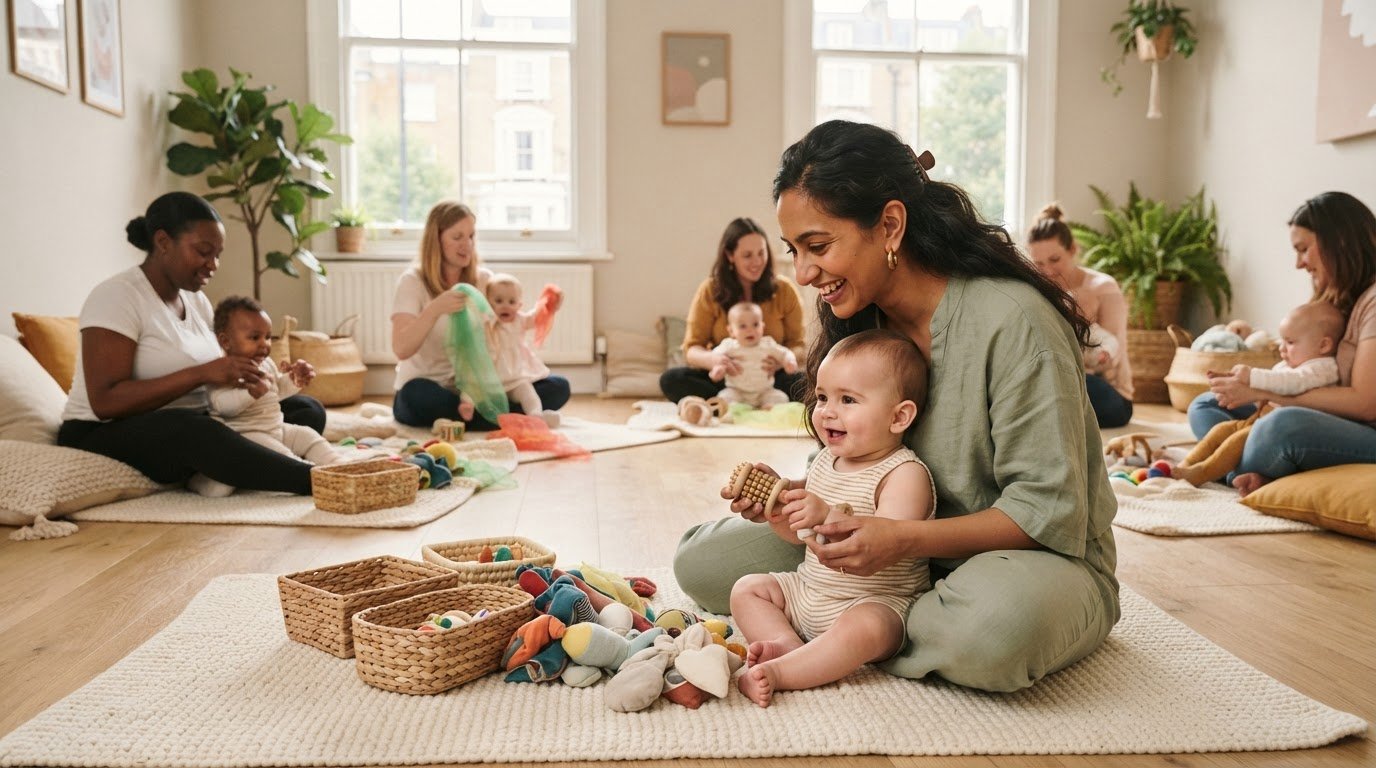
Community is a vital catalyst for reclaiming identity after motherhood. It's about finding those who understand the unspoken weight of the mental load without you having to explain it. When you join baby massage classes in East London, you aren't just learning how to soothe your little one. You're entering a sanctuary where your well-being is just as important as your baby's. Similarly, participating in baby yoga provides a gentle path for postnatal recovery whilst placing you firmly amongst your "village". These spaces allow you to breathe, move, and remember that you exist as an individual.
Group coaching offers another layer of transformation. There is a profound power in hearing another woman voice the exact fears and desires you've been keeping quiet. It validates your struggle and reminds you that your need for an identity beyond parenting is entirely normal. By sharing these experiences, the "grey" feelings begin to lift, replaced by a collective strength that carries you forward. ✨
The Power of Local Community in East London
In-person connection offers something that digital scrolling never can: the warmth of a shared look and the comfort of a physical presence. Whilst digital groups have their place, they can often feel like an endless loop of comparison. In a local baby class, the shared experiences are raw and real. You see the tired eyes, the messy bags, and the genuine smiles. In these moments, your instructor acts as a trusted companion, guiding you through the session whilst holding space for your personal evolution. These real-world interactions often trigger the most significant identity realisations because they happen in real time, amongst real friends.
Your Next Steps: A Nurturing Invitation
Reclaiming your identity is not a race. It is a slow, beautiful unfurling of the woman you are meant to be. You've explored the biological shifts, the cultural pressures, and the practical ways to carve out your own "Unicorn Space". Now, I encourage you to choose just one small action today. Perhaps it's booking a class, or maybe it's simply writing down those three non-parenting strengths we discussed earlier. 🌿
Always remember that you are Mother And More. The "More" isn't a separate person you have to find; she is already there, waiting to be explored and nurtured. You deserve to feel vibrant. You deserve to feel whole. We are here to walk alongside you as you step into this next, exciting chapter of your life. 🌸
Embrace Your Evolution and Step Into Your 'More'
You've navigated the quiet shifts of matrescence and challenged the myths that once held you back. You now know that your spark hasn't vanished; it's simply waiting for the space to breathe. By embracing micro-moments of curiosity and leaning into your village, the journey of reclaiming identity after motherhood becomes a beautiful, intentional evolution. It's about honouring the woman you were whilst celebrating the resilient, powerful person you've become. 🌿
At Mother And More, we believe you deserve a sanctuary where your growth is the priority. Founded by Rebecca Beazley, an accredited life coach, we've supported over 2,000 London families through this profound life transition. Our empathetic, non-judgemental approach is designed to build your confidence and provide a sense of calm amongst the chaos. Whether you seek the connection of our baby classes or the depth of one to one coaching, we are your trusted companion on this path.
Discover our life coaching and nurturing baby classes to help you reclaim your 'More'. Your "More" is waiting to be explored, and we can't wait to see you shine. ✨
Frequently Asked Questions
Is it normal to feel like I don't know who I am after having a baby?
It is entirely normal and expected to feel a shift in your sense of self. This transition, known as matrescence, is a profound psychological and hormonal evolution that rivals adolescence in its intensity. You aren't losing yourself; you're undergoing a massive internal reorganisation. Acknowledging this change is the first step in reclaiming identity after motherhood, allowing you to move from a place of confusion to one of curious self-discovery. 🌿
How can I find time for myself when my baby is so demanding?
Finding time starts with lowering the bar for what "time for me" looks like. Instead of waiting for a free hour, look for "Micro-Moments" of five to fifteen minutes. This might be sketching whilst your baby naps or listening to a podcast during a pram walk. By focusing on these small pockets of time, you build a consistent habit of self-connection without the pressure of finding a long, uninterrupted block of childcare.
What is the difference between postnatal depression and an identity crisis?
Postnatal depression is a clinical health condition involving persistent low mood, hopelessness, and difficulty bonding. An identity crisis, or matrescence, is a developmental transition where you feel a disconnect between your old life and your new role. While they can overlap, matrescence is a natural part of the journey. If you feel unable to cope or find no joy in anything, please speak with your GP or a healthcare professional for clinical support.
How do I deal with the guilt of wanting to do things without my child?
Guilt often stems from the "Perfect Mum" myth that suggests you must be entirely self-sacrificing to be good at your role. Reframe this desire as a vital part of your well-being. When you nurture your own interests, you return to your child with more patience, energy, and joy. Taking time for yourself isn't taking away from your baby; it's investing in the person who cares for them. ✨
Can life coaching really help me find my identity again?
Life coaching provides a structured, non-judgemental space to untangle your thoughts and set intentional goals. An accredited coach helps you navigate the transition of reclaiming identity after motherhood by identifying your core values and building your confidence. It's about having a trusted companion who walks alongside you, offering professional tools to help you bridge the gap between "Mum" and the "More" you're longing to explore.
What are some easy hobbies for new mums to start with?
Start with hobbies that have a "low barrier to entry" and can be stopped and started easily. Creative writing, adult colouring, container gardening, or gentle yoga are wonderful options. The goal isn't mastery; it's the simple act of engaging your brain in something that isn't related to household management. Choose something that feels like a treat rather than another task on your growing to-do list. 🌸
How do I explain to my partner that I need to reclaim my identity?
Open the conversation with "I" statements to express how you're feeling without sounding like you're blaming them. You might say, "I've been feeling a bit lost lately, and I need to spend some time on my own interests to feel like myself again." Explain that having this space makes you a more present and resilient partner and mother. It's about inviting them to be part of the solution in supporting your evolution.
When is the best time to start focusing on 'me' again?
There is no "perfect" date on the calendar to begin this process. For some, it's a few months after birth; for others, it's when their child starts nursery or school. The best time is simply whenever you feel that first spark of desire to reconnect with yourself. You don't need to wait for life to be less busy. Start today with one small, nurturing action that reminds you of your own worth.


Comments