

Reclaiming Identity After Motherhood: A Nurturing Guide to Finding Yourself Again
What if the version of you that feels lost since becoming a mother isn't gone at all, but simply in the middle of one of the most profound transformations a human being can experience? 🌿 Reclaiming identity after motherhood begins with understanding that what you're feeling isn't a personal failing. It's a sign that something significant is happening within you.
You already know this feeling intimately. The quiet ache of scrolling through old photos and barely recognising the woman smiling back. The guilt that creeps in the moment you dare to want something just for yourself. The exhaustion of carrying an invisible load that nobody seems to fully see, let alone share. These feelings are real, they are valid, and you are absolutely not alone in them. 💛
In this guide, we're going to explore the concept of matrescence, a developmental shift as significant as adolescence, and why it holds the key to understanding everything you've been feeling. You'll find gentle, practical steps to begin rediscovering your passions, rebuilding your confidence, and embracing a future that holds space for both the mother you are and the woman you're becoming.
Table of Contents
Understanding Matrescence: Why Reclaiming Identity After Motherhood is a Journey, Not a Destination
Mapping Your Evolution: Identifying Your Needs Beyond the Nappy Bag
Practical Steps to Rediscover Your 'Unicorn Space' and Passions
Finding Your Village: How Professional Support and Community Foster Growth
Understanding Matrescence: Why Reclaiming Identity After Motherhood is a Journey, Not a Destination
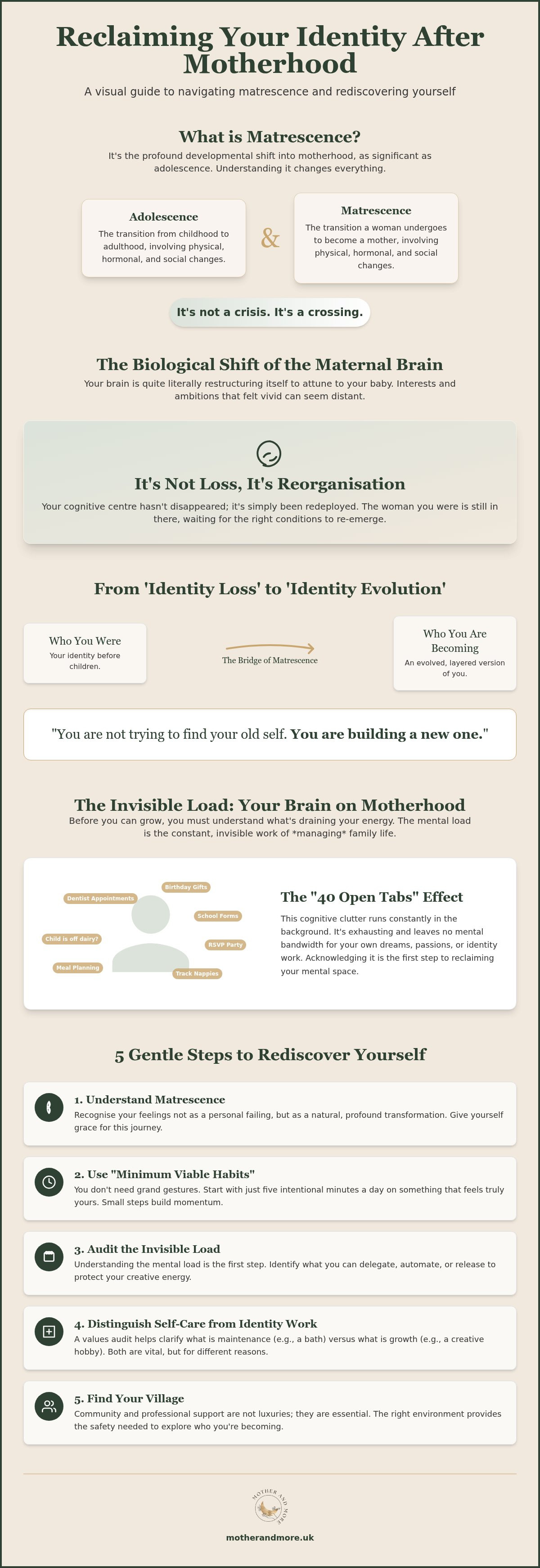
There's a word for what you're experiencing. It's called matrescence, and it changes everything once you understand it. Coined by anthropologist Dana Raphael in the 1970s and brought back into the cultural conversation by reproductive psychiatrist Dr. Alexandra Sacks, matrescence describes the physical, emotional, hormonal, and social transition a woman moves through as she becomes a mother. It is, in every meaningful sense, as significant a developmental shift as adolescence. And just like adolescence, it doesn't happen overnight, and it certainly doesn't resolve itself tidily.
That feeling of not quite recognising yourself? It's not a crisis. It's a crossing.
The Biological Shift of the Motherhood Transition
Your brain is quite literally restructuring itself. Research published in Nature Neuroscience found that pregnancy triggers measurable changes in grey matter, a process scientists call the maternal brain adaptation. These neurological shifts are purposeful; your brain is reorganising its priorities around attunement, vigilance, and the survival of your baby. The result is that interests, ambitions, and pleasures that once felt vivid and close can feel temporarily distant, almost greyed out, as though someone has turned the brightness down on the parts of you that existed before.
This isn't loss. It's reorganisation. Your cognitive centre hasn't disappeared; it's simply been redeployed. Understanding this distinction is quietly powerful, because it means the woman you were is still in there, waiting for the conditions that allow her to re-emerge.
Moving from 'Identity Loss' to 'Identity Evolution'
Here's the shift that matters most: you are not trying to find your old self. You are building a new one. Matrescence is the developmental bridge between who you were before children and who you are becoming because of them, and that bridge is worth crossing with intention rather than anxiety.
Reclaiming identity after motherhood, then, isn't about returning to a previous version of yourself. It's an ongoing, layered practice of discovering what still fits, what no longer serves you, and what entirely new parts of yourself are waiting to be explored. This is precisely where working with a life coach who specialises in supporting mothers can be genuinely transformative. Rather than simply managing the overwhelm, one-to-one life coaching offers a structured, compassionate space to actively navigate who you're becoming, at a pace that honours where you are right now. 🌿
The Invisible Load and the 'Perfect Mum' Myth in the UK
Before you can even begin reclaiming identity after motherhood, it helps to understand what's actively working against you. And one of the most significant, least-discussed barriers isn't a lack of ambition or self-awareness. It's the sheer, relentless weight of the mental load.
How the Mental Load Erases Personal Agency
The mental load isn't the doing of family life. It's the managing of it. It's the part of your brain that holds the dentist appointments, remembers which child is off dairy this week, tracks when the school trip money is due, and plans meals around a toddler's inexplicable new aversion to pasta. It runs constantly, quietly, in the background, like a browser with forty tabs open that nobody else can see.
This kind of cognitive clutter is exhausting in a way that's genuinely difficult to articulate, because it leaves no visible trace. You haven't run a marathon. You've simply thought, planned, and remembered on behalf of everyone else, all day, every day. And when your mental bandwidth is perpetually consumed by logistics, there is simply no space left for personal dreaming. No room to ask yourself what you actually want. No quiet corner of the mind where your own identity can begin to take shape again.
A gentle place to begin is an honest audit of the tasks you're currently holding. Which of them could be shared? Which could be simplified, automated, or quietly released without the world ending? You don't need to overhaul everything at once. Even reclaiming one small pocket of mental space can feel like opening a window in a room that's been sealed shut for years. 🌿
Challenging the UK's 'Superwoman' Narrative
In the UK, there's a particular cultural pressure layered on top of all of this. Maternity leave, whilst a genuine lifeline, can paradoxically become a pressure cooker of expectation. The unspoken narrative is that you should use this time to bond beautifully, recover seamlessly, and prepare to re-enter the workforce as capable and driven as ever, perhaps more so. The 'bounce back' culture applies not just to your body, but to your entire professional identity.
The UK's childcare landscape adds another layer of complexity. With some of the highest childcare costs in Europe, many mothers face an impossible equation: return to work to feel like yourself again, but potentially earn little more than the cost of the childcare that makes it possible. That tension isn't a personal failure. It's a structural one. Yet the weight of it lands squarely on individual women, who are left quietly wondering why they can't seem to hold it all together.
Social media compounds this beautifully. Feeds full of mothers who appear to be thriving, glowing, building businesses from nap times and running 5Ks at six weeks postpartum, create a distorted mirror. And when the reality of identity struggle sits beneath a surface of curated contentment, toxic positivity rushes in to fill the gap. "Cherish every moment." "You've got this, mama." Well-meaning phrases that, in the wrong moment, can make a woman feel even more isolated for not feeling the way she's apparently supposed to.
The 'Perfect Mum' myth isn't just an aesthetic ideal. It's a barrier to authentic self-expression, because it leaves no room for the messy, necessary work of figuring out who you actually are beneath the role. Understanding this is the first act of resistance. The second is finding support that meets you in the reality of where you are, not the highlight reel version of where you're supposed to be. Life coaching for mums in the UK offers exactly that kind of grounded, boundaried space, somewhere to be honest, to be seen, and to begin building a version of yourself that's truly yours. 💛
Mapping Your Evolution: Identifying Your Needs Beyond the Nappy Bag
Knowing that matrescence is real, and that the mental load is quietly consuming your bandwidth, is genuinely important. But understanding the problem is only half of it. The next step in reclaiming identity after motherhood is turning inward with curiosity rather than criticism, and beginning to map what you actually need now, not who you were before, and not who you think you should be.
Here's a distinction worth sitting with: self-care is maintenance; identity work is growth. A bath, a walk, an early night; these things matter, and they're not trivial. But they restore you to zero. Identity work is what takes you somewhere new. It's the difference between filling the tank and deciding where you actually want to drive.
The Self-Audit: Questions to Ask Your New Self
A values audit doesn't need to be a formal exercise. It simply means pausing long enough to ask honest questions, and being willing to sit with the answers without judgement. Try these as a starting point:
What brings me joy that has nothing to do with my children? Not what you think should bring you joy. What actually does, even in small, fleeting moments?
Where do I feel most like 'me' in my current week? Even one moment counts. Notice it. That's a clue.
What did I used to love that no longer fits? And here's the gentle permission slip: that's okay. You're allowed to have outgrown things. Grief and growth can coexist.
One thing the "just go back to your old hobbies" advice misses entirely is that motherhood can genuinely birth new interests you've never explored before. A love of writing that didn't exist pre-baby. A pull towards community work, or creativity, or advocacy. These emerging threads are just as valid as anything you left behind, and they deserve your attention.
Rediscovering Your Inner Strength
Identity reclamation isn't built on interests alone. It's built on a felt sense of competence, that quiet, grounding knowledge that you are capable of things beyond keeping small humans alive. When that sense erodes, everything else feels shakier. Confidence coaching for mothers bridges exactly this gap, helping you move from "I'm just a mum" to a fuller, truer understanding of who you are and what you bring to the world.
Try this: write down three strengths that have nothing to do with parenting. Perhaps you're a natural connector of people. A clear thinker under pressure. Someone who makes others feel genuinely seen. These aren't small things. They're the foundation everything else gets built on. 💛
Practical Steps to Rediscover Your 'Unicorn Space' and Passions
You may have come across the idea of a 'Unicorn Space', that active, creative pursuit that belongs entirely to you, with no practical purpose and no audience to please. It's a genuinely beautiful concept. But the version that suggests you need a full, uninterrupted hour each day to make it meaningful? For a burnt-out mum in the middle of real life, that can feel less like an invitation and more like another item on the to-do list you're already failing at.
Here's what actually works. The Minimum Viable Habit. Five minutes. Not sixty. Not even fifteen. Five.
The principle is simple: doing something for five minutes, consistently, builds a relationship with it. You're not trying to become a concert pianist or publish a novel by Friday. You're simply keeping the door open to a part of yourself that motherhood hasn't closed, only quietened. Reclaiming identity after motherhood doesn't require grand gestures; it requires small, repeated acts of showing up for yourself.
Think of it as Micro-Moments rather than marathon sessions. Five minutes of sketching whilst the kettle boils. A single paragraph of journalling during the school run wait. Three minutes of stretching before the house wakes up. These aren't consolation prizes. They're the actual building blocks of a life that feels like yours again.
Creating Boundaries for Creative Curiosity
One of the most underestimated shifts you can make is creating a physical anchor for your personal space, even a modest one. A dedicated desk corner. A craft box that lives on the shelf. A yoga mat that doesn't get rolled away and forgotten. These aren't luxuries; they're signals to your nervous system that this space exists for you. When something has a home, it's far easier to return to it.
Claiming fifteen minutes of genuinely uninterrupted time whilst at home begins with a conversation, not a schedule. Tell your partner, or whoever shares your space, what you need and why it matters. Not as a request, but as an honest statement: "This is what helps me feel like myself." Most partners, when they truly understand the weight of what you're carrying, want to help. They simply need the specificity.
And when the chaos interrupts anyway, because it will, adopt this as your mantra: amongst the chaos is enough. Imperfect progress is still progress. A half-finished painting, a paragraph abandoned mid-thought, a five-minute walk that got cut to three. It all counts. 🌿
Approach new interests with curiosity rather than the pressure of mastery. You don't need to be good at something for it to nourish you. Trying pottery, learning a language, picking up a camera, none of these require a destination. They simply require your willingness to begin.
Navigating the Career Transition
Returning to work, whether at six months or three years postpartum, is one of the most identity-charged moments in the entire motherhood journey. It can feel like a homecoming and a grief simultaneously. The professional self you were before may still be there, but she's sitting alongside someone new, someone with different priorities, a recalibrated sense of what matters, and perhaps a very different vision of what she wants her working life to look like.
For many UK mothers, the return to the 9-to-5 brings a particular kind of friction: the sense that you're performing a version of yourself that no longer quite fits. If that resonates, career coaching after baby offers a grounded, practical space to work through that transition with intention rather than anxiety.
In the meantime, a few anchors can help:
Protect one non-work interest that you maintain regardless of how busy the working week becomes. Even a small creative practice kept alive during employment is an act of reclaiming identity after motherhood.
Resist the urge to over-prove yourself in the early weeks back. You have nothing to compensate for.
Notice what energises you at work now, not what used to. Your values may have shifted, and that's worth paying attention to.
If you're ready to begin exploring what this next chapter could genuinely look like for you, one-to-one life coaching with Mother And More offers exactly the kind of thoughtful, personalised support to help you move forward with clarity and confidence. 💛
Finding Your Village: How Professional Support and Community Foster Growth
There's a particular kind of loneliness that lives inside a busy house. You're surrounded by people, yet the version of you that exists beyond the role of mother can feel entirely unseen. Reclaiming identity after motherhood is genuinely harder when you try to do it in isolation, not because you lack the strength, but because identity is fundamentally relational. We understand ourselves more clearly when we're reflected back by others who truly see us.
Going it alone means carrying every question, every doubt, and every small breakthrough without anyone to witness it. Community doesn't just make the journey warmer. It makes it faster, more sustainable, and far less frightening.
The Power of Local Community in East London
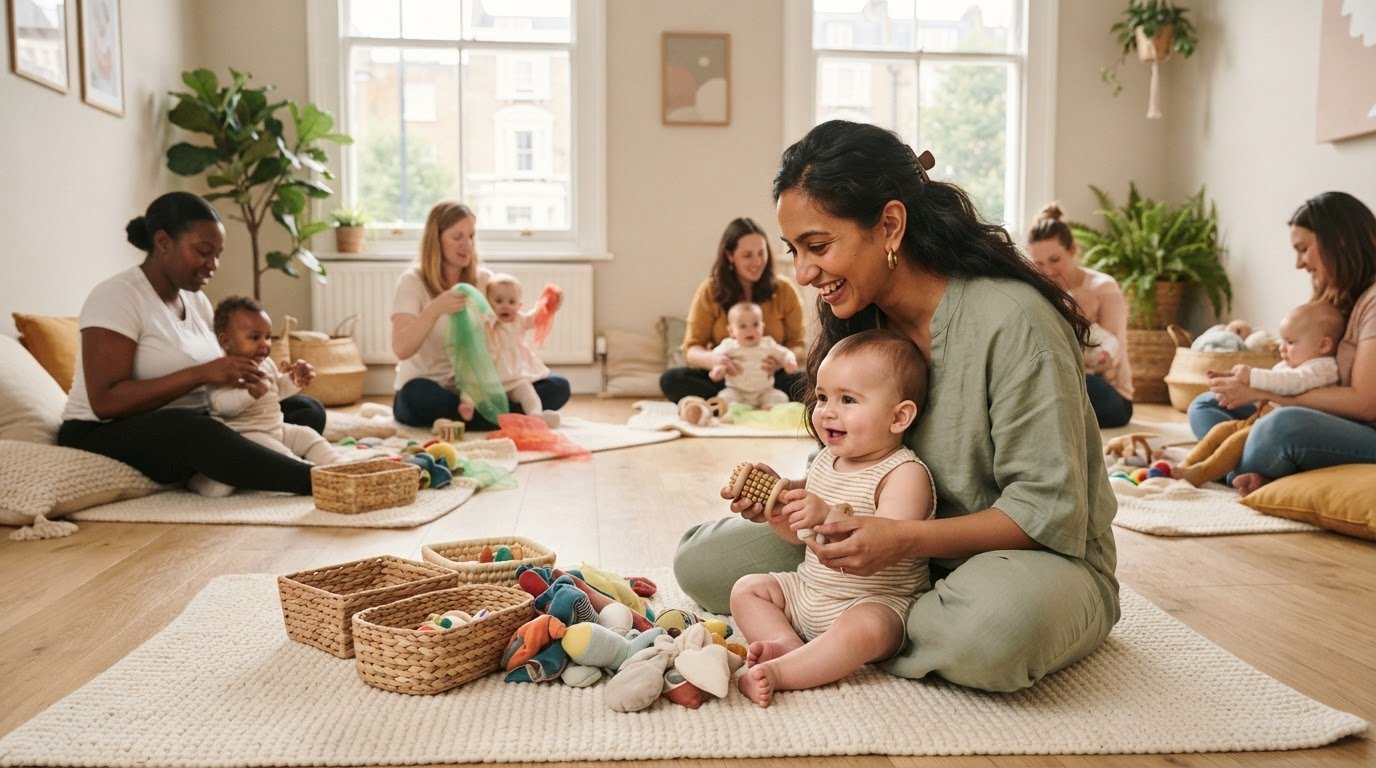
There's something quietly transformative about being in a room with other mothers who are in the same season of life. Not scrolling past their highlights on a screen, but sitting alongside them, watching them navigate the same uncertainties, laugh at the same chaos, and reach for the same small moments of themselves. In-person connection does something that digital community simply cannot replicate: it makes your experience feel real and shared, rather than private and shameful.
Baby massage classes in East London offer exactly this kind of grounded, embodied space. What begins as learning a practical skill for your baby quietly becomes something else entirely: a room where conversation flows honestly, where someone else says the thing you haven't dared say aloud, and where you realise, with genuine relief, that you are not the only one feeling this way. That moment of recognition, "oh, you too?", is one of the most powerful catalysts for identity reclamation there is.
Baby yoga carries its own particular gift. The gentle, rhythmic nature of the practice creates a settling in the nervous system that many mothers describe as the first time they've felt present in their own body since giving birth. It supports postnatal physical recovery whilst simultaneously creating the conditions for emotional softening. And when that softening happens in community, surrounded by other women on the same path, it becomes the foundation of a genuine village.
The role of the trusted instructor or coach in these spaces matters enormously. A skilled, warm facilitator doesn't just guide the session; they hold the container. They create the psychological safety that allows real conversations to happen, and in doing so, they become the bridge between a mother's external experience and her internal world.
Group coaching extends this further still. Hearing another mother articulate a struggle you've been silently carrying is quietly revelatory. It dismantles the shame that grows in isolation and replaces it with something far more useful: solidarity, perspective, and the lived proof that growth is possible.
Your Next Steps: A Nurturing Invitation
Reclaiming identity after motherhood isn't a project with a finish line. It's a slow, beautiful unfurling, and it happens in the smallest moments as much as the significant ones. You don't need to overhaul your life this week. You simply need to choose one thing.
One class. One conversation. One honest question asked of yourself and held with gentleness. That's enough to begin.
And here's the truth worth carrying with you: you were never just a mother. You are Mother And More. The 'More' hasn't disappeared. It's been waiting, patiently, for the conditions that allow it to breathe again. Those conditions are closer than you think. 🌿💛
Your 'More' Is Waiting. Take the First Step Today.
Reclaiming identity after motherhood isn't a single moment of clarity. It's a quiet, cumulative return to yourself, built through small acts of courage, honest self-reflection, and the willingness to ask for support when you need it. You've explored why matrescence makes this journey so significant, how the mental load and the 'Perfect Mum' myth work against you, and how Minimum Viable Habits and genuine community can begin to change things.
None of this requires perfection. It simply requires a beginning.
At Mother And More, Rebecca Beazley, an accredited life coach who has supported over 2,000 London families, brings an empathetic, non-judgemental approach to every session and class. Whether you're drawn to one-to-one life coaching, group coaching, or the warm community of baby classes, there's a space here that's genuinely yours.
You were never just a mother. The 'More' hasn't gone anywhere. Discover our life coaching and nurturing baby classes to help you reclaim your 'More' and take that first gentle step forward. 🌿💛
Frequently Asked Questions
What is the difference between postnatal depression and an identity crisis?
Postnatal depression is a clinical condition often marked by persistent low mood, hopelessness, or difficulty bonding, and it requires professional medical support. An identity crisis, or matrescence, is a developmental transition where you feel "lost" or like a stranger to yourself whilst still functioning in your daily life. While they can overlap, matrescence is a natural part of the motherhood journey that responds well to coaching, community, and intentional self-discovery.
Can life coaching really help me find my identity again?
Life coaching provides a structured, safe space to explore who you are now, beyond your role as a mother. Unlike chatting with friends, a professional coach helps you identify your shifting values, set boundaries around your time, and create actionable steps for personal growth. It acts as a compass during the transition of matrescence, helping you navigate the bridge between your past self and your future evolution with clarity and confidence.
How do I explain to my partner that I need to reclaim my identity?
Start by explaining that your desire for personal space isn't a reflection of your feelings for your family, but a necessary part of your well-being. Use "I" statements to share how you're feeling, such as "I feel like I'm losing my sense of self and I need fifteen minutes a day to reconnect with my own thoughts." Most partners want to support you but need specific, clear directions on how they can help.


Comments