

Setting Boundaries as a Working Mum: A Gentle, Practical Guide
What if setting boundaries as a working mum isn’t about doing less for the people you love, but about making your time and energy go further? When work messages spill into family time and home responsibilities follow you through the working day, it’s understandable to feel stretched thin. Saying no can bring a rush of guilt, even when you know you need a little breathing room.
You’re not failing because you can’t be fully available to everyone, all the time. The pressure to manage work and family demands is real, and boundaries won’t make every challenge disappear. But small, clear agreements can help protect your capacity without becoming walls or ultimatums.
This guide will help you identify where you need more space, communicate your needs calmly and find realistic ways to say no without over-explaining. We’ll look at practical boundaries for work and home, how to handle guilt, and how to revisit agreements as family life and work change. Start gently. One clear conversation or small adjustment can be enough for today.
Table of Contents
What setting boundaries as a working mum really means
Needing limits doesn’t mean you love your work or your family any less. It means recognising that your time, attention and energy have limits too. Setting boundaries as a working mum is about making those limits clearer, so the people around you can understand what’s manageable and you can make choices that support your wellbeing.
A boundary is a clear, flexible limit or agreement that protects your time, energy, attention or wellbeing.
Boundaries are connected to how we understand personal boundaries, but they aren’t a way to control someone else’s behaviour. You can explain what you need, make a request and decide what you’ll do if a limit can’t be respected. You can’t guarantee how another person will respond. Keeping that distinction in mind helps you focus on your choices, rather than turning a boundary into an ultimatum.
What can a boundary look like in everyday working motherhood?
It could mean agreeing with your manager when you’ll finish for the day, protecting a proper break where possible, or arranging with a partner or family member to share school pick-ups. Boundaries may relate to availability, the tasks you take on, how much emotional energy you can offer, or time that helps you feel like yourself. There’s no single right arrangement. What works for one family may not suit another, especially when care, schedules and support differ.
Make the agreement specific enough to understand. “I’ll log off at the time we’ve agreed, unless we’ve discussed an urgent exception” is clearer than “I need work to be less stressful”. At home, “Can we decide who’s doing pick-up on each day?” gives everyone something practical to respond to. A boundary can be a conversation, not a perfect script.
Why can setting boundaries feel uncomfortable?
You might feel guilty, worry about disappointing someone, or fear being seen as less committed. That discomfort can grow when work deadlines, caring responsibilities and household planning compete for the same hours, particularly if you have limited flexibility or support. If you’re used to appearing endlessly capable, asking for a change may feel unfamiliar. Uncomfortable doesn’t automatically mean wrong. Give yourself time to see how a new agreement works in practice.
Why boundaries can feel especially difficult for working mums
Knowing what would help is one thing; finding room to ask for it is another. A work deadline may collide with a nursery collection, a shift change or the household task you’d planned to do after bedtime. Organising care and remembering what needs doing also take time and attention. When those demands overlap, there may be little space to pause and consider what you can realistically take on.
The choices available aren’t equal for everyone. A flexible worker may be able to shift their hours, whilst an office-based colleague may have less control over the working day. Someone working shifts might need to plan around rotas, while a self-employed mum may have more control over her schedule but still need to protect time when work brings in income. Finances, childcare and workplace culture all shape what’s possible. Personal organisation can help, but it can’t solve every structural or unequal demand.
A boundary says what you can offer or choose; it can’t promise that everyone else will behave differently. This keeps the focus on a realistic request or decision, rather than trying to manage other people’s reactions.
How guilt and expectations can make a simple no feel difficult
You may want to be a good mum, a reliable colleague and a supportive partner, all at once. When those roles seem to pull in different directions, declining a request can feel like letting someone down, even when your capacity is already stretched. Try asking yourself: Whose expectation is shaping this decision, and what do I need? You don’t have to wait for guilt to disappear before communicating a reasonable limit.
Why boundaries need to fit your actual circumstances
A helpful boundary has to work within the life you have, not an idealised routine. You might start by asking for clearer notice of changing priorities, agreeing how care handovers will work, or protecting one manageable pause in your day. A small adjustment can be more sustainable than an all-or-nothing reset. If your question involves workplace rights or policy, check your employer’s current guidance or seek trusted UK employment advice rather than relying on assumptions.
It’s also understandable if you need space to untangle what you want from what others expect. One-to-one life coaching for mothers can offer a reflective setting to explore your needs and confidence, alongside the practical steps you can take yourself.
Which boundaries can make the biggest difference at work and home?
There isn’t one boundary that suits every working mum. Start by noticing where the same pressure keeps returning. It might be a recurring clash between work requests and care arrangements, or household jobs taking up the only time you have to rest. Choose one area to explore first. A small, clear adjustment is often easier to discuss and review than trying to reorganise everything at once.
These four areas can help you spot where a boundary might protect your capacity. Each agreement may affect other people too, so consider what they need alongside what’s workable for you.
In brief: work boundaries protect availability and focus; care boundaries support dependable handovers; household boundaries limit the tasks you carry; personal-time boundaries make room for rest and your own interests.
What boundaries can you discuss at work?
Frame a request around your capacity and a workable option: “I can complete both tasks, but not by the same deadline. Could we agree which one comes first?” You might also clarify when you’re available for meetings or what counts as an urgent contact. This invites collaboration without hiding your limits. If your question involves a workplace right or policy, check current employer guidance or trusted UK sources such as ACAS or GOV.UK.
How can you share boundaries with family or your support network?
Specific requests are easier to respond to than unspoken hopes. You could ask someone you trust to take responsibility for a particular handover, or agree in advance how household jobs will be divided. Not everyone has a partner, nearby family or dependable childcare, so shape the conversation around the support you actually have. For working mums in London, where work and care arrangements can vary widely, start with one recurring pressure point and one agreement that could make it more manageable.
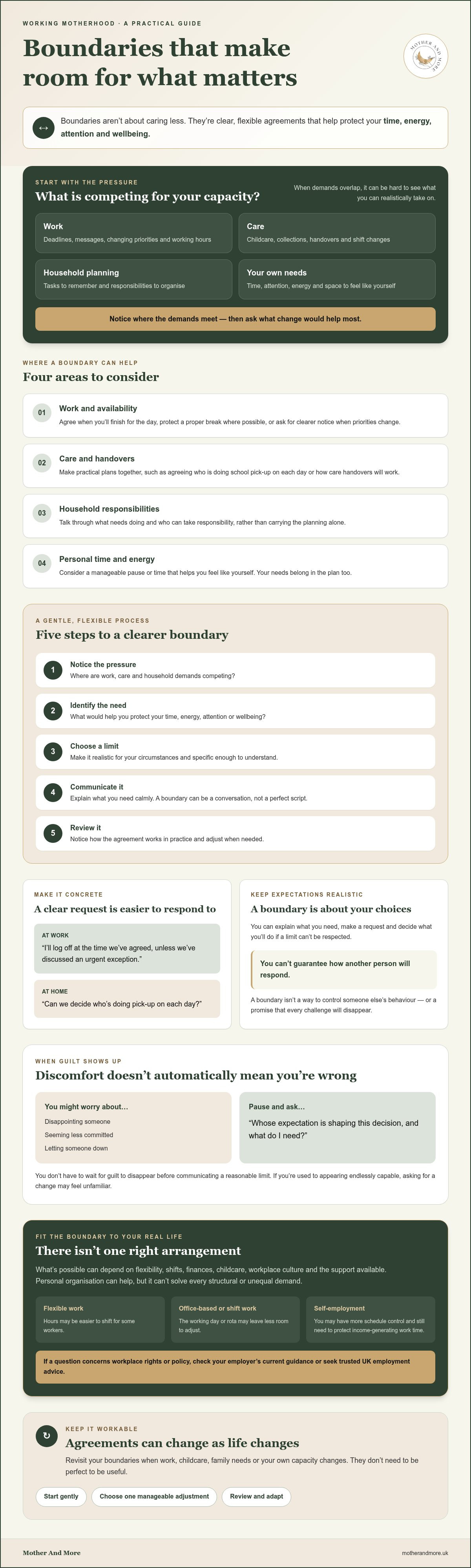
How to set boundaries as a working mum: five gentle steps
Setting boundaries as a working mum doesn’t have to begin with a big announcement or a complete change of routine. Try this five-step process with one pressure point, then adapt it to your work, home life, care arrangements and capacity.
Notice the pressure. What keeps leaving you rushed, resentful or depleted? Look for a recurring moment, rather than judging yourself for finding it hard.
Identify the need. Is it more notice, a clearer division of tasks, protected focus time or room to rest?
Choose a limit. Decide what feels realistic in your circumstances. You might be able to ask for a change, or begin by clarifying what you can manage.
Communicate it. Be calm and direct. You don’t need to give a long explanation or apologise repeatedly.
Review it. After trying the agreement, notice what helped and what still feels difficult. Adjust it if needed.
How do you explain a boundary clearly and kindly?
A simple structure can help: state the situation, name your limit and suggest a workable alternative. Adapt the words to what feels safe and realistic for you.
At work: “I’ve got capacity for one of these tasks by Friday. Which would you like me to prioritise? I can review the other deadline with you.”
With family: “I’m finding the evening routine difficult to manage alone. Could we agree who’s handling each part this week?”
These are invitations to make a plan, not scripts you have to use word for word. Your options may depend on your role, care arrangements and the support available.
What can you do when someone pushes back?
If the conversation becomes difficult, pause if you can. Clarify the need and repeat the limit without turning it into a debate: “I understand this is inconvenient. I’m still not able to take that on, but I can do this instead.” Someone else’s disappointment doesn’t automatically mean your need is unreasonable. If a conversation feels unsafe, coercive or persistently distressing, consider speaking with someone you trust or seeking appropriate support.
A quick check-in to save:
What pressure keeps returning?
What do I need, and what can I realistically ask for?
How will I explain the limit and any alternative?
When will I review whether it’s helping?
If reflecting on your needs and confidence would help, explore one-to-one life coaching for mothers as one possible source of support.
Keep your boundaries realistic as work and family life change
A boundary that helped last month may need adjusting now. A change in your work pattern, childcare, family needs or personal capacity can shift what feels manageable. That doesn’t mean you’ve failed or been inconsistent. It means you’re responding to the life you have today.
How can you tell whether a boundary is working for you?
Check whether the agreement is clear, realistic and easing the pressure it was meant to address. Ask yourself: Do I understand what we agreed? Can I maintain it with my current responsibilities? Is this recurring situation any more manageable? A boundary can be useful even if it brings some guilt or isn’t perfectly calm. Look at what’s changing in practice, not just how you feel in one difficult moment.
If the same strain keeps returning, consider what needs revising. Perhaps the agreement is too broad, depends on support that isn’t reliable, or no longer fits your schedule. You could clarify one part, ask for a different arrangement or choose a smaller step. Reviewing a boundary is a form of care and problem-solving, not a sign that setting it was a mistake.
It may help to revisit an agreement after a change in routine, or whenever you notice the old pressure building again. You don’t need a perfect system. You’re looking for something clear enough to communicate and workable enough to support your capacity.
Where can working mums find supportive space to reflect?
You might talk things through with a trusted friend, explore support available at work, or consider suitable professional guidance. Choose a source that feels appropriate to the question you’re holding. If you’re unsure about a workplace matter, check relevant policies or trusted UK employment guidance.
Coaching can be another optional space to reflect on identity, confidence and wellbeing as life changes. Mother And More offers one-to-one and group life coaching for mothers. This is coaching, not clinical psychological therapy, and the practical steps in this guide remain yours to use whether or not you seek extra support.
If you’d like to explore coaching, Mother And More offers support for mothers in London and beyond. You can take what feels useful and move at a pace that suits you.
Begin with one boundary that supports you
Setting boundaries as a working mum isn’t about getting every part of life perfectly balanced. It’s about noticing where pressure keeps building, choosing one realistic limit and communicating it clearly. Small agreements around work, care, household responsibilities or personal time can help protect your capacity, and they can be reviewed as circumstances change.
You don’t need to wait until you feel completely confident or guilt-free. Start with what feels manageable now, then pay attention to what eases the strain and what may need adjusting. Your needs matter alongside the needs of the people who rely on you.
If reflecting with support would be helpful, Mother And More offers life coaching for mothers focused on identity, confidence and wellbeing. Founded by accredited life coach and former social worker Rebecca Beazley, Mother And More reports supporting hundreds of mothers across the UK. Explore life coaching for mums with Mother And More as a next step.
You’re allowed to make room for yourself, one thoughtful boundary at a time.
Frequently Asked Questions
How do you set boundaries as a working mum?
Start with one recurring pressure point, then decide what would make it more manageable. Setting boundaries as a working mum might mean clarifying your availability, asking to share a regular task or protecting time to rest. State what you need and, where possible, suggest a workable arrangement. Keep it realistic for your circumstances, then review whether it’s helping. You don’t have to change everything at once.
Is setting boundaries as a mum selfish?
No. A reasonable boundary recognises your capacity and makes your needs clearer; it doesn’t mean you care less about your family or work. You may still feel guilty, especially if you’re used to being the person who says yes or keeps everything moving. Ask whether the limit is fair and sustainable, rather than treating guilt alone as evidence that you’re doing something wrong.
How can I set boundaries at work after having a baby?
Begin by identifying what would help you manage your work and caring responsibilities, such as clearer priorities, notice of meetings or agreed communication outside your working hours. You could ask your manager for a conversation about practical arrangements and check your employer’s relevant policies. If you need advice about your rights, consult current guidance from a trusted UK source such as ACAS or GOV.UK.
What can I say when I need to say no to extra work?
Keep your reply calm and focused on capacity. For example: “I can take this on, but I’d need to move another deadline. Which task should I prioritise?” If you can’t offer an alternative, you might say, “I’m not able to take on additional work at the moment.” Adapt the wording to your role and circumstances. A brief, clear response is enough; you don’t need to over-explain.
How do I stop feeling guilty about setting boundaries?
You may not be able to make guilt disappear straight away, and you don’t have to wait until it does to express a reasonable need. Notice the feeling, then consider what’s behind it: are you worried about disappointing someone, or concerned about a real consequence? Remind yourself that a boundary is an agreement about your capacity, not a measure of how much you care. Give yourself time to adjust.
What if my family or colleagues do not respect my boundaries?
Try calmly restating what you agreed and, if helpful, repeat any alternative you offered. For instance: “I understand the deadline matters. I can finish this tomorrow, but I can’t stay late today.” If the agreement keeps being ignored, consider whether it needs clarifying or whether you need support from a trusted person, manager or appropriate adviser. If a conversation feels unsafe or coercive, prioritise your safety and seek trusted support.
Can boundaries change as my child grows or my work changes?
Yes. A boundary can change as your child’s needs, childcare arrangements, work pattern or your own capacity shifts. Check whether the agreement is still clear and realistic, and whether it’s easing the pressure it was meant to address. If not, adjust it. Revising a boundary isn’t a failure; it’s a way to keep your expectations connected to your life now, rather than holding yourself to an arrangement that no longer fits.



Comments