

Work Life Balance Coaching for Mums: How to Choose the Right Support
What if a better work-life balance didn’t mean fitting more into your day, but deciding what no longer needs to be carried alone? If you’re stretched between work and family, exploring work life balance coaching for mums may feel hopeful, yet like one more commitment to squeeze in. It’s understandable to wonder what happens in a session, how coaching differs from therapy or general advice, and whether it can help when your time and energy are already limited.
The right coaching isn’t about achieving a perfect balance or adding another standard to meet. It can offer space to clarify your priorities, recognise what’s weighing on you and consider practical changes that fit your circumstances. That means looking at the invisible load as well as the demands on your calendar.
In this article, you’ll learn what coaching can offer, how to decide whether it suits your needs and what to ask before choosing a coach. We’ll also compare one-to-one and group coaching, so you can consider what feels right for you, your capacity and your own definition of balance.
Table of Contents
What can work life balance coaching for mums realistically help with?
Work, care, relationships and your own needs can all pull in different directions. Some days, even deciding what matters most feels like another task. Work life balance coaching for mums can give you dedicated time to pause, reflect and explore what might make daily life more manageable, without expecting you to create a perfect routine.
Work-life balance coaching is a reflective, goal-focused conversation that helps you clarify what matters and consider practical next steps. It offers questions and structure, not a ready-made formula or someone else’s answers. A useful outcome might be recognising which responsibilities need a conversation, identifying a boundary to try or deciding what deserves your attention first. The Work-life balance concept covers the relationship between work and other parts of life, but what balance means in practice is personal.
What does work-life balance mean when you are a mum?
Your version of balance may shift as your child grows, your work pattern changes or the support around you looks different. A routine that suited your family last year might no longer fit. Instead of measuring yourself against another parent’s timetable, consider what feels sustainable for you and your household now.
That could mean exploring clearer boundaries around work, sharing family responsibilities differently or protecting a little personal time. There’s no single right answer. Notice what feels out of step with your priorities, then decide whether there’s a small, realistic change worth exploring.
What coaching can and cannot offer
Coaching can support reflection, goal-setting and exploring choices. A coach might help you look at a challenge from a new angle, weigh possible options and identify a practical next step. The conversation should centre your priorities, not impose a universal definition of success. Methods and session structures vary, so ask what the coach’s approach involves.
Coaching isn’t clinical psychological therapy, and it can’t provide emergency support. It isn’t a substitute for clinical care if you’re experiencing distress or mental-health concerns that need professional assessment or treatment. In that situation, speak with an appropriate health professional. Coaching may still be relevant for goals and everyday choices, but it’s important to seek the support that fits your needs.
How does coaching help mums navigate work and family pressures?
When demands arrive from every direction, it can be hard to tell which problem to tackle first. A coaching conversation may give you a pause to look at what’s happening, what matters most to you and what choices might be available. The process varies by coach and programme, but it may involve reflection, setting a goal, exploring options and agreeing a practical action to take away.
Coaching can support your decisions, but it can’t control workplace demands, childcare arrangements or other people’s choices. That distinction matters. The aim isn’t to make you responsible for fixing circumstances beyond your control, or to suggest that better organisation alone can resolve unequal caring responsibilities. It’s to help you identify where you have room to act, and where you may need support or a wider conversation.
Turning an overwhelming week into priorities
A coach might help you separate what feels urgent from what reflects your longer-term values. For example, you could consider whether a work request needs an immediate response, or whether a family commitment has become difficult to sustain. If your circumstances allow, you might explore setting a boundary around availability, workload or personal time. If they don’t, that constraint deserves to be acknowledged, not treated as a personal failing.
Goals can be revisited as life changes. A shift in childcare, a demanding spell at work or a drop in energy may mean an earlier plan no longer fits. Adjusting it is part of responding to real life, not a sign that you’ve failed.
Making small changes that fit real family life
Rather than trying to overhaul everything, test one manageable change and notice how it feels. Perhaps you ask a partner to take responsibility for a particular task, speak with your employer about a work pressure or seek help from someone you trust. What’s possible will depend on your relationships, workplace and support network.
A 2011 American Psychological Association summary of research reported that working mothers were healthier and happier than stay-at-home moms. It’s one study, not a prescription for how any family should organise work and care. Your circumstances and preferences remain central. For a broader perspective on coaching and mothers’ experiences, read this life coaching for mums guide.
Work life balance coaching for mums can help you reflect on what to try, then review whether it’s helping as your circumstances shift. If you’re in London and would like to explore Mother And More’s support, find out more about life coaching for mothers.
How to compare work life balance coaching for mums
Choosing a coach is about more than finding someone with an impressive biography. Look for support that feels relevant to your life, respects your boundaries and works with your capacity. Qualifications are worth checking, but no particular credential or coaching style can guarantee a specific result. Notice whether you feel listened to and understood, too.
A study discussed in the research on coaching to support work-life balance examines coaching with women leaders, including self-awareness and work-life strategies. It may offer useful context, but your own fit with a coach and their approach still matters.
Questions to ask a potential coach
Before deciding, ask about the coach’s experience supporting mothers and the kinds of goals they work with. Find out what sessions involve, how you’ll review progress and what happens if your needs or circumstances change. It’s also reasonable to ask how confidentiality works, what the fees are, what the cancellation terms say and whether any contact between sessions is offered.
One-to-one or group coaching: which may suit you?
One-to-one coaching gives you space focused on your own circumstances. Group coaching may bring shared reflection and perspectives from other mothers, though you’ll want to check the group size, privacy, schedule and participation expectations. Details vary by programme, so ask rather than assume. Consider which format feels comfortable and practically possible, not which is supposedly more effective.
Give yourself time to make the decision. If you’d like to explore the available life coaching support for mothers, check the format and practical arrangements before taking the next step. The right fit should feel respectful of your priorities, not like another test to pass.
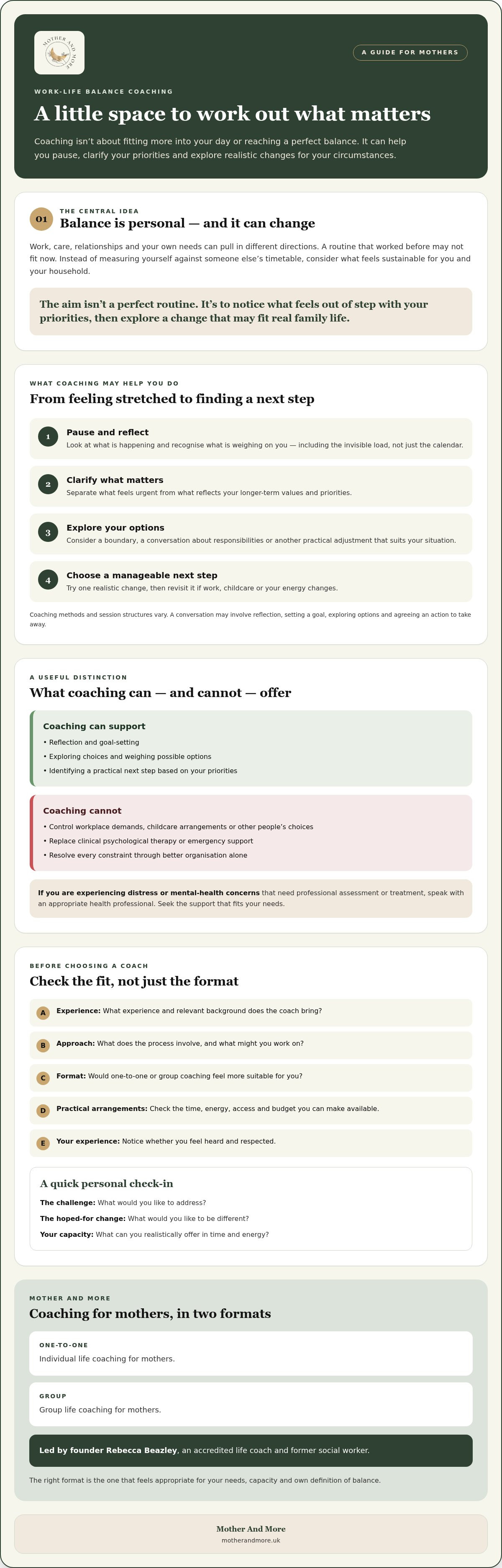
How to know whether coaching fits your schedule, needs, and budget
Considering work life balance coaching for mums doesn’t mean you have to commit straight away. Pausing to check the fit can help you decide whether coaching suits your life as it is now, rather than adding pressure to an already full week. Try this four-step check:
Name the challenge. What feels most difficult or keeps returning to mind?
Define a hoped-for change. What would you like to understand, decide or approach differently?
Assess your capacity. Consider the time, energy and access you can realistically offer to coaching at present.
Ask practical questions. Clarify the arrangements and costs before agreeing to anything.
There’s no readiness test to pass. You might have a clear goal, or simply a question you’d like space to explore. Either can be a starting point. If you have an urgent practical concern or a mental-health need that calls for clinical care, it may be more helpful to speak with an appropriate professional first. Choosing another support route, or waiting until life feels less stretched, is a valid decision too.
Is now the right time to start coaching?
Ask yourself whether you have enough room to think and reflect, even if you can’t yet see a solution. Then consider the practicalities: could sessions fit around work and caring responsibilities, and would the format be accessible to you? If the answer is “not right now”, that’s useful information, not a personal shortcoming. Your needs and capacity may change.
What to clarify before agreeing to coaching
Before making a commitment, check the format, session arrangements, fees in £, cancellation terms and whether you’re expected to prepare or take action between sessions. Ask how the coach responds if your goal changes or a planned step turns out to be unrealistic. A thoughtful process should leave room to adapt as circumstances shift.
A quick checklist to revisit:
Can I name a challenge or question I want to explore?
Do I have enough time, energy and access for the proposed format?
Are the fees and cancellation arrangements clear and manageable for me?
Do I understand what happens if my needs or plans change?
If you’d like to explore whether coaching could fit your current priorities, find out about Mother And More’s life coaching for mothers. You can take the next step when it feels right for you.
Mother And More work-life balance coaching for mums
If you’re considering work life balance coaching for mums, Mother And More offers one-to-one and group life coaching for mothers. The focus includes identity, confidence and wellbeing, which may be relevant when work and family pressures leave you wondering what you need for yourself, as well as what everyone else needs from you.
Mother And More was founded by Rebecca Beazley, an accredited life coach and former social worker. The business has supported hundreds of mothers across the UK through coaching.
What to explore with a Mother And More coach
You might bring a specific work-life question, such as how to make room for personal priorities or how changing responsibilities are affecting your sense of identity. Coaching can give you space to explore your goals and consider practical changes, with your circumstances shaping the conversation. For related themes, read the guide to reclaiming identity and confidence.
Before deciding, ask about the coaching format, current availability, session arrangements and fees. You can explain what you hope to explore and ask whether the coach feels their approach is a suitable fit. Confirm the details directly, as arrangements may vary.
A gentle next step, on your terms
An enquiry doesn’t commit you to coaching. It can simply help you understand what’s offered and whether it feels right. To make the conversation easier, write down one pressure point you’d like support with and one question about the practical arrangements. You don’t need to have everything worked out before you ask.
If you’d like to explore the possibility at your own pace, explore coaching with Mother And More.
Choose support that fits your life as it is
Work life balance coaching for mums isn’t about getting every part of life perfectly in place. It can offer space to clarify what matters, explore choices and consider practical next steps that feel realistic for you. The right coach should respect your priorities and capacity, explain their approach clearly, and make room to revisit goals when circumstances change.
Before deciding, weigh up the format, practical arrangements, fees and the energy you can give to coaching right now. It’s also okay to wait or seek a different kind of support if that feels more suited to your needs.
Mother And More offers one-to-one and group life coaching for mothers. Founder Rebecca Beazley is an accredited life coach and former social worker, and Mother And More has supported hundreds of mothers across the UK. If you’re in London and would like to ask about fit and current arrangements, explore coaching with Mother And More.
Your next step can be a small one. Choose the support that feels right for you, in your own time.
Frequently Asked Questions
What is work-life balance coaching for mums?
Work-life balance coaching for mums is a reflective, goal-focused conversation that helps you explore how work, family responsibilities and personal needs fit together. Rather than offering a universal routine, a coach can help you clarify what matters to you and consider practical next steps. Your priorities may differ from another parent’s, and they can shift as your child grows or your work and support arrangements change.
Can coaching help me balance work and family life?
Coaching may help you make sense of competing demands, identify priorities and consider realistic changes. For example, you could explore a boundary around work availability or how to raise a conversation about caring responsibilities. Coaching can support your decisions, but it can’t control your employer’s response, childcare arrangements or family circumstances. For mums in London, consider how the proposed format fits your location, routine and available time.
How do I choose a life coach as a working mum?
Look for relevant experience, a clear explanation of the coach’s approach and practical arrangements that suit your life. Ask about their experience supporting mothers, how they work towards goals and how progress is reviewed. Check credentials and ask what they mean, but don’t assume a qualification or particular style guarantees results. You should also feel listened to, respected and comfortable discussing your priorities and boundaries.
Is work-life balance coaching the same as therapy?
No. Coaching generally focuses on reflection, goals, choices and possible next steps. It isn’t clinical psychological therapy or emergency support. If you’re experiencing distress or mental-health concerns that need clinical assessment or treatment, speak with an appropriate health professional. A coach should be clear about the boundaries of their role, so you can decide whether coaching is suitable alongside, or instead of, other support you may need.
How much does work-life balance coaching for mums cost?
Fees vary between coaches and programmes, so there isn’t one reliable price that applies to every service. Ask for the current fee in pounds and check what it covers, including the format, session arrangements and any expected preparation or between-session work. It’s also sensible to ask about cancellation terms before deciding. Choose an option that fits your budget without putting pressure on other essential costs.
Is one-to-one or group coaching better for mums?
Neither format is automatically better. One-to-one coaching gives you space to focus on your own circumstances, while group coaching can offer shared reflection and perspectives from other mothers. Consider which feels more comfortable, fits your schedule and lets you take part in a way that suits you. Before choosing a group, ask about its size, privacy, schedule and participation expectations, as these details vary.
What should I expect in a first coaching conversation?
Expect to discuss what’s prompted you to explore coaching, what you’d like support with and whether the coach’s approach seems a good fit. You can ask about goals, format, fees, confidentiality, practical arrangements and what happens if your needs change. There’s no need to arrive with a complete plan. Bringing one pressure point and one question can give the conversation a helpful starting point.



Comments